MARKET FLASH:

"It seems the donkey is laughing, but he instead is braying (l'asino sembra ridere ma in realtà raglia)": si veda sotto "1927-1933: Pompous Prognosticators" per avere la conferma che la storia non si ripete ma fà la rima.


giovedì 28 dicembre 2017

The Reversal: "Smart Money" Using December Day Sessions To Dump Stocks


Everything changed in December...

For months, the so-called "Smart Money" has been on-board with the incessant rally in US equity markets, buying every dip - no matter how shallow.

However, since the end of November, a very different regime appeared to take hold.

As a reminder, Bloomberg's SMART index is calculated by taking the action of the Dow in two time periods: the first 30 minutes and the close. The first 30 minutes represent emotional buying, driven by greed and fear of the crowd based on good and bad news. There is also a lot of buying on market orders and short covering at the opening. Smart money waits until the end and they very often test the market before by shorting heavily just to see how the market reacts. Then they move in the big way. These heavy hitters also have the best possible information available to them and they do have the edge on all the other market participants.  To replicate this index, just start at any given day, subtract the price of the Dow at 10 AM from the previous day's close and add today's closing price.  Whenever the Dow makes a high which is not confirmed by the SMFI there is trouble ahead. 

What does this mean?

Simple - while the S&P 500 is up for the month, the average day sold off into the close, finishing below the day's open...

In fact, in December ALL of the S&P 500's gains have come from the overnight-session (+2.2%), while the day-session has lost 0.65%...

As FBN Securities' JC O'Hara notes,"Selling Pressure is increasing..."

The Reverse Trickle Down Fake Wealth Effect


The Idiocracy believes that printing money is the secret to effortless wealth. But removing it is even better. They will be shocked to learn that neither is true...

The Fed and ECB are going to unwind Trump's tax cut long before it even takes effect. As usual, the dumb money didn't get the memo...


"Each day that goes by is getting closer to a change in the flow in liquidity Jan. 2...There's a $45 billion reduction of QE [quantitative easing asset purchases] from the Fed and ECB Jan. 2." 

One of the more "interesting" aspects of this pathetic era is how the narrative magically changes based solely upon which stock market sectors are currently leading. During the deflation rally phase, gamblers hang on every word from Central Banks promising more dopium. Whereas, during the fake reflation phase, gamblers tell us that Central Bank tightening is now magically "bullish". All of this asinine chicanery has been encapsulated here by Z.H.: Are Central Bankers Losing Control?

Parsing the gibberish contained therein, one is struck by the fact that everyone in the economics profession gets to sound smart, even when they offer competing and conflicting theories on the same topic. Which is even more asinine since they are ALL always wrong when it counts the most - at the end of the cycle. They are all caught out at the same time, extrapolating the indefinite asinine into the indefinite future. The notable aspect missing from the above discussion about money printing is any mention whatsoever about 'Conomy, formerly known as "supply" and "demand". That's because we now live in a world of "supply" and "debt". The alchemists of our time have convinced themselves that the addition and substraction of free money is the secret to a strong 'Conomy, regardless of whether we are producing industrial grade machinery or low value-add cappuccinos. We saw this "policy" at work during the last cycle, when about two decades of housing demand was pulled forward into a three year period to paper over mass corporate layoffs. In other words, Central Banks are specialists in subsidizing bankruptcy with short-term liquidity. Liquidity that is the least available when it's most needed. 

Which brings me to the point of this post, which is that Central Banks really only have one card left to play which they are now taking off the table - the fake wealth effect. Starting just a few days from now in January, the Fed and ECB will be taking a combined $45 billion of monthly liquidity out of the casino. The most since 2008. 

The smart money is prepared for that scenario. The dumb money, not so much.

And those who place their faith in the Plunge Protection Team are apparently the same ones who also believe in Santa Claus...


The Moment The Market Broke: "The Behavior Of Volatility Changed Entirely In 2014"


In the past a remarkable chart - and assertion - came f rom Bank of America: "In every major market shock since the 2013 Taper Tantrum, central banks have stepped in (even if verbally) to protect markets. Following the Brexit vote, markets no longer needed to hear from CBs as they rebounded so quickly that CBs didn't need to respond." As a result, buy-the-dip has a become a self-fulfilling put.
The immediate result of this dynamic has been two-fold: i) investors now buy every dip, or as Bank of America notes, "Investors no longer fear shocks, but love them, as it is an opportunity to predictably generate alpha.", and ii) selling of vol has become a self-reinforcing dynamic, in which lower VIX begets more vol-selling by "yield-starved investors", leading to even lower VIX as the shock that can reset the feedback loop is no longer possible, and thus the strike price on the Fed's put can not be put to a market test.
These observations prompt BofA's derivatives expert Benjamin Bowler to ask the rhetorical question: "volatility: new normal or bubble?" and answer: "It's a bubble." Indeed it is, but absent the abovementioned market-clearing shock, it is difficult, if not impossible to anticipate what can burst this bubble.
In the meantime, the market has spawned some spectacular distortions, including the following observation: "As one measure of volatility, the Dow Jones Industrial Average traded in its tightest trading range since 1900 this year." Here is Bowler:
While asset valuations are not at life-extremes, volatility is. In 2017 the Dow traded in a 110yr record tight trading range, the VIX hit all-time lows, and US equities reversed from sell-offs at near their fastest pace in 90 yrs. Investors no longer fear risk but love it, as it's another opportunity to harvest "dip-alpha". Volatility across asset classes has decoupled from uncertainty. Even if seemingly irrational, apathy to all risk has been the right trade and an impossible trend for most to fight – the definition of a bubble.
A bubble, he adds, "induced by years of heavy handed central bank influence, where investors have learned that it has not paid to panic." Bowler asks readers to consider the following:
As one measure of volatility, the Dow Jones Industrial Average traded in its tightest trading range since 1900 this year
Near 90yr records are occurring in the speed that US equities are recovering from dips

The VIX is near 26yr lows despite political & policy uncertainty recently near 26yr highs

Gold call options price less than 1 in 100 chance of rising North Korean tensions in the face of rising North Korean tensions
The above leads Bowler to concludes that "while there is active debate about whether risk-assets like equities and credit are overvalued, it is much harder to argue that currently depressed volatility levels are unsustainable when near 100yr records in terms of low vol and the lack of persistence of any shock are being recorded."
So when did the market "break", and when did the behavior of volatility change so dramatically?
This overarching question has been plaguing Wall Street strategists for much of 2017. In July, we presented one answer from Deutsche Bank's Aleksandar Kocic who pointed out the divergence between the economic policy uncertainty index and the VIX, which took place roughly in 2012, prompting the derivatives expert to conclude that something "snapped" roughly around that time, or as Kocic said, sometime in 2012 it was as if the markets "lost their capacity to deal with uncertainty."

Bank of America takes a somewhat different approach, and instead of looking at the divergence between volatility and news - or shock - flow, highlights the moment BTFD became religion.
According to Bowler, "the nature of volatility since 2014 has entirely changed, with volatility shocks retracing at record speed. Investors no longer fear shocks, but love them, as it is an opportunity to predictably generate alpha." This is demonstrated in the following stunning chart which not only shows that every VIX dip is now just an opportunity to buy it, but that the market's "fragility" is at an all time high based on the surging frequency of vol spike events, which in turn, and paradoxically, reassure investors that a central bank backstop can not be too far away.


BofA is hardly the first to point out this phenomenon: almost exactly one year ago, it was JPM's "quant wizard" who highlighted precisely the same, if not through the perspective of VIX but the overall market response to recover from "shock" events:
It appears that the time horizon of macro traders has shortened, likely as a result of increased participation of machines and algorithms that are quicker to adjust to significant events and can eliminate trading activity of slower investors. Consider for example the US elections - traders in Japan registered a 5.4% Nikkei drop on the 9th, followed by a 6.7% rally on the 10th, while S&P 500 investors did not register a significant close-to-close move over the election (due to market hours difference). These two days were enough to shift the volatility regime (usually calculated from closing returns) for the whole of 2016 for the Japanese equity market, and leave it unchanged for S&P 500 (e.g. think of rebalancing needs of a hypothetical risk parity fund, or a short volatility strategy based on Nikkei vs. one based on S&P 500). We also noticed that for a number of significant catalysts this year (Brexit, US Election, Italy Referendum) broad expectations were wrong both on the outcome and the directionally forecasted impact. It is possible that the lack of market reaction (or a reaction that went against the accepted narrative) was in part driven by investors' reluctance to transact ("two negatives equal a positive").
Ah yes, the infamous "investor reluctance to transact", which has only gotten worse as we hinted in our "trader paralysis" post, and which Goldman demonstrated vividly just last month when the bank showed that hedge fund turnover has now dropped to an all time low as virtually nobody trades anymore.
Whatever the reason behind the broken market, however, whether it is central banks, machines, algos, risk parity funds, vol-targeting strategies,  self-reinforcing "Pavlovian" dynamics, or simply traders no longer trading, the question is what comes next? While we will have a more detailed breakdown in a subsequent post, here are Bowler's three questions, and several answers of what to expect in 2018:
As we enter 2018, three questions are top of mind when it comes to volatility:
Is 2018 the year when vol begins to normalize, or is this the "new normal"?
As low vol threatens to sow the seeds of the next crisis, how will this end?
Where does vol go in the longer-run; can we ever see the old-normal return?
Vol likely to rise off extreme lows; '87 crash unlikely, but so is VIX averaging 20 While we will look at each question in more detail in turn, the short answers are:
Higher not lower vol: We think 2018 is most likely to see higher (not lower vol) as the Fed builds more "ammunition" in terms of rate-hikes leaving them less sensitive to financial market conditions (i.e. pushing the Fed put strike lower), and as CB balance sheets peak in 2018.
Vol bubble more likely to deflate than explode: While the risk of "fragility" shocks due to positioning and feeble liquidity is high, we think the level of leverage today, which is lower compared to the last time vol was this depressed (2007), does not present the same risks as then.
Vol to remain low vs. long-run average: However, to the extent we remain in a low inflation/low rates environment, we may also remain in a lower than normal vol environment. So while VIX near 9 is an unsustainable bubble, VIX at 20 (the long-run average) may also be unsustainable in a slower growth world.
And BofA's conclusion:
What to watch for? In a world slaved to rates, inflation remains key
From a macro perspective, we continue to believe unexpected inflation is the kryptonite for volatility. Inflation presents a "triple whammy", first driving economic vol higher, destabilizing bond markets (and putting bond/equity correlation at risk), but importantly handcuffing central banks from being as sensitive to financial markets. In other words it both drives fundamental risk higher and significantly impairs the protection markets have become dependent on. Rising rates vol is key to watch.
How bad can it get? From here Aug-15 shock likely but '87 crash is improbable
Interestingly, while the world is hyper-focused on how big the "short-vol" trade is, history shows that any liquidity shock large enough to create an equity bear market (20% fall in equities, similar to 1987 or LTCM crisis) provides a forewarning in terms of rising volatility first (look for S&P vol to double from 10 to 20). Fragility shocks (similar to Aug-15) that happen without warning remain the bigger risk today in our view.
So, how do you trade this? Long "vol beta", cheap options for direction
The most important question is, how do you trade this environment where investors have given up on risk (or have learned to love it as buying dips has been "free money"). Evidence of a "bubble in apathy" is strong, and we believe it is unsustainable. However, the problem with any bubble is not recognizing you are in it but rather timing its end. Hence the key is finding trades that will profit from a change in environment but carry well and hence don't require perfect timing. The beauty of today's low vol is that it can be cheap to own optionality (for example for upside stock replacement) which affords the benefit of not having to time when markets may peak.
Does this mean short vol is a bad idea? No, but it needs to be smartly managed
Importantly, believing that today's low vol is unsustainable does not mean all short vol positions are bad. Don't forget, owning any risk asset (equity, credit etc.) is a short-vol trade. The key is finding the best short vol opportunity (highest risk-adjusted returns), while managing downside risks appropriately. Harvesting rich vol risk-premia is key to funding cheaper long vol positions elsewhere.

mercoledì 27 dicembre 2017

Warren Buffett's Favorite Indicator Just Flashed a Major Warning

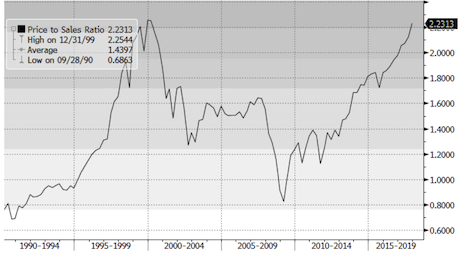
It is clear stocks are in a massive bubble based on their Price to Sale (P/S valuation). 

What about the economy?

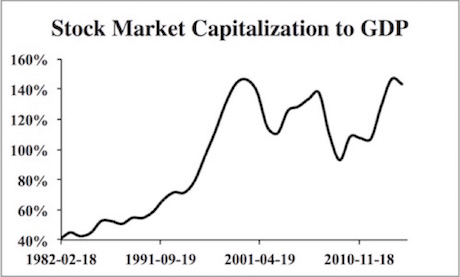
Warren Buffett once famously stated that his favorite means of valuing stock was the stock market capitalization to GDP ratio.

Below is a chart for this metric. As you can see, the stock market today is as overvalued relative to the economy as it was at the peak of the 1999 Tech Mania.

GPC122717.jpg

So stocks are overvalued based on the most reliable corporate data point (revenues) and they are also overvalued relative to the economy. Scratch that, they're not overvalued… they're trading at 1999-Tech Bubble insanity levels.

We all remember what came after that...

Fed Cred Dead? From "Definitely Transitory" To "Imperfect Understanding" In One Press Conference


When Janet Yellen spoke at her regular press conference following the FOMC decision in September 2017 to begin reducing the Fed's balance sheet, the Chairman was forced to acknowledge that while the unemployment rate was well below what the central bank's models view as inflationary it hadn't yet shown up in the PCE Deflator.

Of course, this was nothing new since policymakers had been expecting accelerating inflation since 2014.

In the interim, they have tried very hard to stretch the meaning of the word "transitory" into utter meaninglessness; as in supposedly non-economic factors are to blame for this consumer price disparity, but once they naturally dissipate all will be as predicted according to their mandate.

That is, actually, exactly what Ms. Yellen said in September, unusually coloring her assessment some details as to those "transitory" issues:

For quite some time, inflation has been running below the Committee's 2 percent longer-run objective. However, we believe this year's shortfall in inflation primarily reflects developments that are largely unrelated to broader economic conditions. For example, one-off reductions earlier this year in certain categories of prices, such as wireless telephone services, are currently holding down inflation, but these effects should be transitory. Such developments are not uncommon and, as long as inflation expectations remain reasonably well anchored, are not of great concern from a policy perspective because their effects fade away.

Appealing to Verizon's reluctant embrace of unlimited data plans for cellphone service was more than a little desperate on her part. Even if that was the primary reason for the PCE Deflator's continued miss, it still didn't and doesn't necessarily mean what telecoms were up to was some non-economic trivia.

Over the past few years, consumers have been hit with almost regular (not "residual seasonality") shocks to incomes that seem to be increasing in intensity as well as duration. These are, in effect, downturns within a downturn; short run drops or contractions inside an already lost decade. Acceleration of cheap might actually be the most logical of outcomes.

Rather than dismiss these continued problems in favor of fanciful bias towards monetary policy, it was of a far more scientific basis to wonder whether the Fed knows anything about inflation.

A lot has changed in official terms between September and December, which is to say in terms of inflation nothing changed. There is as yet no acceleration in the PCE Deflator (or CPI) that isn't someway connected to oil price effects. In November 2017, the BEA calculates that consumer prices rose by 1.76% year-over-year, up from 1.59% in October as gasoline prices rose 131% (month-over-month, annual rate).

Core rates that strip out energy prices, such as the Dallas Fed's trimmed mean, continue to undershoot and therefore suggest no momentum and zero upon which to base expectations for acceleration. It's not nothing that monetary policy has missed its target for sixty-five out of the last sixty-seven months, and ninety of the past 110 months going back to October 2008 and the botched monetary response to Lehman and everything before it.

Because of all that within the realm of inflation, meaning the monetary system, it has been more than fair or reasonable to ask whether economists really know what they are doing. Up until 2016, that was a question you weren't allowed to consider unless well outside of the mainstream. Since then, more and more policymakers are actually asking of themselves the same idea.

Having failed all throughout 2017, the year almost completely over, Janet Yellen's final press conference for December, then, was subtly changed from the prior one to at least admit that maybe they really don't know – trying hard not to make too much of a big deal about it.

We continue to believe that this year's surprising softness in inflation primarily reflects transitory developments that are largely unrelated to broader economic conditions. As a result, we still expect inflation will move up and stabilize around 2 percent over the next couple of years. Nonetheless, as I've noted previously, our understanding of the forces driving inflation is imperfect.

As a final official act, Yellen downgraded from "definitely transitory" to "imperfect understanding." This matters a great deal, for if their grasp of basic economic factors is this flawed (just an 18% hit rate in nearly 10 years) there's likely far more gone wrong than just the price effects of unlimited wireless data.

Bubble Watch: The Fed KNOWS We're In a "1999" Type Mania

The Fed raised rates another 0.25% on the last FOMC meeting.

This marks the 5th rate hike since the Fed embarked on its policy tightening in December 2015 and the fourth rate hike in the last 12 months. The Fed's latest statement also indicates it plans on raising rates three more times in 2018.

It is easy to gloss over the significance of this, but the Fed's actions are indeed unusual; other major Central Banks (the Swiss National Bank, Bank of Japan, European Central Bank and Bank of England) are all currently running QE programs (the BoJ, ECB and BoE) or openly printing new money to buy stocks outright (the SNB).

What precisely is the Fed doing? Why the urge to tighten when other banks are all printing new money by the billions?

The following quotes from Fed offer us clues.

Fed Monetary Policy Report, June 2017:

"Forward price-to-earnings ratios for equities have increased to a levelwell above their median of the past three decades,

Fed minutes, July 2017:

"Since the April assessment, vulnerabilities associated with asset valuation pressures had edged up from notable to elevated, as asset prices remained high or climbed further, risk spreads narrowed, and expected and actual volatility remained muted in a range of financial markets."

Janet Yellen response to question from IMF Panel, October 2017:

Market valuations "are at high level in historical terms" when assessed on metrics akin to price-earnings ratios,

Fed Minutes, October 2017:

"In light of elevated asset valuations and low financial market volatility, several participants expressed concerns about a potential buildup of financial imbalances,"

Janet Yellen during Fed presser December 13th, 2017:

Stock valuations are at high end of historical levels.

I want to be clear on the significance of these statements.

The Fed's primary role is to maintain financial stability. This means that the Fed will always downplay risks in its public statements. Indeed, former Fed Chair Ben Bernanke once stated that Fed policy is "98% talk, 2% action."

With that in mind, the above quotes are astonishing in their clarity: the Fed isexplicitly stating (in Fed terms) that the markets are in a bubble. And the Fed didn't just do this once, the Fed has been warning about asset valuations/froth in the system for six months straight.

So just how "frothy" are things that the Fed is being so explicit?

Try "1999-levels" frothy.

Perhaps the best means of measuring frothiness in stocks is the Price to Sales (P/S) multiple. Most investors prefer to use Price to Earnings (P/E), but I am wary of that method because earnings can easily be fudged via gimmicks (different methods of depreciation, write-offs, reducing loan loss reserves, tax loopholes, etc.).

Sales, on the other hand, are very hard to fudge. Either money came in the door, or it didn't. And if a company gets caught fudging its revenues, someone goes to jail.

With that in mind, consider that the S&P 500's current P/S multiple has surpassed its former all time peak from 1999: a period that is now widely considered to be the single largest stock bubble in history.

Put simply, stocks are extraordinarily overvalued by a reliable measure.


H/T Bill King

We all remember what came after that...

China and Russia Now Have CRITICAL MASS To Dethrone King Dollar

The link is integrated: The Oil-Yuan-Gold triangle signed the death warrant, and the Gold Trade Note will be the dagger to the heart…

The many new integrated non-USD platforms devised and constructed by China finally have critical mass. They threaten the King Dollar as global currency reserve. Clearly, the USDollar cannot be displaced in trade and banking without a viable replacement for widespread daily usage. Two years ago, critics could not point to a viable integrated system outside the USD realm. Now they can. The integration of commercial, construction, financial, transaction, investment, and even security systems can finally be described as having critical mass in displacing the USDollar. The King Dollar faces competition of a very real nature. The Jackass has promoted a major theme in the last several months, that of the Dual Universe. At first the USGovt will admit that it cannot fight the non-USD movement globally. To do so with forceful means would involve sanctions against multiple nations, and a war with both Russia & China. Their value together is formidable in halting the financial battles from becoming a global war. The United States prefers to invade and destroy indefensible nations like Libya, Iraq, Ukraine, Syria, and by proxy Yemen. The USMilitary appears formidable against undeveloped nations, seeking to destroy their infra-structure and their entire economies, in pursuit of the common Langley theme of destabilization. In the process, the USMilitary since the Korean War has killed 25 million civilians, a figure receiving increased publicity. The Eastern nations and the opponents to US financial hegemony will not tolerate the abuse any longer. They have been organizing on a massive scale in the last several years. Ironically, the absent stability can be seen in the United States after coming full circle. The deep division of good versus evil, of honest versus corrupt, of renewed development versus endless war, has come to light front and center within numerous important USGovt offices and agencies.

The shape of the US nation will change with the loss of the USDollar's status as global currency reserve. The starting point for the global resistance against the King Dollar was 9/11 and the onset of the War on Terror. It has been more aptly described as a war of terror waged by the USGovt as a smokescreen for global narcotics monopoly and tighter control of USD movements. Then later, following the Lehman failure (killjob by JPMorgan and Goldman Sachs) and the installation of the Zero Interest Rate Policy and Quantitative Easing as fixed monetary policies, the community of nations has been objecting fiercely. The zero bound on rates greatly distorted all asset valuations and financial markets. The hyper monetary inflation works to destroy capital in recognized steps. These (ZIRP & QE) are last ditch desperation policies designed to enable much larger liquidity for the insolvent banking structures. Without them, the big US banks would suffer failure. They also provide cover for the amplified relief efforts directed at the multi-$trillion derivative mountain. In no way, can the global financial system tolerate unbridled monetary inflation which undermines the global banking reserves.


The Eastern nations have been organizing to end the USDollar abuse, which has suffocated economic growth and financed regional wars with motive to sustain the USDollar dominance. Their many non-USD platforms finally can boast at having critical mass, and finally are integrated with the most important link of all. The Oil-RMB-Gold triangle is the death warrant to the USDollar, and the Gold Trade Note will be the dagger in its heart.


One Belt One Road Cornucopia

It is also known as the Belt & Road Initiative (BRI). China has been promoting infra-structure development, but with the BRI, they have coordinated the funding agents, the consulting groups, the construction firms, and more. They have built a gigantic table, acting as a cornucopia for funding and completing a very large group of massive projects, all over $1 billion in value. Almost none will use the USDollar except in dumped securities in order to cover the costs. It is commonly called Indirect Exchange, since no US-based party is in the mix. The many US-based firms are largely excluded from the BRI contracts. Look for European firms to clean up, especially the Germans since they make friends well and provide world-class technology. The Belt & Road Initiative can be considered the project development arena for the burgeoning newly forming Eurasian Trade Zone, often called the Eurasian Economic Union (EAEU). It will not use the USD.

Asian Infra-structure Investment Bank (AIIB)

The AIIBank serves as a gigantic funding agency among the community of nations. Their projects seem to be focused on SouthEast Asia, but not completely. The British deeply angered the Obama Admin by joining the AIIBank last year, against urgent pressure from Washington. Soon a global entity, not just Eastern. The London City (sovereign nation within England) did not wish to lose out in the financial traffic involved in the many projects. The projects will expand beyond Asia, in time to connect Europe. London strives to gain an RMB Hub for both currency exchange and bond trading. Think Panda Bonds, like for Italian Govt debt issuance in RMB terms without any currency risk for Chinese investors. The AIIBank makes the Intl Monetary Fund irrelevant. The Chinese have a newfound dominant role in the IMF, to shut it down as a funding arm, but to ensure the Chinese Yuan currency becomes a bank reserves basis. Together, the Belt & Road Initiative and the AIIBank are the most important investment platforms in retiring the USDollar from its global currency reserve status.

BRICS New Development Bank (NDB)

This platform went quiet in the last couple years, as the AIIBank took away the attention for development. However, the BRICS are organizing better in the last several months. Their projects are entirely focused on BRICS nations, plus their neighbors in connection. The Jackass theory was that South Africa was suffering from high level political corruption, while India was suffering from high level financial collusion. Expect the SA problem to continue, but the Indian independence to come forth in a survival gesture. The BRICS NDBank is pressing forward, with renewed emphasis given by Russia & China for the purpose of gaining momentum. Another Jackass theory is that the New Development Bank will become a primary center for conversion of Western sovereign bonds into Gold bullion for bank reserves purposes. Refer to USTreasury Bonds primarily, but also to EuroBonds, UKGilts, and Jap Govt Bonds. Imagine the power of a central window for conversion of fiat major nation bonds into gold, after the USDollar is well recognized as having lost its global reserve currency status. The implication would be for fast removal of the USTBonds in the global banking system, replaced by Gold bullion. The NDBank could become an important catalyst.

Asian Development Fund

This fund is small and new, but is gaining traction fast, run independently from the USGovt for the benefit of Asian nations, mostly in the SouthEast Asian region. It is competing directly with the Asian Development Bank, led by the USGovt. The Asians do not wish for the United States to run their business development any longer, since assistance comes with a stranglehold and considerable coercion. It is no longer wanted.

Cross-Border Interbank Payment System (CIPS)

This payment system is a direct frontal assault on the SWIFT transaction payment system, as in bank to bank transfers. The USGovt has abused this system for political purposes like a financial weapon, causing severe repercussions and backlash. The Society for Worldwide Interbank Financial Telecommunication has a new rival, a strong one with stress test success. The CIPS does not stand for Chinese Interbank Payment System, but it is led and run by the Chinese. It will feature lower fees, faster transfers, and no interference with political motive. It is ramping up in volume, with numerous commitments for its future usage. The USGovt will lose its financial weapon used and abused to isolate nations which do not wish to trade (primarily energy products) using the USDollar.

Shanghai Oil-Gold futures contract

This contract came into being last August, but has not really gotten off the ground yet. It needed a link to the RMB fortress. Now that link has arrived. This contract served as a harbinger of linkage of the two most important commodities for commerce and currency with existing systems. It served as notice for the planned imminent death of the Petro-Dollar. It required completion of the triangle for its full effect.

Shanghai RMB-Oil futures contract

This contract completes the triangle, and will serve as the executioner for the USDollar death warrant. With the triangle completed, nations like Russia can sell China its crude oil (by whatever path or delivery method), accept RMB in payment, then quickly convert to Gold bullion within the same city of Shanghai. Think one-stop shopping that undermines the Petro-Dollar system at its core. Expect China to require many of its oil suppliers to use the Shanghai system for managing the forward price contracts, with implicit pressure. The key region to watch is the Gulf Region where the Saudis and their neighbor oil monarchies will line up to use these contracts in oil sales and payment systems. Most assuredly, rival Iran will use the triangle with high volume oil sales to China, keeping the oil price down in the process. However, as important as this triangle is for displacing the King Dollar from the financial catbird seat, more lies ahead. The Oil-RMB-Gold triangle will in all likelihood be used as the foundation for the upcoming Gold Trade Note, which will remove the USTBill as standardized payment instrument for Asian trade. The Gold Trade Note will have an equity placement in gold, a promise of gold payment upon product delivery, and a net settlement feature. If the Oil-RMB-Gold triangle is the death warrant, the Gold Trade Note is the dagger in the USDollar heart with respect to the global reserve currency role. The role has two sides: trade payment (led by oil market) and bank reserves (led by USTBond).

BRICS Gold Platform

This platform has just recently been introduced, promoted for usage by the lead team of Russia & China. They have promoted their plans and objectives for running the platform. They openly deride the usage of paper price discovery methods, which have corrupted the COMEX beyond any recognition of a gold mart where metal is bought and paid for. The COMEX has no metal delivery, but the BRICS Gold Platform will indeed have direct metal delivery. The new platform will feature gold bullion sales with immediate delivery, and thus an honest price system. Expect the eventual merger with their New Development Bank, if their intention ever becomes realized to provide the fulfilled role in conversion of sovereign bonds to Gold bullion bars.

Russian Gold Exchange

Another gold exchange which will likely merge with the BRICS Gold Platform, it will be based in Moscow. Expect this exchange to connect with the Russian Sverbank, and in particular with the Shanghai gold market.

Holy Grail Energy Deal

In the year 2014, the Chinese cut a deal worth $250 billion for delivery of Russian oil & gas, including the construction of delivery pipeline systems. The deal is the largest in the history of the energy market and spans over 10 years in time. To label the deal in USD terms is fully legitimate, even though a bilateral Russia-Chinese contract, because China will pay the great majority of the bill for crude oil, natural gas, and pipeline construction in the form of USTreasury Bonds, in a grand dumping exercise. Yet more Indirect Exchange which will reduce the Chinese Govt official USD holdings. Expect to hear next that the Russians will use the USTBonds to buy RMB currency, and with it convert to Gold bullion in Shanghai in a sudden sequence. In doing so, the Russians will essentially be converting Chinese-held USTBonds into Gold bullion for reserves.

Shanghai Cooperative Organization (SCO)

The SCO is growing in membership beyond the Russia + Former Soviet Republics. The most recent member nation signed on is Iran, which had been given provisional status earlier. By taking its current form in 2001, the SCO organization is designed for cultural, political, economic, security, and other purposes. In 2017, SCO's eight full members account for approximately half of the world's population, a quarter of the world's GDP, and about 80% of the Eurasian landmass. Expect the SCO to rival NATO in an offsetting role toward pursuit of global balance.

Union Pay Credit Card

The Chinese credit card has more subscribers than MasterCard and Visa combined. Just as SWIFT has been sidestepped for any politically-based obstruction, Union Pay can sidestep any Western credit card abuse in obstructions across the Asian Economies. There is precedent for MC/Visa obstructions in Asian countries.

Dagong Credit Rating Agency

The Chinese have created an independent credit rating agency, free from the West, which will be used to provide ratings for bonds and firms. The Western credit agencies of Standard & Poors, Moodys, and Fitch have each become deeply politicized. They ignore the Third World nature of USGovt debt, which is actually worse than the Greek Govt debt. The USTreasury Bond still has a AAA rating, despite $trillion annual deficits without hope of remedy. In recent years, the Big Three Ratings firms have taken on a political motive in downgrades of Russia debt, despite the fact that Russia has exited its foreign-held debt and whose finances have never looked better.

IRONY ON DATES & GOLD RESERVES

Official gold reserves match important dates for Russia and China in their national history. The dates give a message which should be heard, since no such coincidences could have occurred with these important dates. Russia claims 1801 tons right now in their official gold reserves. The year 1801 in Russian history is when Alexander I took reign. He was one of the greatest czars in a millennium for their nation. He devoted himself to foreign policy, well known in the annals for defeating Napoleon. China claims 1842 tons right now in their official gold reserves. Note the irony in Chinese history for that year. The year 1842 marked a time of total embarrassment and weakness to China. In 1842, the Qing Dynasty was compelled to sign the Treaty of Nanking, the first of what the Chinese later called the unequal treaties. It granted an indemnity and extra-territoriality to Britain, opened five treaty ports to foreign merchants, and ceded the Hong Kong Island to the British Empire. The failure of the treaty to satisfy British goals of improved trade and diplomatic relations led to the Second Opium War (1856-1860) in disgusting vile retaliation. The Qing defeat resulted in social unrest within China. That ugly war is considered by the Chinese to the beginning of modern Chinese history.

Chinese Leaders Proclaim End To Government Bond Risk Backstop, Look To Detroit For Guidence

Xu Zhong, head of the People's Bank of China's research bureau, is in an unusual position. In a nation known for government intervention in free market forces, he recognizes the slippery slope of the moral hazard of the government bailing out risky lending practices. Looking at how local Chinese governments have become over-leveraged, he says the world's second-largest economy needs a bankruptcy process for local governments, using Detroit as an example. The central government needs to send a message that it will not give blanket bailouts for irresponsible practices, he says, amid mounting concern. The warning comes as the Bank of International Settlements and a wide variety of international finance organizations have been noting the fears.

China needs to change thousands of years of political history of central government backstopping market risk

The Chinese central government's "core proposition for the political and economic history "that has led to "thousands of years" of central government support for local government financing may be coming to a close.

In an editorial on the financial news website Yicai, Xu lamented to perverse incentives that have been created by a central government providing an unrequited risk backstop to local governments, who have issued bonds with little prospect of payback.

"There does not need to worry about local governments chaotically issuing debt," he wrote, pointing to "the immense risk of the local bond market and its negative impact on macroeconomic volatility have become China's 'gray rhinos' that are of global concern."

He pointed to 20 cities and counties that were "guilty of illegal debt guarantees" and a continued reliance on the central government backstopping bad bonds that, in a free market, never would have had much chance of success.

Xu is not the only one concerned.
When Chinese leaders all send the same message, it has added meaning

"Financial institutions must not provide financing to projects without a source of stable operating cash flow or that do not have compliant collateral," China's National Audit Office said in a report published Saturday. The report pointed to a controlled spending on new projects.

The report, which came days after Xu's public statement, pointed to the need to break the "illusion" that the Beijing will bailout local regions that engage in irresponsible debt practices.

Chinese President Xi Jinping had earlier called for effective control of leverage in the world's second-largest economy. In October, the nation's central bank governor, Zhou Xiaochuan, called on reforms to crack down on local governments obfuscating their financial reports "to disguise debts," a practice that made bond offerings riskier.

Local government financing vehicles (LGFVs), a primary method to market debt, have sold 1.7 trillion yuan ($259 billion) in onshore and offshore bonds markets in 2017: this represented a 23% drop from 2016's level, according to data compiled by Bloomberg, as investor concerns about a lack of support for such bond offerings reverberated to investors.

Fitch Ratings said in September that bond defaults from Chinese LGFV investment vehicles were becoming more likely. Moody's, for its part, has been warning about Chinese debt and their aging demographics for years.

The concern over Chinese debt is not new. Financial worries from Bank of America Merrill Lynch and legendary hedge fund manager George Soros have issued warnings that unsustainable debt underwriting practices and a blanket risk guarantee issued by central governments are a recipe for financial problems.

And it is here that Xu looks to Detroit, MI for answers.

"China must have an example like the bankruptcy in Detroit," he wrote, pointing to the 2013 $18 billion municipal bankruptcy, the largest in US history. "Only if we allow local state-owned firms and governments to go bankrupt will investors believe the central government will break the implicit guarantee." That said, Xu thinks the bankruptcies should not result in social services cuts, a delicate balancing act indeed.

This May Be Bitcoin's Moment of Truth

The market is at a crucial juncture in the waning days of 2017.

Bitcoin Has Had A Terrific Year Overall, Thanks To A Small But Dedicated Set Of Believers In The Disruptive Power Of Cryptocurrencies Who Have Also Enabled Many Other Individual Investors To Participate In The Eye-Popping Phenomenon. Yet After Bitcoin's Value Fell By More Than A Third In Just A Few Days Last Week, And As Exchanges Struggle To Cope With All The Investor Activity, The Market Finds Itself At An Important Juncture -- Perhaps Even A Defining One. Either This Sharp Price Correction Will Act As A Catalyst For Expanding What, Until Now, Has Been Quite Limited Institutional Involvement In This Market -- Or It Will Become A Stage In The Deflation Of A Remarkable And Historic Asset Bubble.

Bitcoin hit several milestones as it surged from around $1,000 at the beginning of the year to a record of nearly $20,000 last week -- from the introduction of bitcoin futures trading on the CBOE and CME to the emergence of specialized investment products. Most importantly, these events fueled a growing appreciation of the potential of blockchain technology, the innovation underlying bitcoin.

Also notable is what has failed to happen. At least until now, with the exception of China, bitcoins have yet to attract the type of government intervention and regulation you might expect on the basis of traditional concerns about consumer protection, money laundering and other criminal activity, and even financial stability.

Also absent is a significant erosion in what, as illustrated by recent data from the U.S. Commodity Futures Trading Commission, remains a notably segmented investor base. The "longs" -- that is, those who bought bitcoins outright, either as an investment or as a trade -- are dominated by individual ("retail") investors; the "shorts" -- those who sold in anticipation of covering their position profitably at a lower price -- are anchored by a more professional class of market participants. Meanwhile, large institutional investors (such as traditional mutual funds, Wall Street banks and established hedge funds) have generally remained on the sidelines, even though their involvement is key to bitcoin's sustainability. After bitcoin experienced one of the biggest roller-coaster weeks in its young history, the most important question facing it is whether the recent price correction will prove to be what market participants refer to as "healthy" -- specifically, one that serves to shake out excessive irrational exuberance, provides for the entry of institutional investors, encourages the development of market-deepening products, and widens and balances out the investor base and the product offering. Were this to occur, it would help bitcoin -- as well as its growing universe of cryptocurrency peers -- develop deeper structural roots, reduce the probability of a heavy-handed regulatory response, and lower the threat of a price crash. Absent this, not even the deep commitment of true believers will be enough to protect individual retail investors who would end up experiencing a price appreciation and collapse that would rival even the biggest investment bubbles in history.

lunedì 25 dicembre 2017

Ponzi Supernova


Most people don't believe that social mood drives markets, which is the only reason it works. Conning the same sheeple over and over again. The most crowded "investment" is now "useless"...

Social Mood is blowing off into the tax cut. Gamblers are chasing from one ponzi bubble to the next, trying to keep the buzz alive. Scammers are recycling the fake narratives hourly to keep the dumb money flowing... 

Recall the last time Bitcoin Cash exploded to the upside and Bitcoin (original) imploded back to the 50 day. It was early November when the Segwit2x fork was cancelled. The narrative back then was that Bitcoin original is dead because it can't scale, therefore Bitcoin Cash is the future. Of course, shortly after that pump and dump, Bitcoin Cash imploded and Bitcoin original began its parabolic 300% ascent in four weeks. 

Now this:


ZH: Bitcoin Flash Crashes. Bitcoin Cash Up 60%
"According to Bitcoin.com co-founder and CTO Emil Oldenburg, Bitcoin is "useless" and has no future as a tradeable currency, citing high transaction fees and long lead times"


In other words, Bitcoin lost its momentum and another toy had to be found to replace it. Speculators have lost interest and the uptrend for the world's most crowded Ponzi scheme is now in jeopardy:


"We're going to need another futures exchange"


And now ANYTHING with the word "Crypto" or "Bitcoin" in the name, business prospectus or Twitter feed is going parabolic:


As always, context is everything:


Speaking of late stage junk, Twitter is now "leading" this rally...


Here is how much money is about to be vaporized:


I meant, here:


Fabrizio 

1929 Is Now Priced In


In 1929 at the height of the Roaring '20s stock market bubble, Republicans elected Herbert Hoover, a businessman with no prior political experience. Stocks ramped higher late into his first year on the promise of deregulation and tax cuts. Then crashed 90%...


America's pseudo-elite are as tone deaf as a brick. They're making America Great Again by taking proven failure to level '11':


"George Orwell once offered an excellent explanation for this phenomenon: as the imperial end-game approaches, it becomes a matter of imperial self-preservation to breed a special-purpose ruling class—one that is incapable of understanding that the end-game is approaching" - Club Orlov, License to Kill


"The latest polling by the Wall Street Journal and NBC News shows the tax bill not only unpopular among American voters but accelerating in unpopularity during its brief period in the public eye. Few respondents, the Journal reported, believe it will cut taxes for the middle class or for their own families. More than two-thirds of respondents perceive the law as designed mostly to help corporations and the wealthy."

Wall Street Journal: Only 10% of Republican tax cut goes to middle class, congressional monitor says

Cohn, of course, similarly confessed to being in the dark at a Wall Street Journal CEOs event in mid-November as to why few executives were willing to raise their hands in an informal pledge to invest in their companies and boost hiring once corporate taxes were cut."

Beyond the 37 year proven failure of trickle down Ponzinomics, there is a much more imminent reason why Americans are skeptical of the latest tax cut. The Fed has been raising rates in lockstep with the year-long passage of tax cut legislation. The "pause" in rates during 2016 gave way to a steady rise in rate hikes throughout 2017.

Now consumer credit delinquencies are the highest since late 2008:


The Trump tax cut pulled forward consumption, which will be financed at a higher interest rate:


What has been interesting in this cycle, has been the massive short-covering rally in left-for-dead retail stocks into the tax cut. 

Of course we saw the exact same thing at the end of the last cycle:


The question on the table is will the RepubliCon tax cut for the ultra-wealthy, offset the rise in delinquences from Fed rate hikes?

Most Americans already know the answer to that question, even if the Trump administration and stock market gamblers remain clueless, by design...


'b' waves are fake rallies premised upon deteriorating economic fundamentals and unfounded optimism