MARKET FLASH:

"It seems the donkey is laughing, but he instead is braying (l'asino sembra ridere ma in realtà raglia)": si veda sotto "1927-1933: Pompous Prognosticators" per avere la conferma che la storia non si ripete ma fà la rima.


domenica 17 dicembre 2017

Is A Petro-Dollar Versus Petro-Yuan Showdown Coming On Monday?


China made its move finishing the testing of the oil-for-yuan futures contracts, and on Monday, President Trump goes on the offensive…

from Z.H.:

Just a few short days after Chinese regulators gave the greenlight to petro-yuan futures trading, signaling an escalation in the war against dollar hegemony, President Trump is reportedly set to accuse China of "economic aggression" in efforts to "undermine international order" during his national security strategy speech on Monday.

The last week has more intriguing than usual in the world of Sino-US relations – not only did China push ahead with its plans for a yuan/gold-backed oil futures contract, directly threatening the great military-servicing global petrodollar recycling scheme; but Washington appeared to do an about-face in its rhetoric towards North Korea, as Secretary of State Tillerson indicated that the US would be willing to hold talks with North Korea without any preconditions.

Both actions could be seen as tilting towards China (obviously with the oil trading and more what China had hoped for on North Korea), appear to have prompted Trump to go on the offensive, as The FT reports, Donald Trump will accuse China of engaging in "economic aggression" when he unveils his national security strategy on Monday, in a strong sign that he has become frustrated at his inability to use his bond with China's President Xi Jinping to convince Beijing to address his trade concerns.

Several people familiar with the national security strategy – a formal document produced by every US president since Ronald Reagan – said Mr Trump would propose a much tougher stance on China than previous administrations.

"The national security strategy is likely to define China as a competitor in every realm. Not just a competitor but a threat, and therefore, in the view of many in this administration, an adversary," said one person.

"This is not something that they just cooked up. Mar-a-Lago interrupted the campaign rhetoric, and Xi Jinping took a little gamble and came here and embraced Trump. Trump said 'fine, do something on North Korea and on trade', but that didn't work out so well."

Mr Trump castigated China repeatedly on the campaign trail. But in office, and particularly since his Mar-a-Lago summit with Mr Xi, he had taken a less combative stance, partly because the US believes Chinese pressure on North Korea is crucial to tackling the nuclear crisis.

 "The national security strategy is the starting gun for a series of economic measures against the Chinese," said Michael Allen, a former Bush administration official at Beacon Global Strategies.

"It is sort of the Rosetta Stone for translating campaign themes into a coherent governing document."

Some people familiar with the strategy said it would be the most aggressive economic response to China's rise since 2001 when the US backed its entry into the World Trade Organization. It points to the waning influence of Gary Cohn, the White House National Economic Council head who many people believe will leave the administration next year.

 "It's like a Peter Navarro PowerPoint presentation," said one person, referring to the provocative economist and author of "Death by China" who is now a White House official.

And while 'trade' is the cover, perhaps it was comments from HR McMaster, US national security adviser who oversaw the strategy, this week that confirm the threat to dollar hegemony as he said China – along with Russia – was a "revisionist power" that was "undermining the international order."

And that would be the unipolar world order with Washington on top.

"This Is The Moment Everyone Went All In"


There is a fascinating table in JPMorgan's 2018 year-end outlook released overnight, previewed yesterday by head quant Marko Kolanovic: it shows that a funny thing happened as the so-called experts were looking for signs of retail euphoria (and repeatedly were unable to find it): everyone went "all-in" stocks, and not just retail investors and US households, but mutual funds, hedge funds, pensions, systematic, and sovereign wealth funds.

The table below breaks down equity positioning in percentile terms by investor type: it shows that never investors have never been more long equities, or more "all-in" stocks.

As JPMorgan calculated first one month ago when looking at the equity positioning of the main investor types, "allocations are near historical highs, not leaving much room for further increases." How historic? The bank explains: 

Starting with retail investors one can notice that margin debt (measured as percentage of market capitalization) is at its highest point ever, which includes the 2000 tech bubble episode. The percentage of US household wealth in equities is in its 94th percentile and above its 2007 peak, but slightly below 2000 levels. Sovereign wealth funds and US mutual funds are also near record levels. Pension Fund allocations appear to be in the 88% percentile, although there is some uncertainty around this number in adjusting for private asset and HF holdings. Global Hedge Funds' allocation (as measured by equity beta) are also near record highs, and Equity Hedge funds' allocation in their 93rd percentile (since 2005). 

Why does this matter? Because with everyone already long stocks, there is no marginal buyer left, or as JPM puts it, "there is only so much the market can rally if equity investors are already near  maximal allocations." And with increasingly more traders and momentum-chasers shifting away from the manipulated arena of stock trading, and on to cryptocurrencies, one can understand why both commercial and central banks - in addition to Jamie Dimon of course, who is "richer than you are" only as long as you trade those instruments in which he makes markets - hate the best performing asset class of 2017.

And while it is not just retail investors that are all in...

... and so are Long/Short, Macro and Systematic hedge funds...

... the question asked - and answered - by JPMorgan is what event catalyzed this rush to "all in" stocks for everyone from hedge funds to mutual funds, to robots, algos and ultimately, retail investors. The answer, as shown on the chart below, was the election of Trump. 

It was that event in November 2016 that ended the outflows from equity funds - and the great unrotation from stocks into bonds - and saw some $300 billion in new funds allocated toward passive, or ETF funds. 

And since bond funds have paradoxically also enjoyed a substantial inflow of new capital, or some $171Bn YTD (in anticipation of frontrunning central banks during the next QE), the only losers from this "Trump Trade" are active, better known as "human", professional investors: YTD active equity funds have lost a cumulative $136 billion. As for the irony, that of all the things that could crush the "smartest people in the room", and leave them with paltry bonuses for 7 years in a row, the three biggest factors turned out to be record high stock prices and cheaper investing alternatives, a populist president who unleashed a historic rally into the biggest market bubble of all time, and of course, the Federal Reserve's central planning, we doubt that said active investors who now find themselves quoting each other on twitter instead of actually managing money, find it as amusing as we do.

venerdì 15 dicembre 2017

Enron Déjà Vu? Citi, BofA, HSBC, Goldman, BNP on the Hook as Steinhoff Spirals Down

$21 billion of debt. Off-balance-sheet entities. Moody's wakes up, downgrades it four notches, with more to come.

Steinhoff International Holdings – which acquired nine companies in the past two years, including Mattress Firm Holding in the US, and which presides over a cobbled-together empire of retailers and assorted other companies in the US, Europe, Africa, and Australasia – issued another devastating announcement today: It cancelled its "private" annual meeting with bankers in London on Monday and rescheduled it for December 19.

This is the meeting when the company normally discusses its annual report with its global bankers. The annual report should have been released on Wednesday, December 6. But on precisely that day, the company announced cryptically that "accounting irregularities" had "come to light" that required "further investigation," and that CEO Markus Jooste had been axed "with immediate effect," and that it would postpone its annual report indefinitely.

This is raising serious questions about the company's viability as a going concern. The lack of transparency doesn't help.

To soothe investors, the company announced on Thursday that it was trying to prop up its liquidity by selling some units ASAP. And it made more cryptic statements: It "has given further consideration to the issues subject to the investigation and to the validity and recoverability" of some assets of "circa €6 billion" ($7 billion).

"The validity and recoverability" of assets worth $7 billion? The company is infamous for its opaque communications which equal its opaque corporate structure.

It's considering selling "certain non-core assets that will release a minimum of €1 billion of liquidity." It also "committed" to wringing out €2 billion from its subsidiary Steinhoff Africa Retail Limited (STAR) by refinancing "on better terms" some debt that the subsidiary owes the parent company, which the subsidiary should be able to handle, "given the strong cash flow."

With these measures, it hopes "to be able to fund its existing operations and reduce debt." Shareholders and bondholders were aghast.

The shares, traded in Frankfurt and held widely by international investors, had still been in the €5-range in June. But in August, German prosecutors said they were probing if Steinhoff had booked inflated revenues at its subsidiaries. Shares began to drop. By Tuesday, there were down 41% at €2.95.

On Wednesday, after the "accounting irregularities" had "come to light," shares crashed 64% to €1.07. By Friday, they'd dropped to €0.47. Market capitalization plunged by about €18 billion ($21 billion) since June to €2 billion.

On Thursday, given the fiasco, Moody's downgraded the company four notches in one fell swoop, from Baa3 (one notch above junk) to B1, which is well into junk, and added "on review for further downgrade." It said:


Given that allegations of accounting irregularities were raised and rebutted in August 2017 and again in November 2017 it calls into question the quality of oversight and governance at Steinhoff.

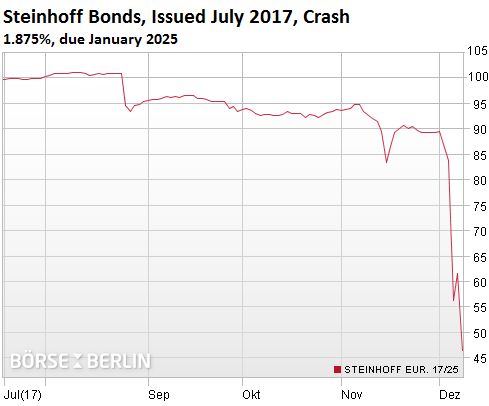
The €800 million of bonds that Steinhoff Europe AG issued during the halcyon days of June 2017 had traded at over 100 cents on the euro in August. By Tuesday, they'd dropped below 85. On Wednesday they crashed to 56. On Friday, they closed at 46.56 cents on the euro:


Moody's 4-notch downgrade with more downgrades likely shows once again how credit ratings are lagging indicators that merely give investors confirmation of what the plunge in price has already shown in gruesome detail.

But Steinhoff owes its banks a lot more than its bondholders – the same banks with which it was supposed to meet on Monday. According to Bloomberg, the company's "total exposure to lenders and other creditors was almost €18 billion ($21 billion) as of the end of March."

"The great unknown is the funding of the off-balance-sheet structures, which could spill over into fresh bank liability," Adrian Saville, CEO of Cannon Asset Managers in Johannesburg, told Bloomberg. He said the short-term debt could "fall over if the business fails."

These are the banks, according to Bloomberg, that are exposed to the company, its off-balance sheet vehicles, and the investment vehicles of its Chairman Christo Wiese, globally:
Citigroup
Bank of America
HSBC
BNP Paribas
Goldman Sachs
Nomura Holdings

And in South Africa:
Standard Bank Group
Investec
Rand Merchant Bank, a unit of FirstRand

Bloomberg explains:


Last year, [Wiese] the billionaire and largest shareholder of the company pledged 628 million of Steinhoff's shares in collateral to borrow money from Citigroup, HSBC, Goldman Sachs Group Inc. and Nomura Holdings Inc. That was to participate in a share sale in conjunction with the acquisition of Mattress Firm and Poundland, according to a company statement.

The value of those pledge shares has plunged to €301 million, from about €3 billion a year ago.

"The disclosures have also turned a fresh spotlight on a set of transactions involving related entities that critics say may have hid operational losses and artificially pumped up the company's valuation," according to The Wall Street Journal.

The German prosecutors said in August that, according to the Journal, "they suspect the revenue came from a set of contracts, each valued in the hundreds of millions of dollars, that Steinhoff subsidiaries sold to undisclosed related parties."

This week, analysts scrambled to make sense of some of the transactions, parts of which are publicly disclosed. In the past, some transactions had triggered specific concern by analysts. Despite those questions and the German probe, investors had largely been satisfied with Steinhoff's public explanations – until now.

"It's the unknown unknowns that are the big worry here. You've got to ask, 'Who knows the whole story?'" Brian Pyle, an analyst at Old Mutual Investment Group, told the Journal. The firm is one of Steinhoff's top-20 shareholders. "We just don't know what else is out there."

In one widely circulated research report published anonymously Tuesday, a group calling itself Viceroy Research accused Steinhoff of using companies owned by some of its former executives and other close associates to hive off unprofitable assets. Those disposals, Viceroy alleges, were often financed by loans from Steinhoff, the interest from which Steinhoff booked as revenue.

Viceroy said some of these transactions involved Campion Capital SA, a Swiss private-equity firm. Campion directors include Siegmar Schmidt, a former finance chief at one of Steinhoff's subsidiaries, according to public records and other documents reviewed by The Wall Street Journal.

In 2015, Steinhoff Möbel, a Steinhoff subsidiary, entered into a joint venture with a company owned by Campion, according to these records. The joint venture then bought a company called GT Global Trademarks from Steinhoff.

The following year, Campion bought two consumer-loan units from South Africa-based Steinhoff Africa Holdings, a Steinhoff International subsidiary. It then sold parts of those firms seven months later to Pepkor, a South African retailer owned by Steinhoff's Johannesburg-listed subsidiary, according to a determination by the South African Competition Commission in October of that year.

The terms of both transactions are unclear.

And there were more indications. The Journal:

In Steinhoff's third-quarter earnings call in August, a credit analyst from HSBC asked then-Chief Executive Markus Jooste why the company was taking on debt and entering into complex partnerships even though its balance sheet showed it had plenty of cash.

Mr. Jooste answered that the joint ventures "had nothing to do with liquidity or monetary terms" and that it just wanted to have local partners who understood how to grow its business.

Reuters reported in November that Steinhoff "did not tell investors about almost $1 billion in transactions with a related company despite laws that some experts believe require it to do so." Short-seller Viceroy Capital, mentioned above, has alleged that Steinhoff used such related-party transactions to channel losses off its financial statements.

Steinhoff's roll-up strategy made it practically impossible for investors – even those tempted to try – to establish underlying cash flows, revenue growth, and earnings. But these schemes cannot be carried on forever.

And the ECB bought into this company.

mercoledì 13 dicembre 2017

BIS: The situation in the global economy is similar to the pre-2008 crash era… ‘WORSE THAN 2007’: Top Central Banker warns of looming wave of worldwide bankruptcies

FINANCIAL MARKETS COULD BE OVER-HEATING, WARNS CENTRAL BANK BODY

Bank for International Settlements' quarterly health check warns global economy resembles era just before financial crash

Investors are ignoring warning signs that financial markets could be overheating and consumer debts are rising to unsustainable levels, the global body for central banks has warned in its quarterly financial health check.

The Bank for International Settlements (BIS) said the situation in the global economy was similar to the pre-2008 crash era when investors, seeking high returns, borrowed heavily to invest in risky assets, despite moves by central banks to tighten access to credit.


The BIS, known as the central bankers' bank, said attempts by the US Federal Reserve and the Bank of England to choke off risky behaviour by raising interest rates had failed so far and unstable financial bubbles were continuing to grow.

Claudio Borio, the head of the BIS, said central banks might need to reconsider changing the way they communicated base interest rate rises or the speed at which they were increasing rates to jolt investors into recognising the need to calm asset markets.

"The vulnerabilities that have built around the globe during the long period of unusually low interest rates have not gone away. High debt levels, in both domestic and foreign currency, are still there. And so are frothy valuations…

 World faces wave of epic debt defaults, fears central bank veteran

Exclusive: Situation worse than it was in 2007, says chairman of the OECD's review committee

The global financial system has become dangerously unstable and faces an avalanche of bankruptcies that will test social and political stability, a leading monetary theorist has warned.

"The situation is worse than it was in 2007. Our macroeconomic ammunition to fight downturns is essentially all used up," said William White, the Swiss-based chairman of the OECD's review committee and former chief economist of the Bank for International Settlements (BIS).

"Emerging markets were part of the solution after the Lehman crisis. Now they are part of the problem, too."

William White, OECD

"Debts have continued to build up over the last eight years and they have reached such levels in every part of the world that they have become a potent cause for mischief," he said.

"It will become obvious in the next recession that many of these debts will never be serviced or repaid, and this will be uncomfortable for a lot of people who think they own assets that are worth something," he told The Telegraph on the eve of the World Economic Forum in Davos.

"The only question is whether we are able to look reality in the eye and face what is coming in an orderly fashion, or whether it will be disorderly. Debt jubilees have been going on for 5,000 years, as far back as the Sumerians."

 China's debt surpasses 300 percent of GDP, IIF says, raising doubts over Yellen's crisis remarks

Global debt has hit a record level in the first quarter of this year, mainly driven by emerging markets, raising questions of whether there will be another financial crisis in the near future.

Data from the Institute of International Finance showed that global debt reached $217 trillion in the first quarter of this year, or 327 percent of gross domestic product.

"The debt burden is not distributed evenly. Some countries/sectors have seen deleveraging while others have built up very high debt levels. For the latter, rising debt may create headwinds for long-term growth and eventually pose risks for financial stability," the IIF said in its Global Debt Monitor report on Tuesday.

On Tuesday, U.S. Fed Chair Janet Yellen told an audience in London that banks are in a "very much stronger" position and another financial crisis is unlikely "in our lifetime."

The 2008 financial crisis began with high indebtedness levels by U.S. households.

But Yellen's remarks aren't' consensual.

"I think Yellen's comment — if I am interpreting it correctly — is a huge hostage to fortune. The words Titanic and unsinkable spring to mind," Erik Jones, professor of international political economy at Johns Hopkins University, told CNBC via email.

martedì 12 dicembre 2017

How market behavior is similar to a person with mental illness


Men, it has been well said, think in herds; it will be seen that they go mad in herds, while they only recover their senses slowly, and one by one.

— Charles Mackay, in the preface to Extraordinary Popular Delusions and the Madness of Crowds,1852.

He made the first reflecting telescope, invented calculus, solved the mystery of gravity, created the laws of motion and his 1687 book Principia laid the groundwork for modern science.

He is often called the smartest person to ever live, but Sir Isaac Newton nearly went broke investing in the South Sea Bubble of 1720-21. An experience which famously caused him to lament: "I can calculate the motions of heavenly bodies, but not the madness of people."

All investors and traders can relate to Newton's exasperation. How often, after witnessing the irrational gyrations of market prices have you shaken your head and said: This market makes no sense -- it's crazy!

Mad, irrational, insane, crazy. All of these terms can be used to describe market behavior at times. It begs the question: Is the market mentally ill? Or more precisely, do markets in fact exhibit behavior similar to that of a person with mental illness?

In a 2010 paper entitled "Does Mr. Market Suffer from Bipolar Disorder?" James H.B. Cheung asserts that, like individuals who experience the severe mood swings of bipolar disorder, investment markets are characterized by moods that range from major depression to mania. Cheung postulates that knowing the "mood state" of a market can help an investor identify optimal entry and exit points and also avoid the devastating losses caused when bubbles burst.

Understanding and identifying the cyclical emotional extremes of a market gives an investor the advantage over those unknowingly swept up by mania or blindsided by crashes. Each stage of Cheung's Market Mood Model has unique implications for investor behavior, market trends, investor feedback mechanisms, expected returns, risk management, and optimal investment strategies.

Cheung's market mood model and the role of Graham and Bufferr

Cheung is not the first to compare markets to human emotional states. In his classic investment book The Intelligent Investor, Benjamin Graham created the parable of "Mr. Market" to illustrate an approach for managing the emotional whipsaws of investing:

"...Imagine that in some private business you own a small share that cost you $1,000. One of your partners, named Mr. Market, is very obliging indeed. Every day he tells you what he thinks your interest is worth and furthermore offers either to buy you out or to sell you an additional interest on that basis. Sometimes his idea of value appears plausible and justified by business developments and prospects as you know them. Often, on the other hand, Mr. Market lets his enthusiasm or his fears run away with him, and the value he proposes seems to you a little short of silly. "

Warren Buffett, a disciple of Benjamin Graham, and the third richest man in the world, has called discovering The Intelligent Investor when he was 19 one of the luckiest moments of his life, because the book gave him the intellectual framework for investing. And Buffett's favorite part of the book is Chapter 8 -- where Mr. Market is introduced.

Here's what Buffett had to say about "Mr. Market" in 1997:

...sad to say, the poor fellow has incurable emotional problems. At times he falls euphoric and can see only the favorable factors affecting the business. When in that mood, he names a very high buy-sell price, because he fears that you will snap up his interest and rob him of imminent gains. At other times, he is depressed and can see nothing but trouble ahead for both the business and the world. On these occasions, he will name a very low price, since he is terrified that you will unload your interest on him... Under these conditions, the more manic depressive his behavior, the better for you."

Manic depression is now known as bipolar disorder -- a diagnosis that is not trivial for those affected. According to the National Institute of Mental Health, every year Bipolar disorder affects approximately 5.7 million adult Americans, or about 2.6% of the U.S. population age 18 and older. It is a brain affliction that causes unusual shifts in mood, energy and activity levels, and can severely hinder the ability to carry out daily tasks.

Below is a chart of mood changes associated with Bipolar Disorder I, the most severe version of the disorder.

Here is the National Institute of Mental Health's list of bipolar symptoms during manic and depressive episodes:

It is not a great leap to extrapolate the symptoms of bipolar disorder shown by individuals onto markets driven by the mass psychology of many individual investors. When Mr. Market is besieged by the above symptoms, it's little wonder that he makes irrational investment decisions.

In Graham and Buffett's view, the intelligent investor should ignore the bipolar Mr. Market. Only if Mr. Market quotes a price way above or below intrinsic value should we pay attention. But be warned: Mr. Market's moods are deceptively contagious. The herding instinct is deeply ingrained in humans, and falling under the influence of the market's mood should be avoided at all costs. If you think this is an exaggeration, know that Warren Buffett has long avoided keeping a live market price monitor in his office, lest his logic be corrupted by Mr. Market's siren song.

Graham and Buffett have a value investor's mindset -- concerned with what the underlying assets and operations of an investment is reallyworth, not it's ever-fluctuating price as voiced by Mr. Market.

However that is not the approach of most investors. John Maynard Keynes, in The General Theory of Employment Interest and Money [1936], writes that the majority of investors, including expert professionals, are essentially in the business of predicting changes in the mass psychology of investors:

"[Investment professionals] are largely concerned, not with making superior long-term forecasts of the probable yield of an investment over its whole life, but with foreseeing changes in the conventional basis of valuation a short time ahead of the general public. They are concerned, not with what an investment is really worth to a man who buys it "for keeps," but with what the market will value it at, under the influence of mass psychology, three months or a year hence."

So as Keynes sees it, professional investors are generally occupied with trying to predict what the emotionally volatile Mr. Market will do next. While Graham and Buffett may call this folly, the fact is that, like Isaac Newton, most investors who make their own decisions are attempting to calculate the madness of people.

Because the mass psychology of markets moves through a generally predictable cycle, knowing where a market is in the cycle may give an investor an edge. Understanding of market mood phases may offer a framework for making profitable market decisions.

Cheung's Market Mood Model uses the phases of bipolar disorder as a basis for identifying the phases which comprise a market's emotional swings.

There are six phases of market mood in Cheung's model:

  1. Normal -- This is the base-building or consolidation phase where fundamentals are poor but stabilizing. Value investors are showing interest.
  2. Hypomania -- Favorable news shocks hit the market, and prices break higher out of consolidation. Speculators, focused on short-term gains, begin buying. As the market continues higher, positive feedback ensues.
  3. Mania -- The uptrend is very strong. Favorable analyst reports predict further gains, adding fuel to the fire. Sophisticated and novice investors alike are swept up in the market. Positive feedback is very strong as stories of big profits entice ever more speculators. Some smart money investors quit buying and begin to pare holdings, but consensus is overwhelming that more profits are to come.
  1. Moderate depression -- The market peaks and begins to fall. Bulls become indecisive, and a narrative that questions the bullish story begins to build. Some buy on dips, expecting a rebound and further gains. Professionals increase short sales. Falling prices create a negative feedback loop. Investors begin to panic. Prices decline quickly.
  2. Major depression -- The trend is very bearish and stories are resoundingly negative. Negative feedback mechanism is prevalent. Those who have not sold their positions in phases 3 and 4 are distressed and depressed, many "throw in the towel" and quit following the market.
  1. Normal -- Selling has abated as bubble buyers have exited, but new buying interest remains weak. The market is "washed out." Fundamentals are poor but beginning to stabilize. The market transitions back into phase 1 and value investors again begin accumulating, starting the cycle over again.

Knowing that the mood of the market is part of a cycle may help investors catch a trend early, before it becomes a bubble, and ride it profitably with appropriate risk management, expecting that market mania will inevitably cycle back to market depression.

While we may not be able to fully calculate the madness of men, an understanding of the bipolar cycle may help an investor do what Warren Buffett says is at the heart of his investment philosophy: "Be Fearful When Others Are Greedy and Greedy When Others Are Fearful."

Bitcoin to be declared a financial institution – Beware!

The risk with Bitcoin is that the government could simply change the definition of money. That is what they did to M.A. back in 1980 because he was one of the three main market-makers in gold (perhaps the biggest). It was all a hunt for taxes, not concerning him but his clients. He have explained before why he retired from making markets in gold — the IRS declared him to be a BANK! When gold was legalized in 1975 and began trading on the COMEX in New York, the New Jersey Senate asked him to write the law on gold to make sure it would not be taxable to buy and sell gold bullion. He worked with Senator Foran and developed the language that "gold was not taxable unless converted to use."

M.A. was making the market to buy gold scrap from all the stores you see with "WE BUY GOLD" signs. They buy the jewelry and it has to be refined. To do that, you needed a minimum lot of 100 ounces, which was the contract size on COMEX. When gold was $800, that meant one 100 ounce bar was valued at $80,000. The refining period was 6 weeks. Therefore, all of these small operations could not afford the float. If they bought 100 ounces per week, then they would need $560,000 in working capital. That would not work for most of these small shops buying gold.

M.A. made the market. The shops could ship whatever they bought that day and he would buy it at the daily price. M.A. gathered all the gold sold by countless stores. The gold was shipped by armored cars to Englehard for refining (PhiBro or Philipps Brothers who eventually bought Saloman Brothers). M.A. was doing tens of millions per week back then and refined a mountain of gold.

First, the NJ tax authorities walked in and declared him to be a merchant. M.A. said gold was not taxable unless converted to a usable product. They said their "interpretation" was that the "use" was investment. M.A.refused to pay and opted for a trial. Of course, you do not get M.A. lost.

Simultaneously, the Feds walked in and declared M.A. to be a BANK. They then declared that M.A. had to file forms to report when his clients bought or sold more than $10,000. Their interpretation was that gold was NEVER formally declared not to be money in 1971, so M.A. was a BANK. They threatened him saying that the fine was $50,000 up to the full amount of every transaction M.A. failed to report. They said they knew M.A. perhaps did not "realize" M.A. was a BANK and would forego the fines if M.A. would allow them access to audit all his clients. M.A. had no choice. They set up shop in his office. M.A. walked by, noticing that they were pulling out names of those whose transaction were even $5,000, and he asked what was going on. The agent turned to him and said very aggressively, "You have a problem, keep your mouth shut!" The next day in rolled the vans and they took all his business records and began an audit over 3,000 of his clients for the next three years.

That is why M.A. retired. He neither wanted to collect sales taxes on bullion nor be a BANK and report on his clients. Since he was the biggest, they were starting with him. People doing business outside of New Jersey would not have the sales tax problem and the IRS was interested in him because of his size. They would not do the same for small shops. So it was time to get out of the business. Clients wanted the research to continue, so that was spun-off as a new company in 1981.

Now comes Bitcoin. The Judiciary Committee of the United States Senate is currently working on Bill S.1241 that aims to criminalize deliberate concealment of property or the control of a financial account. The bill was submitted in June, and the law would change the definition of "financial account" and "financial institution," and thus also cover digital currencies and digital exchanges. Who is pushing it? None other than California's Senator Dianne Feinstein, who maintains that the bill is needed to update existing money laundering laws because of terrorists.

This means that the miners of Bitcoin will become a "bank," as A.M. was declared. The operators of the trading platform Coinbase were forced by court ruling to notify the IRS of the identity of over 14,000 investors who were trading $20,000 in Bitcoin. Users were affected if their trading volume had exceeded $20,000 at the beginning of 2013 by the end of 2015. So this is NOT a single transaction, but accumulative. The IRS will now "presume" tax evasion. This is what M.A. warned would happen. Been there done that! They can shut down Bitcoin in the blink of an eye by simply defining anyone who is a miner to be a financial institution.

The bill will change the definition of "financial institution" in Section 53412 (a) of Title 31 , United States Code. The text will read:

"An exhibitor, a redeemer or a cashier of prepaid access devices, digital currency or a digital exchanger or a digital currency."

The regulation will remove the anonymity of Bitcoin and other cryptocurrencies defeating this idea that there is an alternative-financial-universe separate from government.

lunedì 11 dicembre 2017

In 2018, Central Banks Will Have to Choose… Blow Up Stocks or Bonds…


And they're going to choose to let stocks go.

The #1 driver of the stock market is Central Bank money printing. In 2017 alone, the BoJ and the European Central Bank (ECB) have printed over $1.5 TRILLION and funneled it into the financial system.

The primary goal of this is to ramp stocks higher. But the consequence is that inflation has been unleashed.

We are getting signs of an inflationary shock throughout the world: in Germany, China, the US, the UK, and even Japan.

And this is a MASSIVE problem for the Bond Bubble.

Bond yields trade based on inflation. If inflation rises, bond yields will do the same. And when bond yields rise, bond prices COLLAPSE. And when bond price collapse, the bond bubble bursts.

And so the BoJ and other Central Banks now face a choice:

1) STOP QE and money printing to try and halt inflation (thereby letting stocks collapse).

2) Keep printing money, let inflation spiral out of control, bursting the Bond Bubble and triggering a deflationary crisis that will make 2008 look like a joke.

The choice is obvious: Central Banks will be tightening… at least temporarily.

Truth is most stock markets could drop 30% and still be in bull markets.

But if bonds drop… entire countries will go bust (think Greece in 2010).

Do you really think the US, Japan, China, and the EU could service their debt loads if rates were normalized? Collectively these countries have added over $20 trillion in debt since the 2008 crisis.

And ALL of this has been built on the back of the Bond Bubble. And because Bonds are the bedrock of the financial system, when they go into a bubble, EVERYTHING goes into a bubble.

Put simply: Central Banks will not risk blowing up the bubble in bonds. And so the money printing will be halted (for now) and stocks will be dropping.

Bubble Watch: The Bank of Japan is About to Shock the World


The Bank of Japan (BoJ) will RAISE rates in 2018. And it's going to collapse the stock market. The #1 driver of the stock market is Central Bank money printing. In 2017 alone, the BoJ and the European Central Bank (ECB) have printed over $1.5 TRILLION and funneled it into the financial system.

The primary goal of this is to ramp stocks higher. But the consequence is that inflation has been unleashed. We are getting signs of an inflationary shock throughout the world: in Germany, China, the US, the UK, and even Japan. And this is a MASSIVE problem for the Bond Bubble.

Bond yields trade based on inflation. If inflation rises, bond yields will do the same. And when bond yields rise, bond prices COLLAPSE. And when bond price collapse, the bond bubble bursts. And so the BoJ and other Central Banks now face a choice:

1) STOP QE and money printing to try and halt inflation (thereby letting stocks collapse). 

2) Keep printing money, let inflation spiral out of control, bursting the Bond Bubble and triggering a deflationary crisis that will make 2008 look like a joke.

The choice is obvious: Central Banks will be tightening… at least temporarily.

Truth is most stock markets could drop 30% and still be in bull markets.

But if bonds drop… entire countries will go bust (think Greece in 2010).

Do you really think the US, Japan, China, and the EU could service their debt loads if rates were normalized? Collectively these countries have added over $20 trillion in debt since the 2008 crisis. And ALL of this has been built on the back of the Bond Bubble. And because Bonds are the bedrock of the financial system, when they go into a bubble, EVERYTHING goes into a bubble.

This is why in 2014 was coined the term Everything Bubble and when this bubble bursts (as all bubbles do) the policies Central Banks employ will make those from 2008-2015 look like a cakewalk. Put simply: Central Banks will not risk blowing up the bubble in bonds. And so the money printing will be halted (for now) and stocks will be dropping.

domenica 10 dicembre 2017

Enron 2.0? ECB, Global Banks On The Hook For $21 Billion In Steinhoff Implosion

Earlier last week has been reported that as part of the stunning, unexpected collapse of South African retail giant Steinhoff, which also owns France-based Conforama furniture chain, Mattress Firm in the U.S. and Poundland in the U.K., none other than the ECB was unveiled as owning an unknown amount of its recently issued €800 million in 2025 bonds, which plunged from 85 to as little as 41 cents on Wednesday when the news hit...
 

... and which was said would be sharply downgraded in the coming days as the rating agencies - once again painfully behind the curve - caught up with reality. That's precisely what happened late on Thursday, when Moody's cut its Baa3 rating by four notches deep into junk territory, highlighting "the uncertainties and implications for the company's liquidity and debt capital structure."
 After the downgrade- much to the humiliation of the ECB which has to explain why as part of its economic revitalization efforts, i.e. QE it is holding this pile of steaming garbage - Steinhoff bonds extended losses on Friday as the world paid increasingly more attention to the accounting scandal that's threatening the survival of the global furniture and clothing retailer.
Meanwhile, whispers of Enron 2.0 have emerged as the investing community begins to appreciate the potential implications of Steinhoff's implosion. For South Africa, the collapse of the company which employs 130,000 people worldwide, already has systemic implications. As Bloomberg reports, South African Finance Minister Malusi Gigaba said he's "mindful" that many retirement and savings funds will be hurt by the loss in value and has asked the PIC to prepare a report on the extent of the exposure.
Still, unless South Africa is willing to fund a state bailout, the fate of Steinhoff, which has appears to be sealed.
"I think it is the end," Simon Brown, Johannesburg-based chief executive officer of trading company JustOneLap, told Bloomberg. "The end will be a break up. There are lots of decent businesses that others will want to buy and it's likely they'll fetch decent prices. so staff will mostly be fine, except in head office."
"There's no way back," David Shapiro, deputy chairman of Sasfin Wealth in Johannesburg, said in emailed comments on Friday. "The worry is that there are a huge number of operating companies within the stable – if you were a supplier to these businesses would you sell goods on credit? I reckon they should file for Chapter 11 or business rescue and try and salvage what they can."
That outcome would be a disaster not only for the ECB, which as showed is a proud owner of an unknown amount of the company's plunging bonds.


The fallout from the spectacular implosion also means that U.S. and European banks with billions of dollars at stake were told they'd have to wait another week to confront the global clothing and furniture retailer that's engulfed in an accounting scandal, Bloomberg reported on Friday.  
The company on Friday delayed a meeting with lenders to Dec. 19 from Dec. 11, citing that full-year earnings that are typically discussed in the annual gathering haven't been published. The owner of chains such as Mattress Firm in the U.S. and Conforama in France didn't say whether it planned to report financials before Dec. 19.
Finding themselves in limbo, and in a communication lockout, is hardly good news for lenders who stand to lose massive amount should Steinhoff liquidation. Total exposure to lenders and other creditors was almost 18 billion euros ($21 billion) as of the end of March, with Bloomberg reporting that "long-term liabilities were 12.1 billion euros and short-term liabilities 5.87 billion euros." Those are the most recent Steinhoff results available after it indefinitely postponed publishing full-year financials on Wednesday. The latest numbers will likely be even greater to account for the July issuance of the company's 2025 bonds.
But the real dangers is what is not reported on the books: "The great unknown is the funding of the off-balance-sheet structures, which could spill over into fresh bank liability," Adrian Saville, chief executive officer of Cannon Asset Managers in Johannesburg, told Bloomberg on Friday. The short-term debt could "fall over if the business fails," he said.
It is unclear which banks are on the hook although in South Africa, Steinhoff has relationships with Standard Bank Group, Investec and a unit of FirstRand. Globally some of the lenders include Citigroup, Bank of America, HSBC and BNP Paribas.
Banks also have exposure to Steinhoff through loans provided to Chairman, billionaire Christo Wiese's investment vehicles. Last year, the billionaire and largest shareholder of the company pledged 628 million of Steinhoff's shares in collateral to borrow money from Citigroup, HSBC, Goldman Sachs Group Inc. and Nomura Holdings Inc. That was to participate in a share sale in conjunction with the acquisition of Mattress Firm and Poundland, according to a company statement. It's unclear whether Wiese has repaid part of those loans since, Bloomberg notes. The value of all shares pledged as collateral is now 365 million euros, down from 2.2 billion euros a month ago.
Meanwhile, in a desperate attempt to salvage value, Steinhoff said after the market close on Friday that it had appointed a new sub-committee to improve corporate governance at the company.
The three non-executive directors are all existing board members, and are led by Johan van Zyl, the co-CEO of financial services firm African Rainbow Capital Ltd. Steve Booysen, an ex-head of lender Absa, and Heather Sonn, a former investment banker, make up the trio.
Steinhoff also said it was considering boosting liquidity by selling assets worth at least 1 billion euros. It also said one of its African subsidiaries would refinance long-term liabilities amounting to another 1 billion euros, while the possibility of recovering assets for around 6 billion euros was being investigated. All of these measures may help recoup some of the money owing to banks and investors, and while a complete loss on the $21 billion in exposure is unlikely, it seems virtually guaranteed that the banks will suffer steep haircuts on their Steinhoff exposure.
As will the ECB, which on Friday was rumored it was considering selling its Steinhoff bonds. It is not exactly clear how this would take place, since the ECB's QE by definition only buys, not sells, at least for now.
One thing that is certain, however, is that this is just the beginning of the ECB's balance sheet woes: as we showed on Wednesday using UBS data, the ECB now holds no less than 26 "fallen angel" equivalent bonds, amounting to €18 billion in notional exposure; both numbers are set to soar when the next recession hits and the bulk of the ECB's holdings shift down in quality, leaving Mario Draghi and his henchmen dealing with countless credit committees in bankruptcy court as the European central bank finds itself the post-reorg equity holder of countless European companies.