MARKET FLASH:

"It seems the donkey is laughing, but he instead is braying (l'asino sembra ridere ma in realtà raglia)": si veda sotto "1927-1933: Pompous Prognosticators" per avere la conferma che la storia non si ripete ma fà la rima.


sabato 7 ottobre 2017

The American empire is coming to an end. Get ready, fasten your seat-belts

The American empire is coming to an end. The U.S. economy is being drained by wars in the Middle East and vast military expansion around the globe. It is burdened by growing deficits, along with the devastating effects of deindustrialization and global trade agreements. Our democracy has been captured and destroyed by corporations that steadily demand more tax cuts, more deregulation and impunity from prosecution for massive acts of financial fraud, all the while looting trillions from the U.S. treasury in the form of bailouts. The nation has lost the power and respect needed to induce allies in Europe, Latin America, Asia and Africa to do its bidding. Add to this the mounting destruction caused by climate change and you have a recipe for an emerging dystopia. Overseeing this descent at the highest levels of the federal and state governments is a motley collection of imbeciles, con artists, thieves, opportunists and warmongering generals. And to be clear, I am speaking about Democrats, too.


The empire will limp along, steadily losing influence until the dollar is dropped as the world's reserve currency, plunging the United States into a crippling depression and instantly forcing a massive contraction of its military machine.


Short of a sudden and widespread popular revolt, which does not seem likely, the death spiral appears unstoppable, meaning the United States as we know it will no longer exist within a decade or, at most, two. The global vacuum we leave behind will be filled by China, already establishing itself as an economic and military juggernaut, or perhaps there will be a multipolar world carved up among Russia, China, India, Brazil, Turkey, South Africa and a few other states. Or maybe the void will be filled, as the historian Alfred W. McCoy writes in his book "In the Shadows of the American Century: The Rise and Decline of US Global Power," by "a coalition of transnational corporations, multilateral military forces like NATO, and an international financial leadership self-selected at Davos and Bilderberg" that will "forge a supranational nexus to supersede any nation or empire."


Under every measurement, from financial growth and infrastructure investment to advanced technology, including supercomputers, space weaponry and cyberwarfare, we are being rapidly overtaken by the Chinese. "In April 2015 the U.S. Department of Agriculture suggested that the American economy would grow by nearly 50 percent over the next 15 years, while China's would triple and come close to surpassing America's in 2030," McCoy noted. China became the world's second largest economy in 2010, the same year it became the world's leading manufacturing nation, pushing aside a United States that had dominated the world's manufacturing for a century. The Department of Defense issued a sober report titled "At Our Own Peril: DoD Risk Assessment in a Post-Primacy World." It found that the U.S. military "no longer enjoys an unassailable position versus state competitors," and "it no longer can … automatically generate consistent and sustained local military superiority at range." McCoy predicts the collapse will come by 2030.


Empires in decay embrace an almost willful suicide. Blinded by their hubris and unable to face the reality of their diminishing power, they retreat into a fantasy world where hard and unpleasant facts no longer intrude. They replace diplomacy, multilateralism and politics with unilateral threats and the blunt instrument of war.


This collective self-delusion saw the United States make the greatest strategic blunder in its history, one that sounded the death knell of the empire - the invasion of Afghanistan and Iraq. The architects of the war in the George W. Bush White House, and the array of useful idiots in the press and academia who were cheerleaders for it, knew very little about the countries being invaded, were stunningly naive about the effects of industrial warfare and were blindsided by the ferocious blowback. They stated, and probably believed, that Saddam Hussein had weapons of mass destruction, although they had no valid evidence to support this claim. They insisted that democracy would be implanted in Baghdad and spread across the Middle East. They assured the public that U.S. troops would be greeted by grateful Iraqis and Afghans as liberators. They promised that oil revenues would cover the cost of reconstruction. They insisted that the bold and quick military strike—"shock and awe"—would restore American hegemony in the region and dominance in the world. It did the opposite. As Zbigniew Brzezinski noted, this "unilateral war of choice against Iraq precipitated a widespread delegitimation of U.S. foreign policy."


Historians of empire call these military fiascos, a feature of all late empires, examples of "micro-militarism." The Athenians engaged in micro-militarism when during the Peloponnesian War (431-404 B.C.) they invaded Sicily, suffering the loss of 200 ships and thousands of soldiers and triggering revolts throughout the empire. Britain did so in 1956 when it attacked Egypt in a dispute over the nationalization of the Suez Canal and then quickly had to withdraw in humiliation, empowering a string of Arab nationalist leaders such as Egypt's Gamal Abdel Nasser and dooming British rule over the nation's few remaining colonies. Neither of these empires recovered.


"While rising empires are often judicious, even rational in their application of armed force for conquest and control of overseas dominions, fading empires are inclined to ill-considered displays of power, dreaming of bold military masterstrokes that would somehow recoup lost prestige and power," McCoy writes.


"Often irrational even from an imperial point of view, these micromilitary operations can yield hemorrhaging expenditures or humiliating defeats that only accelerate the process already under way."


Empires need more than force to dominate other nations. They need a mystique. This mystique—a mask for imperial plunder, repression and exploitation—seduces some native elites, who become willing to do the bidding of the imperial power or at least remain passive. And it provides a patina of civility and even nobility to justify to those at home the costs in blood and money needed to maintain empire. The parliamentary system of government that Britain replicated in appearance in the colonies, and the introduction of British sports such as polo, cricket and horse racing, along with elaborately uniformed viceroys and the pageantry of royalty, were buttressed by what the colonialists said was the invincibility of their navy and army. England was able to hold its empire together from 1815 to 1914 before being forced into a steady retreat. America's high-blown rhetoric about democracy, liberty and equality, along with basketball, baseball and Hollywood, as well as our own deification of the military, entranced and cowed much of the globe in the wake of World War II. Behind the scenes, of course, the CIA used its bag of dirty tricks to orchestrate coups, fix elections and carry out assassinations, black propaganda campaigns, bribery, blackmail, intimidation and torture. But none of this works anymore.


The loss of the mystique is crippling. It makes it hard to find pliant surrogates to administer the empire, as we have seen in Iraq and Afghanistan. The photographs of physical abuse and sexual humiliation imposed on Arab prisoners at Abu Ghraib inflamed the Muslim world and fed al-Qaida and later Islamic State with new recruits. The assassination of Osama bin Laden and a host of other jihadist leaders, including the U.S. citizen Anwar al-Awlaki, openly mocked the concept of the rule of law. The hundreds of thousands of dead and millions of refugees fleeing our debacles in the Middle East, along with the near-constant threat from militarized aerial drones, exposed us as state terrorists. We have exercised in the Middle East the U.S. military's penchant for widespread atrocities, indiscriminate violence, lies and blundering miscalculations, actions that led to our defeat in Vietnam.


The brutality abroad is matched by a growing brutality at home. Militarized police gun down mostly unarmed, poor people of color and fill a system of penitentiaries and jails that hold a staggering 25 percent of the world's prisoners although Americans represent only 5 percent of global population. Many of our cities are in ruins. Our public transportation system is a shambles. Our educational system is in steep decline and being privatized. Opioid addiction, suicide, mass shootings, depression and morbid obesity plague a population that has fallen into profound despair. The deep disillusionment and anger that led to Donald Trump's election - a reaction to the corporate coup d'état and the poverty afflicting at least half of the country - have destroyed the myth of a functioning democracy. Presidential tweets and rhetoric celebrate hate, racism and bigotry and taunt the weak and the vulnerable. The president in an address before the United Nations threatened to obliterate another nation in an act of genocide. We are worldwide objects of ridicule and hatred. The foreboding for the future is expressed in the rash of dystopian films, motion pictures that no longer perpetuate American virtue and exceptionalism or the myth of human progress.


"The demise of the United States as the preeminent global power could come far more quickly than anyone imagines," McCoy writes. "Despite the aura of omnipotence empires often project, most are surprisingly fragile, lacking the inherent strength of even a modest nation-state. Indeed, a glance at their history should remind us that the greatest of them are susceptible to collapse from diverse causes, with fiscal pressures usually a prime factor. For the better part of two centuries, the security and prosperity of the homeland has been the main objective for most stable states, making foreign or imperial adventures an expendable option, usually allocated no more than 5 percent of the domestic budget. Without the financing that arises almost organically inside a sovereign nation, empires are famously predatory in their relentless hunt for plunder or profit—witness the Atlantic slave trade, Belgium's rubber lust in the Congo, British India's opium commerce, the Third Reich's rape of Europe, or the Soviet exploitation of Eastern Europe."

When revenues shrink or collapse, McCoy points out, "empires become brittle."

"So delicate is their ecology of power that, when things start to go truly wrong, empires regularly unravel with unholy speed: just a year for Portugal, two years for the Soviet Union, eight years for France, eleven years for the Ottomans, seventeen for Great Britain, and, in all likelihood, just twenty-seven years for the United States, counting from the crucial year 2003 [when the U.S. invaded Iraq]," he writes.

Many of the estimated 69 empires that have existed throughout history lacked competent leadership in their decline, having ceded power to monstrosities such as the Roman emperors Caligula and Nero. In the United States, the reins of authority may be in the grasp of the first in a line of depraved demagogues.

"For the majority of Americans, the 2020s will likely be remembered as a demoralizing decade of rising prices, stagnant wages, and fading international competitiveness," McCoy writes. The loss of the dollar as the global reserve currency will see the U.S. unable to pay for its huge deficits by selling Treasury bonds, which will be drastically devalued at that point. There will be a massive rise in the cost of imports. Unemployment will explode. Domestic clashes over what McCoy calls "insubstantial issues" will fuel a dangerous hypernationalism that could morph into an American fascism.

A discredited elite, suspicious and even paranoid in an age of decline, will see enemies everywhere. The array of instruments created for global dominance—wholesale surveillance, the evisceration of civil liberties, sophisticated torture techniques, militarized police, the massive prison system, the thousands of militarized drones and satellites—will be employed in the homeland. The empire will collapse and the nation will consume itself within our lifetimes if we do not wrest power from those who rule the corporate state.

sabato 9 settembre 2017

Swiss-central-bank-boosts-stakes-in-faamg-stocks-by-77-percent-to-9.38-billion USD: tulip territory

The Swiss central bank may be part of a modern age Tulip Bubble.

Since June 30 of last year, Switzerland's central bank, the Swiss National Bank, has increased its stock holdings of five U.S. social media/tech stocks from $5.3 billion to $9.38 billion, an increase of 77 percent in 12 months. The stocks are Apple, Alphabet (parent to Google), Microsoft, Amazon and Facebook. The stock information comes from a 13F filing the Swiss National Bank made this month with the U.S. Securities and Exchange Commission (SEC), a quarterly form required of institutional investment managers who manage $100 million or more.

According to the SEC form, the Swiss central bank owns the following positions as of June 30, 2017: $2.76 billion in Apple common stock; over $2 billion in two classes of Alphabet stock; $1.864 billion in Microsoft common; $1.434 billion in Amazon common; and $1.32 billion in Facebook Class A. It owns tens of billions of dollars more in other U.S. and global stocks.

Adding to the peculiarity of this central bank, its own stock actually trades on a stock exchange and its stock price has soared by 88 percent since April. (See chart above.)

According to the website of the Swiss National Bank, it "does not pursue any strategic interests in its equity investments and as a general rule does not engage in any stock selection." It says its share holdings are "managed passively by replicating a combination of different indices."

It has a flexible do-no-evil expressed philosophy in buying stocks for its portfolio, writing that it "avoids shares in companies which produce internationally banned weapons, seriously violate fundamental human rights or systematically cause severe environmental damage." That philosophy has not prevented it from (as of June 30, 2017) owning $464 million in Philip Morris International, which says it is "the world's leading tobacco company" and that "six of the world's top international brands are ours, including Marlboro, the world's number one."

In 1999, the U.S. Department of Justice sued Philip Morris and other large tobacco companies under the Racketeer Influenced and Corrupt Organizations Act (RICO). The government charged that the tobacco companies engaged in a four-decade conspiracy to mislead the public about the dangers of smoking, distort the dangers of secondhand smoke, lie about the addictiveness of nicotine, deceitfully market cigarettes as light or low tar while fully aware that these products were as hazardous as regular cigarettes, and unconscionably target the youth market as "replacement smokers."

Following a nine-month bench trial, on August 17, 2006, Judge Gladys Kessler of the U.S. District Court for the District of Columbia issued a 1,683 page opinion. The Court found that "Cigarette smoking causes disease, suffering, and death."

The Swiss National Bank is one of more than a dozen central banks that are now investing in publicly traded stocks. Economist Ed Yardeni had this to say about the practice last year:

"In the long run, it's hard to imagine that having the central monetary planners buy corporate bonds and stocks with the money they print can end well. In effect, the central banks are turning into the world's biggest hedge funds, financed by their own internal primary (money-printing) dealers and backstopped by the government — which can always borrow more from the central bank or force taxpayers to make good on this Ponzi scheme…"

Add the central banks' stock binge to the trillions of dollars that U.S. corporations have spent buying back their own stock over the past decade and we are clearly in tulip territory.

China Battles "Impossible Trinity"


Just because something is inevitable does not mean it cannot be postponed.

The popular name for this is "kicking the can down the road," which is a perfectly good description.

I prefer more technical terms such as dynamic systems in "subcritical" and "supercritical" state space, but it amounts to the same thing.

A financial crisis can be a long time in the making, but it will definitely erupt. When it does, there will be huge losses for those who ignored the warning signs.

China is in a pre-crisis situation today: it is confronting the harsh logic of the "Impossible Trinity."


The Impossible Trinity theory was advanced in the early 1960s by Nobel Prize-winning economist Robert Mundell. It says that no country can have an open capital account, a fixed exchange rate and an independent monetary policy at the same time.

You can have one or two out of three, but not all three. If you try, you will fail - markets will make sure of that.

Those failures (which do happen) represent some of the best profit-making opportunities of all.

Understanding the Impossible Trinity is how George Soros broke the Bank of England on Sept. 16, 1992 (still referred to as "Black Wednesday" in British banking circles. Soros also made over $1 billion that day).

The reason is that if more attractive total returns are available abroad, money will flee a home country at a fixed exchange rate to seek the higher return. This will cause a foreign exchange crisis and a policy response that abandons one of the three policies.

But just because the trinity is impossible in the long run does not mean it cannot be pursued in the short run. China is trying to peg the yuan to the U.S. dollar while maintaining a partially open capital account and semi-independent monetary policy. It's a nice finesse, but isn't sustainable.

sabato 26 agosto 2017

Stock & Bond Markets in Denial about QE Unwind, but Banks, Treasury Dept Get Antsy


"Let markets clear." It'll be just "a financial engineering shock."

Stock and bond markets are in denial about the effects of the Fed's forthcoming QE unwind, whose kick-off is getting closer by the day, according to the minutes of the Fed's July meeting.

"Several participants" were fretting how financial conditions had eased since the rate hikes began in earnest last December, instead of tightening. "Further increases in equity prices, together with continued low longer-term interest rates, had led to an easing of financial conditions," they said. So something needs to be done about it.

And "several participants were prepared to announce a starting date for the program at the current meeting" – so the meeting in July – "most preferred to defer that decision until an upcoming meeting." So the September meeting. And markets are now expecting the QE unwind to be announced in September.

Since then, short-term Treasury yields have remained relatively stable, reflecting the Fed's current target range for the federal funds rate of 1% to 1.25%. But long-term rates, which the Fed intends to push up with the QE unwind, have come down further. As a consequence, the yield curve has flattened further, which is the opposite of what the Fed wants to accomplish.

The chart shows how the yield curve for current yields (red line) across the maturities has flattened against the yield curve on December 14 (blue line), when the Fed got serious about tightening:


Yields of junk bonds at the riskiest end (rated CCC or below) surged in the second half of 2015 and in early 2016, peaking above 20% on average, as bond prices have plunged (they move in opposite directions) in part due to the collapse of energy junk bonds, which caused a phenomenal bout of Fed flip-flopping. But by rate-hike-day December 14, the average yield was 12%. And since the tightening moves and the planning for the QE unwind, the yield has dropped to 10.7% currently:


So markets are loosening "financial conditions" for companies, thus making capital cheaper and easier, rather than tightening financial conditions. The St. Louis Fed tracks these financial conditions with its "Financial Stress Index." In this chart of the Financial Stress Index, the blue line (=zero) represents "normal financial market conditions." Values below zero indicate below-average financial market stress. The record low was -1.609 on June 27, 2014. Currently, the index is at -1.604, just barely above the record low:


In other words, financial conditions have almost never been easier despite the current series of tightening moves. And this is what it looks like in more granular detail:


Stocks are still near all-time highs, though they've come down a tad. Interest rates for conforming 30-year mortgages are still quoted below 4%, thus propping up the housing market, despite the Fed's plan to begin shedding its portfolio of mortgage-backed securities, which it acquired over the years specifically to push down mortgage rates.

After a 12-month phase-in period, the Fed will reduce its balance sheet by up to $50 billion a month in Treasuries and mortgage-backed securities, every month, with clock-work regularity. That's the plan. By $600 billion a year or $1.2 trillion in two years. QE was designed to bring yields down and inflate asset prices. Now the opposite is being planned, and markets are just blowing it off.


No one knows how this will turn out. The Fed has never done a QE-unwind before. But folks are concerned. A committee of investors and banks – the Treasury Borrowing Advisory Committee or TBAC – pointed out some of those risks in its presentation to Treasury Department earlier this month.

They pointed out, for example, that the corporate and government borrowing costs are likely to rise. At the riskier end, borrowing costs could rise significantly. In addition, the federal government's borrowing needs is also expected rise, Jason Cummins, TBAC chairman, wrote in the letter to Treasury Secretary Steven Mnuchin. So just when the Fed is cutting its balance sheet and the cost of borrowing rises, the amounts to be borrowed by the government are expected to increase.

"The private sector piggy-backed on the Fed's large-scale asset purchases, a move that promoted a surge in corporate borrowing and tighter risk spreads," Cummins wrote. "In an adverse scenario, there's the possibility of a meaningful, but not systemically risky, decline in both credit and equities."

It would be a "tail risk" the presentation said. It could entail accelerating "risk premium decompression," where "small increases in yields can potentially lead to large changes in risk premium." Which means large-scale declines in the prices of riskier bonds, and thus far higher borrowing costs for those issuers, and a big hit to stocks. The presentation:

Pro-cyclical behavior of investors who 'piggy backed' central bank purchases and ECB tapering are possible accelerators to the rise in US risk premium in a tail risk event.

"There may be a "meaningful decline in risk assets." But it's not going to be "systemic," it said. "Banks and households have not leveraged to higher asset prices." They can withstand the shock. So "Let markets clear." It's just "a financial engineering shock."

Given how corporate bonds are now largely held by exchange-traded funds and mutual funds, this could get even more interesting. When bond prices decline, investors in those funds – painfully aware of the first-mover advantage experienced in prior bond-fund collapses – will be getting out of these funds, and funds have to sell bonds to meet the redemptions. At that point, bond market liquidity dries up, and this selling by funds will accelerate the pressures. And yet, bond and stock markets are still euphoric.

mercoledì 9 agosto 2017

The Perfect Crash Indicator Is Flashing Red

What’s the last big toy you buy when things have been good for a really long time and you already have all the other toys? An RV, of course. A dubious thing to own if you already have a house, but when the good times seem likely to roll on forever, why the hell not?
And what’s the first thing you sell when you lose your job and your stocks are tanking? That very same RV. Which makes new RV sales a useful indicator of our place in the business cycle.
What does it say now? Here you go:
Notice the mini-spike in the late 1990s and the major spike in mid-2000s, both of which were followed by corrections. Now note the mega-spike from 2010 and 2016.
And how are things going so far this year? Well, the space is on fire:

‘The RV space is on fire’: Millennials expected to push sales to record highs

(CNBC) – RV shipments are expected to surge to their highest level ever, according to a forecast from the Recreation Vehicle Industry Association.
It would be the industry’s eighth consecutive year of gains.
Thor Industries and Winnebago Industries posted huge growth in their most recent earnings report.
Those shipments are accelerating, and should grow even more next year, the group said. Sales in the first quarter rose 11.7 percent from 2016.
Much of the growth can be attributed to strong sales of trailers, smaller units that can be towed behind an SUV or minivan, which dominate the RV market. The industry also is drawing in new customers.
As the economy has strengthened since the Great Recession, and consumer confidence improved, sales have picked up, said Kevin Broom, director of media relations for RVIA.
Two of the major players in the industry, Thor Industries and Winnebago Industries, both manufacturers of RVs, reported huge growth in their most recent earnings report. Thor saw sales skyrocket 56.9 percent to $2.02 billion fromlast year. Winnebago’s surged 75.1 percent last quarter to $476.4 million.
Gerrick Johnson, an analyst at BMO Capital Markets, attributed much of that growth to acquisitions. Thor bought Jayco, then the No. 3 player in the industry, last June; Winnebago bought Grand Design in October.
Thor stock has experienced strong growth over the past year of almost 40 percent. Winnebago tells an even better story: Its shares are up 56 percent over the past 12 months.
“They’ve done massively well because they’ve made massively creative acquisitions,” said Johnson. “Wall Street didn’t realize how creative those deals were. Each quarter they came through. The RV space is on fire, and the demand metrics are quite positive.”
What we have here is another classic short. During the past couple of recessions, RV stocks plunged as everyone came to their senses and stopped buying $60,000 motel rooms. Based on the above chart that’s a pretty good bet to repeat going forward. Let’s revisit this play in a couple of years.

The Dollar And Equities Will Plunge Together – While Gold Spikes

The dollar has been falling lately, which isn’t what a lot of people expected with the Fed being the only major central bank that’s raising interest rates. Higher yields on dollar balances should, according to basic economics, have attracted foreign capital to Treasury paper, thus putting upward pressure on the dollar. Didn’t happen though. The dollar is down about 10% since the Fed started tightening.
Stocks, meanwhile, might reasonably have been expected to fall, as their dividend yields become less attractive relative to rising risk-free fixed income returns. Also didn’t happen. US equities are now at record levels.
As for what happens next, Ron Rosen of the Rosen Market Timing newsletter has just published some dramatic predictions. Here’s an excerpt:
This REPORT attempts to demonstrate that the day the Dollar Index crosses beneath the 91.88 level will probably be the beginning of a collapse in the stock averages and a massive rise in the precious metals complex.
The completion of the 9 year Zig-Zag correction in the Dollar Index is telling us that D-Day will take place the day that the Dollar Index crosses beneath the 91.88 low. The following is an explanation of a Zig-Zag correction.
Excerpts from the NASDQ description of a Zig–Zag correction: “Zig zags look like a lightning bolt on the chart. There are 2 rules for zig zags: 1. The sub waves of an A-B-C zig zag appear as 5-3-5 2. Wave B of the zig zag cannot retrace 100% of Wave A – most of the time wave B retraces 38-78% of wave A The 3 waves of the zig zag (A-B-C) subdivide as a 5-3-5 meaning the ‘A’ leg has 5 sub waves in it, the ‘B’ leg has 3 sub waves in it, and the ‘C’ leg has 5 sub waves in it. As a result of the ‘A’ and ‘C’ legs both containing 5 sub waves each, the impact of the whole zig zag structure is to be a deep retracement and recover a lot of price from the previous trend. Also, the zig zag was designed to make progress against the trend. Therefore, wave B of a zig zag can be any 3 wave pattern (including another zig zag), but wave B cannot retrace 100% of wave A. A retracement of 99% is acceptable, though unlikely and progress needs to be made.”
It is as obvious as anything can be that the Dollar Index underwent a 9 year zig-zag correction that began in the June quarter of 2008. The zig-zag correction was complete at the high of 103.815.
The S&P 500 and the Dow Jones Industrial Average accompanied the Dollar Index on its huge corrective zig-zag rise. It is highly probable that they will accompany the Dollar Index on its coming collapse.
Gold bullion as representative of the precious metals complex has bottomed and completed its first minor rally. Its explosive move up waits in anticipation of the crossing of the 91.88 level for the Dollar Index.
The XAU as representative of the precious metal shares is in the same bullishly explosive position as gold bullion.
If something like this happens there will be all kinds of fundamental explanations (to go with the technical one outlined above), including political turmoil in the US and abroad, divergent central bank monetary policies and rising geopolitical tensions in Asia and the Middle East.
But the truth will be simpler: This bull market in financial assets has continued for far too long on the back of artificially easy money, something that is by its nature unsustainable. So it eventually had to end and now is that time.

Also nearly certain is that when a currency/stock market crisis finally hits it will be met with a truly breathtaking set of central bank asset buying programs. QE was big, but the equity, corporate bond, and (possibly) real estate buying binge that comes next will put it to shame.

When the "Fix" Increases Systemic Fragility, Things Fall Apart? It's going....


All the "fixes" have fatally weakened the real economy, and created a dangerous illusion of "wealth," "growth" and solvency. The "fix" of the last eight years worked, right? This was the status quo's "fix":

1. Massive expansion of debt: sovereign, household and corporate, all in service of a) bringing consumer demand forward b) fiscal stimulus funded by debt c) corporate stock buybacks to boost stock valuations d) asset bubbles in real estate, bonds, stocks, bat guano futures, etc.
2. Monetary stimulus, i.e. creating and distributing money at the top of the wealth/power pyramid so corporations and the super-wealthy could buy more assets with free money for financiers issued by central banks.
3. Gaming statistics such as unemployment and metrics such as stock indices to generate the illusion of "growth," "stability" and "wealth."
4. Saying all the right things: the "recovery" is creating millions of jobs, inflation is low, virtue-signaling is more important than actual increases in inflation-adjusted wages, etc.

This "fix" has fatally weakened the real economy. The cost of maintaining the illusions of "growth," "stability," "wealth" and solvency is extremely high, and hidden from view: systemic fragility has increased to the point of brittleness. What is fragility? Fragility is the result of an erosion of resilience, redundancy, adaptability, accountability, honesty, feedback and willingness to sacrifice today's consumption for tomorrow's productivity and systemic stability. The status quo "fix" has gutted resilience, redundancy, adaptability, accountability, honesty, feedback and willingness to sacrifice today's consumption for tomorrow's productivity. The status quo is now like a wafer-thin sheet of ice over a deep lake of killing-cold water. To the naive and inexperienced, the ice looks solid; they believe the tall tales of "recovery," growth," "wealth" and solvency. It's all phony public relations. PR doesn't make thin ice thick enough to stand on.


Gravity eventually overpowers financial fakery. When debt-asset bubbles expand at rates far above the expansion of earnings and real-world productive wealth, their collapse is inevitable

The Supernova model of financial collapse is one way to understand this. A Supernova analogy can properly explain why it illuminates the dynamics of financial bubbles imploding. According to Wikipedia, "A supernova is an astronomical event that occurs during the last stellar evolutionary stages of a massive star's life, whose dramatic and catastrophic destruction is marked by one final titanic explosion.". A key feature of a pre-supernova super-massive star is its rapid expansion. As the star consumes its available fuel via nuclear fusion, the star's outer layer expands. Once there is no longer enough fuel/fusion to resist the force of gravity, the star implodes as gravity takes over. This collapse ejects much of the outer layers of the star in an event of unprecedented violence. The financial analogy is easy to see: when rapidly expanding debt consumes a critical threshold of earnings (fuel), the equivalent of gravity (default, inability to service the enormous debt) triggers the collapse of the entire debt/leverage-dependent financial system. If earnings stagnate or decline while debt races higher, eventually earnings are insufficient to service the debt and default is inevitable. The other problem that arises as more and more of earned income goes to debt service is that there is less and less disposable income left to support consumer spending--the lifeblood of economies worldwide. Once debt service absorbs a significant chunk of household earnings, recession is the inevitable result as spending collapses once more debt cannot be loaded on households. In other words, debt is limited by earnings. If earnings decline, or fall far behind the expansion of debt, eventually borrowers can no longer borrow more, or refuse to borrow more. At that point, consumer spending falls and recession generates a self-reinforcing cycle of declining sales, profits, employment and wages. Recession further reduces the ability and appetite for more debt, and this acts as "gravity".

Why The Markets Are Overdue For A Gigantic Bust It's just not possible to print our way to prosperity - part 1


Let's begin with a caveat: confirmation bias is an ever-present risk for analyst as we are. Based on lots of historical inputs, we may anyway conclude that rinting money out of thin air can engineer lots of things, including asset price bubbles and the redistribution of wealth from the masses to the elites. But it cannot print up real prosperity. As much as I try, I simply cannot jump on the bandwagon that says that printing up money out of thin air has any long-term utility for an economy. It's just too clear to me that doing so presents plenty of dangers, due to what we might call 'economic gravity': What goes up, must also come down. Which brings us to the enclosed chart. The 200 bubble blown by Greenspan was bad, the next one by Bernanke was horrible, but this one by Yellen may well prove fatal. At least to entire financial markets, large institutions, and a few sovereigns. It's essential to note that more than two-thirds of the net worth tracked in the above chart is now comprised of ‘financial assets.’ That is, paper claims on real things. As the central banks have printed with abandon over the past decade, they’ve created the most extreme gap between real things (GDP) and the claims on those same things (Net Worth) in all of history. Following the Great Recession, the ‘plan’ of the central banks, such as it was, seems to have been to jam up people’s paper wealth, under the theory that people who feel wealthier are more likely to spend more and hopefully borrow more, too. That plan has worked rather well, at least from the standpoint of creating vastly larger amounts of new borrowing (debt and credit). But "how much GDP growth has resulted?" Not that much.The gap between the two only grows and grows at this point. And the central banks are now stuck at this point. They literally have no idea how to undo this problem they've managed to create. At some point that gap is going to have to close. 

The Market Has Never Done This Before

A fascinating statistic about the current no-vol state of the market, courtesy of Deutsche's Jim Reid, who points out that the last time we had 13 consecutive days in which the S&P moved less than 0.3% in either direction was... never: "... all you really need to know about markets at the moment is that yesterday's move in the S&P 500 (+0.16%) added to the record daily run of less than 0.3% moves in either direction. It’s now 13 days since we had a larger move using daily data back to 1927. The second longest streak of this length was of 10 days which has happened twice in history. The most recent time was in England's solitary football World Cup winning year (06 Jan 1966 - 19 Jan 1966), and the other between 15 Nov 1961 and 29 Nov 1961. So these continue to be remarkable financial times we are living through". Visually (see chart below). Another way of showing the chart reported below is with the S&P's closing prints over the same period: 2474, 2473, 2473, 2470, 2477, 2478, 2475, 2472, 2470, 2476, 2478, 2472, 2477, 2481. And here is some more from Reid: "To put the steady but relentless rally in the S&P in context, it is now 73 trading days since the S&P increased by more than 1% in any one day. Give it another 7 days and we will beat the prior record set back in November 06 and March 07. Although, given the current lull in the activity (VIX now back to below 10), we might even get close to the 100 day record set back in mid-July 1995 to early Dec 1995". Finally, this from BofA: "Earlier this year, the Dow recorded its lowest one-month trading range since 1900, and last summer the S&P traded within a 1.77% range for 42 consecutive days, the tightest such streak in history (the lull was ultimately broken on 9-Sep-16, when the S&P 500 dropped 2.45% on ECB policy, North Korea, and a fear of higher rates in the US).This is just another piece of evidence for Canaccord's thesis that traders are are not complacent, they are simply "paralyzed." Ready for the next plunge?


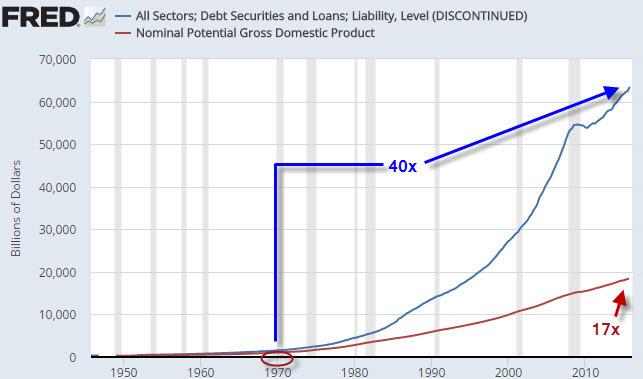
A chart is worth thousand of words: a key chart not enough seen and stared at.......

A chart is worth thousand of words. That's really true!! If anyone can make a good argument that USA is not in very serious debt trouble, I would love to hear it. And remember, the figures in the included chart don’t even include corporate debt. They only include government debt on the federal, state and local levels, and all forms of personal debt. So are they ready to share the debt accumulated burden?
Nobody that I know could write that kind of a check without sweating. The truth is that as a nation USA seems flat broke. The only way that the game can keep going is for all of them to borrow increasingly larger sums of money, but of course that is not sustainable by any definition.
Eventually they're (and us) going to slam into a wall and the game will be over.
One of my pet peeves is the national debt. USA politicians spend money in some of the most ridiculous ways imaginable, and yet no matter how much we complain about it nothing ever seems to change. For example, the U.S. military actually spends 42 million dollars a year on Viagra. Yes, you read that correctly. 42 million of US taxpayer's dollars are being spent on Viagra every year. And overall spending on “erectile dysfunction medicines” each year comes to a grand total of 84 million dollars… According to data from the Defense Health Agency, DoD actually spent $41.6 million on Viagra — and $84.24 million total on erectile dysfunction prescriptions — last year. And since 2011, the tab for drugs like Viagra, Cialis and Levitra totals $294 million — the equivalent of nearly four U.S. Air Force F-35 Joint Strike Fighters. Is this really where US spending on “national defense” should be going? USA figures are nearly 20 trillion dollars in debt, and yet they continue to spend money like there is no tomorrow.......

lunedì 8 maggio 2017

Bill Blain: "Macron Will Prove A Disappointment As Nothing Is Actually Fixed In Europe"


May 8, 2017 5:57 AM
"To summarise the summary: anyone who is capable of getting themselves made President should on no account be allowed to do the job.."
The best thing about the French Election is I've just won a case of very fine French wine on the result! 
The papers and financial blogosphere are full of positivity – France is fixed, therefore the Euro is safe and its all great news. Put yer buying boots on.. And on the back of Friday's very strong US numbers.. don't worry that bonds continue to rally in the face of a likely Fed Hike..
Please.. the only thing good about the French vote is the least bad candidate won.
I question the grand expressions of upside the market is calling for. France has dodged a bullet, perhaps, but they aint solved the crisis – which boils to down to being the wrong economy using the wrong currency and absolutely no control of monetary or fiscal policy to fix it.
Macron has a head full of supply side policy cliches about sorting the labour market, and some catchy soundbites on Franco-German European hegemony – including the sacrifice of a fraction of the bloated state payroll. For all the hype, he's a compromise of compromise candidates.
Lets not forget that fully 12% of the votes were spoilt – meaning a significant minority of Frenchmen made a conscious choice that neither candidate was any good!
I'll make a grand prediction: Macron will prove a disappointment. His lack of power base from which to actually effect long term change across France means we'll get one or other of the Le Pens in 5 years time. 
Although he will no doubt trade on his youth and popularity – don't be surprised if the lustre quickly fades. A number of blogs say he'll quickly build a coalition of the willing.. I doubt it. He's going to struggle to form any kind of working government in the face of the established parties, and hostility from right and left. 
There is also the likelihood the electorate will come to realise the gifted young game-changer is actually as establishment as they come. Don't forget he is the protégé of Jacques Attali -  those of us of a certain vintage will remember Attali as the archetypal enarch - squandering billions on titivating the Glistening Bank (The EBRD) with marble lifts and ego-building offices rather than actually lending. Macron's paid up membership of the discredited French upper class is something a better organised Front Nationale will play to in coming years.
On the upside, the numbers are moving in Macron's direction. The state isn't in the same perilous debt position pre ECB intervention. A wee bit inflation will massage the numbers nicely. There are no immediate risks on the horizon. Unemployment is trending down (slowly), and is likely to boost his popularity.Merkel looks a shoe in for the German Election (very strong showing at the weekend in Danish Germany).  
But, but and but again..
When Europe looks calm and sorted, its not. Nothing is actually fixed.. For all the happy posts this morning about Euro strength, which stocks to buy on the basis of French recovery, and the rest… I doubt it.
From Bill Blain's latest Morning Porridge edition
"To summarise the summary: anyone who is capable of getting themselves made President should on no account be allowed to do the job.."
The best thing about the French Election is I've just won a case of very fine French wine on the result! 
The papers and financial blogosphere are full of positivity – France is fixed, therefore the Euro is safe and its all great news. Put yer buying boots on.. And on the back of Friday's very strong US numbers.. don't worry that bonds continue to rally in the face of a likely Fed Hike..
Please.. the only thing good about the French vote is the least bad candidate won.
I question the grand expressions of upside the market is calling for. France has dodged a bullet, perhaps, but they aint solved the crisis – which boils to down to being the wrong economy using the wrong currency and absolutely no control of monetary or fiscal policy to fix it.
Macron has a head full of supply side policy cliches about sorting the labour market, and some catchy soundbites on Franco-German European hegemony – including the sacrifice of a fraction of the bloated state payroll. For all the hype, he's a compromise of compromise candidates.
Lets not forget that fully 12% of the votes were spoilt – meaning a significant minority of Frenchmen made a conscious choice that neither candidate was any good!

I'll make a grand prediction: Macron will prove a disappointment. His lack of power base from which to actually effect long term change across France means we'll get one or other of the Le Pens in 5 years time.
Although he will no doubt trade on his youth and popularity – don't be surprised if the lustre quickly fades. A number of blogs say he'll quickly build a coalition of the willing.. I doubt it. He's going to struggle to form any kind of working government in the face of the established parties, and hostility from right and left.
There is also the likelihood the electorate will come to realise the gifted young game-changer is actually as establishment as they come. Don't forget he is the protégé of Jacques Attali -  those of us of a certain vintage will remember Attali as the archetypal enarch - squandering billions on titivating the Glistening Bank (The EBRD) with marble lifts and ego-building offices rather than actually lending. Macron's paid up membership of the discredited French upper class is something a better organised Front Nationale will play to in coming years.
On the upside, the numbers are moving in Macron's direction. The state isn't in the same perilous debt position pre ECB intervention. A wee bit inflation will massage the numbers nicely. There are no immediate risks on the horizon. Unemployment is trending down (slowly), and is likely to boost his popularity. Merkel looks a shoe in for the German Election (very strong showing at the weekend in Danish Germany). 
But, but and but again..
When Europe looks calm and sorted, its not. Nothing is actually fixed.. For all the happy posts this morning about Euro strength, which stocks to buy on the basis of French recovery, and the rest… I doubt it.
Although there is apparently nothing to worry about in Euroland anymore – we've still got the festering pustule that is Italy, episode 47 of the Greek Crisis on our doorsteps, and the who knows what coming from the Brexit negotiations. Europe will continue to amuse, fascinate and frustrate..
I don't normally spend my Sundays watching the TV wallpaper paste that passes as "political comment" but as I supped my coffee, one soundbite caught my ear: "the aim of Europe is to ensure the economic collapse of the UK to make clear leaving the EU is never an option."
Oh dear....
Is there a danger the now pointless UKIP decides to establish some convoluted relevance as the force of anti-Europeanism? Sure enough, someone later suggested we should mount a European boycott. If we stop buying French plonk, German cars, Spanish holidays, etc, then that'll teach 'em.
It so happens an American chum of mine was in Yoorp over the weekend and he popped down for dinner last night. As he is an economist of some renown, and a former Scotsman before he went all Yankee on us, I asked his opinion on Brexit and what America thinks. He was succinct: "We don't give a fig. As long as you all play nice and don't break the global economy meaning we'll have to bail it out, we really don't care about Europe and the UK." Nice.. but to the point..
A trade war with Europe and the nihilistic post UKIP politics of aggression would be a very bad idea... If I can't get good European wine, it will inevitably mean drinking more Argentine Malbec.. Not a bad wine, but it's impossible to function properly afterward!

giovedì 27 aprile 2017

"Lo Stato innovatore" di Mariana Mazzucato - la presentazione del libro

27 aprile 2017


LO STATO INNOVATORE

L’impresa privata è considerata da tutti una forza innovativa, mentre lo Stato è bollato come una forza inerziale, troppo grosso e pesante per fungere da motore dinamico. Lo scopo del libro che avete tra le mani è smontare questo mito.
Chi è l’imprenditore più audace, l’innovatore più prolifico? Chi finanzia la ricerca che produce le tecnologie più rivoluzionarie? Qual è il motore dinamico di settori come la green economy, le telecomunicazioni, le nanotecnologie, la farmaceutica? Lo Stato. È lo Stato, nelle economie più avanzate, a farsi carico del rischio d’investimento iniziale all’origine delle nuove tecnologie. È lo Stato, attraverso fondi decentralizzati, a finanziare ampiamente lo sviluppo di nuovi prodotti fino alla commercializzazione. E ancora: è lo Stato il creatore di tecnologie rivoluzionarie come quelle che rendono l’iPhone così ‘smart’: internet, touch screen e gps. Ed è lo Stato a giocare il ruolo più importante nel finanziare la rivoluzione verde delle energie alternative. Ma se lo Stato è il maggior innovatore, perché allora tutti i profitti provenienti da un rischio collettivo finiscono ai privati?

Presentazione del libro di Laterza:
L’impresa privata è considerata da tutti una forza innovativa, mentre lo Stato è bollato come una forza inerziale, troppo grosso e pesante per fungere da motore dinamico. Lo scopo del libro che avete tra le mani è smontare questo mito.
Chi è l’imprenditore più audace, l’innovatore più prolifico? Chi finanzia la ricerca che produce le tecnologie più rivoluzionarie? Qual è il motore dinamico di settori come la green economy, le telecomunicazioni, le nanotecnologie, la farmaceutica? Lo Stato. È lo Stato, nelle economie più avanzate, a farsi carico del rischio d’investimento iniziale all’origine delle nuove tecnologie. È lo Stato, attraverso fondi decentralizzati, a finanziare ampiamente lo sviluppo di nuovi prodotti fino alla commercializzazione. E ancora: è lo Stato il creatore di tecnologie rivoluzionarie come quelle che rendono l’iPhone così ‘smart’: internet, touch screen e gps. Ed è lo Stato a giocare il ruolo più importante nel finanziare la rivoluzione verde delle energie alternative. Ma se lo Stato è il maggior innovatore, perché allora tutti i profitti provenienti da un rischio collettivo finiscono ai privati?
Per molti, lo Stato imprenditore è una contraddizione in termini. Per Mariana Mazzucato è una realtà e una condizione di prosperità futura.È arrivato il tempo di questo libro. Dani Rodrik, Harvard University
Uno dei libri di economia più incisivi degli ultimi anni. Jeff Madrick, “New York Review of Books”
L’economia tradizionale propone modelli astratti; la dottrina convenzionale continua a sostenere che la chiave è nell’imprenditoria privata. Mariana Mazzucato afferma invece che la prima è inutile e la seconda insufficiente. Un libro brillante. Martin Wolf, “Financial Times”
Lo scopo, come dice Mariana Mazzucato, è che lo Stato e il settore privato assumano insieme i rischi della ricerca e godano insieme dei benefici. Teresa Tritch, “New York Times”
Molti governi si interrogano su come incrementare la produttività e l’innovazione. Questo libro fornisce le linee guida per individuare le politiche industriali più efficaci. Robert Wade, London School of Economics
Lo Stato innovatore dimostra punto per punto quanto pensare per convenzioni sia ottuso. Christopher Dickey, “Newsweek”