MARKET FLASH:

"It seems the donkey is laughing, but he instead is braying (l'asino sembra ridere ma in realtà raglia)": si veda sotto "1927-1933: Pompous Prognosticators" per avere la conferma che la storia non si ripete ma fà la rima.


martedì 18 aprile 2017

Are Options Traders Running For The Hills?

Apr 18, 2017 3:00 PM

Fear finally made its way into the equity options market at the end of last week – at least for a day.

After months of (well-documented) investor complacency, recent stock turbulence has begun to introduce some fear back into the market. It has been manifested in the volatility market, as we covered extensively in our Vexing Vix miniseries last week. And after last Thursday’s sharp selloff, fear has now also crept into the options market – at least for a day.
We base this on last Thursday’s reading of the CBOE Equity Put/Call Ratio. Of course, when the ratio is elevated, it is indicative of relatively heavy put volume – and a possible sign of an elevated level of fear on the part of traders. Last Thursday, the reading came in at 0.95. This was just 1 of 3 readings that high over the last 12 months. The other 2 dates happened to be within a day or 2 of the market lows during the Brexit episode and the U.S. Presidential election.


So now that options traders have seemingly headed for the hills, is the coast clear for stock investors? Inasmuch as the coast is ever really “clear” in the markets, we may have to caution investors about getting too giddy based on this data point. For, as we also demonstrated in the the case of the VIX last week, the circumstances surrounding last Thursday’s reading aren’t exactly textbook conditions of a market low.

Specifically, while most readings above 0.94 in the CBOE Equity Put/Call Ratio since the onset of the Bull Market in 2009 have come following a gradual buildup of fear, this was more or less a one-off. As evidence, of the 54 daily readings over 0.94 in the past 10 years, this is just the 5th occurring while the 10-day average of the ratio was less than 0.70. Now, that does not mean that last Thursday’s reading was not a meaningful show of investor fear (witness yesterday’s subsequent big bounce). However, it may make it less likely that a durable bottom is in place, than had it occurred into an already more fearful environment.

Here’s Italy’s Latest Plan B, Where Desperation Meets Insanity

Apr 13, 2017

Selling securities backed by defaulted loans to NIRP refugees.

Nerves are beginning to fray in Italy’s banking sector, as pressure rises on the worst hit banks to remove the most noxious elements off their books — most likely at big discounts that will further impair their balance sheets. On Saturday Italy’s finance minister, Pier Carlo Padoan, begged the ECB for more time for the banks to clean up their act. “We cannot demand that suddenly banks offload their NPLs, because this could be potentially destabilizing, especially if the problem involves several banks in the same banking system,” Padoan told a news conference. By “several banks, ” Padoan means perhaps the 114 banks, of the close to 500 banks in Italy, that have “Texas Ratios” of over 100%. The Texas Ratio, or TR, is calculated by dividing the total value of a bank’s non-performing loans by its tangible book value plus reserves — or as money manager Steve Eisman put it, “all the bad stuff divided by the money you have to pay for all the bad stuff.”
If the TR is over 100%, the bank doesn’t have enough money to “pay for all the bad stuff” and tends to fail. In Italy, 24 banks are estimated to have ratios of over 200%. On Tuesday it was the Governor of Bank of Italy Ignazio Visco’s  turn to plead for more time. “The majority of bad loans are held by banks whose financial position does not require to sell them immediately,” he told European Union lawmakers. One bank that does need to sell its bad loans immediately — originally planned for last year — is the poster-child of Italy’s financial crisis, Monte dei Paschi di Siena. According to a new report by Il Sole 24 Ore, the world’s oldest bank has a new, highly creative plan to save itself from the brink, which is actually an old plan that’s been dug up from the archives and repackaged.
The securitization option is back in the cards for the disposal of €29 billion of non-performing loans at Italian lender Monte dei Paschi di Siena (MPS) – maybe with US investment bank JP Morgan. This will be the strong point of the group’s industrial plan under consideration at the European Commission.
That’s right: the new “strong point” of MPS’ latest self-salvation scheme is to securitize €29 billion of toxic debt and spread it as far and wide as it possibly can, with the help of none other than JP Morgan Chase. In other words, have we finally reached the juncture of Italy’s banking crisis where desperation meets insanity — the insanity of yield-starved investors, those NIRP refugees that have been tortured for too long by the ECB’s negative interest rate policy?
Under this plan, the bank would slice, dice, and repackage non-performing financial assets, such as loans, residential or commercial mortgages, or other  sometimes uncollateralized Italian “sofferenze” (bad debt) into asset-backed instruments which can then be sold to yield-starved gullible investors all over the world. This is riskier than the subprime mortgage-backed securities in the US that played a major role in the global financial crisis.
Now banks, central banks, regulators and governments are talking about allowing the same to happen with assets that are not just at risk of failure but have already failed. In some cases they haven’t generated income for years and in many cases they are personal or business loans that are not backed by any collateral of any kind. The idea is for investors to use the inadequate and slow-moving Italian legal system to collect on this often illusory collateral if any.
The FT describes the idea of securitizing NPLs as “subprime derivatives on steroids,” but only in relation to China’s plans to do exactly the same thing with its own non-performing loans, which according to official figures recently surpassed the $200 billion mark. The FT has been a lot less critical of the same plans being hatched in Italy. Some economists are even calling for an Europe-wide securitization of toxic debt.
As the FT reports, one major hurdle Chinese banks currently face in securitizing their debt is getting rated by the international rating agencies. Not that it’s stopped them. As for banks in Italy, they are less likely to face such a problem.
As part of a deal reached with the European Union in January, 2016, Italian banks can bundle bad loans into securities and buy state guarantees for theleast risky portions, provided those notes have an investment-grade credit rating. So the taxpayer would not only be on the hook for a portion of the NPLs underlying these securities, but also for the fees and profits generated along the way to securitize them.
In the first iteration of this process (depicted in the included  infographic by Deloitte), executed in September 2016, Popolare di Bari got informal approval from PricewaterhouseCoopers LLP and the Bank of Italy not only to remove the entire face value of the bad loans from its books but also to keep the senior portion of its securitization. The result: healthier looking balance sheets while the risks posed by its toxic assets have been shifted elsewhere.
Since then, Italy’s biggest and sole global systemically important bank (G-SIB) Unicredit has joined the party, shedding €17.7 billion of non-performing loans into two separate securitization vehicles, one managed by Pimco and the other by Fortress Investment Group. UniCredit retained minority stakes. The transaction was aptly dubbed Project Fino – as in, everything is just fine.


Observer Warns: "Nothing Has Changed Under Trump... We're Headed For A Major Crisis"

Apr 13, 2017 10:40 PM

When Donald Trump was elected, there was so much optimism among libertarians and conservatives, it was almost palpable. However, it’s only been several months into his first term, and it’s becoming quite apparent that Trump is no savior. In retrospect, it was foolish to think any single person could snap his fingers, and reverse decades of financial mismanagement and political corruption. It was foolish to think that he could dismantle an entrenched bureaucracy that is more powerful than most people realize.

But not everyone was convinced that Trump was going to be able to turn this ship around. Peter Schiff knew that the damage done by the political establishment was irreversible, and that our financial system was living on borrowed time. In a recent interview with Future Money Trends, Schiff explains why Donald Trump can’t stop the inevitable, and how you can crash proof your assets ahead of the economic pain that is coming:

Donald Trump should already be disappointing a lot of people who thought we were going to get change, we were going to make America great again. We didn’t repeal Obamacare, that’s here to stay. Major tax reform is dead. We’re dropping bombs.


I mean it’s the same old same old right? Big government… bigger deficits… more cheap money… keep the air in the bubble. We’re headed for a major major crisis.


As for what that major crisis will be, it’s not what most people would expect. As Schiff points out, it’s not going to be triggered by one sector of the economy, as we saw in during the last financial crash. The crisis is going to emerge with the dollar itself, which Schiff says could cause precious metal prices to soar.Everyone is taking for granted the fact that the dollar is king, but it’s not going to be for long. Not when our government continues to rack up debt like a compulsive gambler; which at this point, doesn’t appear to be changing under Trump.

The dollar is living on borrowed time, literally. And so we just don’t know. It’s like a bomb with a fuse, but we just don’t really know how long the fuse is. The dollar, I think is in a major bubble. I think it is in the process of topping out. I think once it completes this top it’s going down. And I think it’s going to take out the lows from 2008…


…I think it’s going to go down for the count. Because the last time, what saved the dollar was the financial crisis, and that crisis resulted in everybody buying the dollar. But I think the next crisis is not going to be the same crisis that we had in 08. I think the dollar is going to be the crisis. I don’t think it’s going to be a bread and butter financial crisis.


This is going to be a currency crisis. So it’s going to be the US government. It’s not going to be the mortgage markets that’s blowing up. It’s going to be the treasury bond market that’s blowing up. It’s going to be the Federal Reserve that’s blowing up. And this is going to be a major major negative for the dollar, not a positive.

We really don’t know how long that fuse is, but there’s no doubt that it’s been lit. There is a frustrating truism in economics. You can easily predict if something bad is going to happen, but you can never predict when it’s going to happen.

That’s because the economy is built on numbers that are easy to calculate, but it’s impossible to predict how people will react to those numbers. In our case, people don’t want to believe that this economy is built on a house of cards and that their standard of living is in jeopardy. That willful ignorance, that confidence, can keep the show going long after the curtain should have been drawn. However, no amount of confidence can keep an unsustainable system running forever. Eventually, reality becomes impossible to ignore.


Trump doesn’t want to preside over a major decline in our standard of living, but ultimately that has to happen. Because this is the consequence of all this excess consumption that went on before he was president. You know, we sacrificed our future to indulge our past. The future is now the present. We’re here, and it’s time to pay the piper.

Three More Reasons to Worry about the Euro’s Future - From the “Doom Loop” to the Black Hole.

 Apr 9, 2017

“Despite uncertainty over Brexit — formally triggered last week by prime minister Theresa May — central bankers from around the world see the UK as a safer prospect for their reserve investments than the Eurozone, a new poll reveals”.

At first whiff, this may smell counter intuitive. After all, it’s the UK that’s supposed to be in the weaker negotiating position over Brexit terms. It also risks losing a sizable chunk of its core industry, finance. Yet according to a survey of reserve managers at 80 central banks, who together are responsible for investments worth almost €6 trillion, the stability of the monetary union is their greatest fear for 2017.

They have good reasons to worry. Here are three of them:

1. The Doom Loop is Back in All Its Glory.

In fact, it never went away; it was just squeezed into temporary irrelevance by the ECB’s mass purchase of Eurozone sovereign bonds. The biggest beneficiaries are Italy and Spain where banks’ balance sheets are overflowing with bonds of their individual governments — all considered “risk free” for regulatory reporting.

In 2012, Spanish banks held a staggering 32% of Spain’s national debt (excluding regional and local debt). At the end of 2016, that figure had shrunk to 22.7%, or €168 billion. This scheme has kept the doom loop in some form of check, but shoveling as much peripheral sovereign debt as possible from peripheral banks onto the ECB’s books is not a sustainable long-term solution — not when the ECB’s balance has already crossed the €4-trillion mark. That’s the equivalent of 38% of the Eurozone’s GDP, well in excess of the Fed’s 23.7%.

The moment the asset purchases slow, however, the Doom Loop kicks in again, as has happened in the last few months. After the ECB announced that it was paring down its asset purchases from €80 billion a month to €60 billion a month, the purchase by Italian and Spanish banks of their respective national bonds began ticking up again.


When rates begin rising, those same banks will begin bleeding losses from their current holdings of government debt. As a new report by Spanish consultancy firm Analistas Financieros Internacionales (AFI) warns, over 70% of the fixed income assets held on the balance sheets of Spain’s biggest banks are prone to price variations, and in the worst case, the solvency of some banks could be called into question. In Italy, as many as one-quarter of the banks are already verging on insolvency. French banks have very limited exposure to French government debt but they are estimated to hold over €250 billion of Italian bonds.

2. Rising Imbalances.

The financial imbalances in the Eurozone are growing and in some cases have exceeded the crisis levels hit in 2012. The best indicator for this is Target2, standing for Trans-European Automated Real-time Gross Settlement System, which, month after month, has tracked the accelerating capital flight from the region’s periphery (Italy, Spain, Portugal, Greece and Ireland) to the core (Germany, the Netherlands, and Luxembourg).

In March, Italy’s Target2-deficit — the total amount the Bank of Italy owes other national central banks in the Eurozone (mainly Germany’s) — widened by €34 billion to a fresh record of €420 billion. At the height of the sovereign debt crisis in 2012, it was just €290 billion. In Spain things are not much better: in February its central bank owed €361 billion, €25 billion more than at the height of its banking crisis in 2012.

The ECB asserts that record T2 balances are pure accounting values and should be viewed as a benign by-product of the decentralized implementation of QE rather than renewed capital flight. Draghi refers to them even as a form of solidarity within the European system — a way for the core to help fund the periphery.

But in a recent letter to Italian EU politicians the same Draghi maintained that such debts should be settled in full should Italy decide to leave the euro. With Target II liabilities of close to 25% of GDP in Italy and above 30% of GDP in Spain, this poses a double-barreled question: how, and in what currency?

3. A Big (and Growing) Black Hole in EU Finances

If the first two problems are primarily monetary in nature and are exclusive to the Eurozone, the third is purely fiscal and affects all EU countries. At the heart of Brussels’ finances is a growing black hole. At the end of last year itreached €238 billion, up from €99 billion in 2002. This is the so-called reste à liquider, or RAL, which is a stock of commitments at the end of each year that have been made in annual EU budgets, but which are deferred for payment in later budgets.

Even under normal situation, this would be cause for concern. But the EU’s current fiscal situation is anything but normal: the bloc is in the process of losing one of its biggest net providers of funds, the UK. As the German economist Hans Werner Sinn recently put it, “Because the UK is so large, its withdrawal is economically equivalent to the withdrawal of 20 of the smallest EU countries – 20 out of 28, which we have in total.”

Other EU countries will have to pick up the slack. Günther Oettinger, the German commissioner, said as much in February. Those countries include Italy, whose public debt amounts to 133% of GDP, among the highest in the world, and it hasn’t even started bailing out its banks yet. In other words, the people in Italy may have to pay more taxes to Brussels while suffering more austerity, in the process becoming even more disenchanted with the euro project, hardly a strong foundation for a long-term future.

For the Bundesbank, the War on Cash is a war on personal freedom and choice.

venerdì 3 febbraio 2017

NIRP is dying

Markets are suspecting that central banks are in the process of exiting this fabulous multi-year party quietly, and that on the way out they won’t refill the booze and dope, leaving the besotted revelers to their own devices. That thought isn’t sitting very well with these revelers.
In markets where central banks have pushed  government bond prices into the stratosphere and yields, even 10-year yields, below zero, there has been a sea change.
The 10-year yield of the Japanese Government Bond (JGB) jumped 2.5 basis points to 0.115% on Thursday, the highest since January 2016, after an auction for ¥2.4 trillion of 10-year JGBs flopped, as investors were losing interest in this paper at this yield, and as the Bank of Japan, rather than gobbling up every JGB in sight to help the auction along, sat on its hands and let it happen.
And on Friday morning, the 10-year yield jumped another 3 basis points to 0.145%!
In September last year, the BOJ started the now apparently troubled experiment of trying to control not just short-term interest rates but also the entire yield curve. It targeted a 10-year yield of about 0% (it was negative at the time). Analysts believed that this would mean a range between -0.1% and +0.1%, and that if the yield rose to +0.1%, the BOJ would throw its weight around and buy.
But the fact that the BOJ allowed the yield to go above that imaginary line signaled to the markets that it no longer has the intention of capping the yield at +0.1%, that in fact the BOJ has stepped back.
This happened even as BOJ Governor Haruhiko Kuroda, on Thursday, once again was trying to jawbone the markets with a verbal commitment to his yield-curve targeting strategy and his mega-QQE of ¥80 trillion ($710 billion) a year in asset purchases.
The 10-year yield had fallen below zero for the first time on February 9, 2016, as the BOJ began dabbling with its own negative interest rate policy (NIRP), because its zero-interest-rate policy and its mega-QQE bond and stock buying binge somehow wasn’t enough, and because everyone in Europe was doing it. But that’s like so ancient history now (via Trading Economics; red marks in the charts below are mine):


Germany, the second largest NIRP fiefdom, is subject to the ECB’s crazed NIRP absurdity and asset-buying binge that includes government bonds, corporate bonds, covered bonds, asset backed securities, and what not.

But there too, bonds have fallen in price despite the ECB’s purchases, with the 10-year yield emerging from negative la-la land just before the US election and soaring after it. There are now rumors that the ECB will announce sometime later in 2017 the untimely and slow death of QE (via Trading Economics):


Denmark, whose households are the second biggest debt slaves in the world, still has its own currency and therefore its own monetary policy, and therefore its own NIRP. But the 10-year yield only briefly dipped below 0% and has since rumbled higher (via Trading Economics):


And that leaves Switzerland, whose households are the Number 1 debt slaves in the world, as the lone straggler in the 10-year negative yield absurdity, but it too is about to exit.
Its 10-year yield plunged below 0% in January 2015, the first sovereign debt in that maturity to do so, when the Swiss National Bank scuttled its currency cap against the euro, and at the same time cut its benchmark interest rate from -0.25% to -0.75%. It was a day of chaos that those who got tangled up in it will likely never forget. A lot of wealth was transferred, by dint of a central bank decision.
The charts above covered one year because that was the time frame of negative 10-year yields in those countries. But in Switzerland, the story started two years ago hence the five-year chart. On Wednesday, the 10-year yield rose to -0.10%, and on Thursday, it rose further to -0.024%, getting perilously close to 0%, before easing back to -0.04% (via Trading Economics):


In France, the 10-year yield never quite made it into the negative. The French government would like nothing more than to maximize its profits from its debts, which the negative-yield absurdity allows it to do. But it only got within a hair of it in September 2016 when the 10-year yield reached an all-time low of +0.10%. Close, but no cigar.

France, I believe, was the country whose 10-year yield got the closest to participating in the NIRP absurdity without actually making it. Alas, since then, bond prices have tumbled as the 10-year yield has soared over a full percentage point to 1.05% (via Trading Economics):


These 10-year yields are still very, very low at a time when the annual inflation in the Eurozone has shot up to 1.8% and is threatening to tear higher. Financial repression at its finest continues.
In the US, 10-year Treasury prices have also fallen and the 10-year yield has surged by over a full percentage point since last summer. Unlike the central banks in Japan and Europe, the Fed is on a path of raising rates and is also thinking out loud about unwinding its big-fat balance sheet by shedding some of its Treasuries or mortgage backed securities or both.
So it would make sense for US yields to rise. But why are yields in the bailiwicks of the other central banks so jumpy? Because markets smell a rat – as central banks, despite ceaseless jabbering, appear to be sitting on their hands after years of iron-fisted market domination.
But markets have gotten so used to central-bank booze and dope that they “cannot believe” it will ever really end. 


mercoledì 28 settembre 2016

EU Banking Mayhem, One Bank at a Time, then All at Once


Investors are not amused.

The European banking crisis simply doesn't let up. Currently, the big two German banks are grabbing the headlines away from the Italian banks, due to their size and the damage they could do to the global financial system. Other banks are in bigger trouble still, and some have already collapsed, with bailouts and bail-ins getting lined up.

Deutsche Bank had to endure a horrendous Monday after it was leaked on Friday that Merkel had refused to entertain bailing out the bank before the general elections a year from now. Merkel's popularity has gotten broadsided recently, and bailing out bank bondholders with taxpayer money is just not popular at the moment.

Then Commerzbank, in which the government already owns a stake of 16% as a result of the bailout during the Financial Crisis, graced the headlines with leaks that it would lay off 9,000 employees, nearly one-fifth of its workforce. This will cost about €1 billion, according to the sources. To pay for it, the bank will scrap its dividend for 2016 to reduce the bleeding and preserve capital, in what is turning out to be the hellish environment of negative interest rates.

We've been writing about the European banking crisis for a long time, it seems, as it drags on, and meanders from one country to another, and sometimes we write about it in an amused fashion because we've got to keep our sense of humor in all this gloom.

But investors who believed in all the hype and in Draghi's promises and in Merkel's strength and in the willingness of all of them to do whatever it takes to protect bank bondholders and stockholders, and who believed in the miracle of Spain's recovery, and in Italy's new government and what not – well, they're not amused.

For them, it has been bloody. The global financial crisis got swept under the rug. Then the euro debt crisis took down some banks at the periphery, and taxpayers stepped in to bail out the bondholders, mostly, and a lot more things got swept under the rug. But the problems weren't solved. And as the decomposing assets under the rug kept exuding their pungent odor, investors held their nose and played along for a while.

But now it's just getting worse. And investors are wondering what exactly is under these rugs – or maybe they'd rather not know for it's too ugly to behold. And every time someone does look, for example at the Italian banks, they find even bigger problems that have started to metastasize.

This banking crisis has the potential to transmogrify into a financial crisis. All it takes is for one of the big ones to suddenly topple. The flow of credit would freeze up instantly. In an economic system that depends on credit, and whose lifeblood is credit, such an event is a financial crisis.

martedì 27 settembre 2016

I fallimenti di Bce e Deutsche Bank

martedì 27 settembre 2016 

Ha fatto scalpore e sensazione la notizia del vertice bilaterale franco­tedesco organizzato per domani da cui è stata esclusa l'Italia, ennesimo schiaffo dopo la conferenza stampa congiunta Merkel­/Hollande al termine del vertice di Bratislava. Soltanto chi ha creduto alla pagliacciata di Ventotene poteva pensare che fossimo in presenza di un reale reset nelle relazioni intra­europee, che l'asse renano avesse davvero deciso di allargarsi e trattare da pari le "cicale" italiane. Certo, la presenza attiva di Renzi al vertice mediterraneo in Grecia non ha giovato alle nostre relazioni con i partner nordici, soprattutto per l'agenda dichiaratamente anti­austerity di quel meeting, ma non è solo questo il problema: Berlino e Parigi non ci ritengono partner affidabili, né alleati di pari livello. Ci disprezzano, da sempre, pur dissimulando. Il premier Renzi ha glissato, giustamente, sull'argomento, non attribuendogli troppa importanza, ma resta il fatto che gli schiaffi diplomatici e protocollari cominciano a essere un po' troppi e sempre più volgari. Cosa farei se fossi premier io? Comincerei a mettere le cose in prospettiva, ovvero a dipingere i nostri altezzosi partner per ciò che sono: dei falliti. La Merkel sta perdendo ogni elezione che le si pari sul cammino, addirittura umiliata nel suo Land un mese fa e nel suo stesso partito le fronde si sprecano, tanto che gli alleati bavaresi della Csu hanno detto chiaro e tondo che o si cambia registro su immigrazione e sicurezza o alle elezioni del prossimo anno non ci saranno liste comuni di apparentamento. Vogliamo parlare di Hollande, presidente di un Paese che spende il 65% del Pil in spesa pubblica, ovvero un Paese clinicamente morto? Un sondaggio di due settimane fa diceva plasticamente che solo un francese su dieci lo rivorrebbe all'Eliseo, sintomo che forse tutto questo Napoleone 2.0 non lo è. E noi ci facciamo umiliare e dettare l'agenda da gente simile? Ma dove è finito l'orgoglio nazionale? Al vertice di domani saranno presenti tutti i più grossi gruppi imprenditoriali d'Europa e, fino a prova contraria, il nostro Paese è il secondo in fatto di manifattura nell'Ue, la Francia è dietro di noi: come possiamo accettare certe umiliazioni senza colpo ferire? Volete sapere che cos'è in realtà l'Europa con cui si riempiono la bocca i nostri altezzosi partner? Ce lo mostra plasticamente la grafica a fondo pagina, dalla quale scopriamo che quest'anno la Bce ha stampato circa 600 miliardi di euro nel suo programma di Qe, mentre nello stesso periodo il Pil dell'eurozona è cresciuto di soli 31 miliardi: questo significa per ci vogliono 18,48 euro di denaro stampato dal nulla per generare 1 euro di crescita, quindi ogni mese buttiamo via circa 80 miliardi di euro. Ecco la geniale intuizione di Mario Draghi, ecco la formidabile Europa in azione. E dove vanno i soldi "generati" dal Qe? Non certo all'economia reale italiana o francese o portoghese, ma nemmeno al mercato azionario, sempre debole, mentre quello statunitense continua a sfondare nuovi record: la Bce sta davvero servendo gli interessi europei o sta facendo ciò che la Fed non può più fare ufficialmente? È questa Europa da cui ci facciamo dettare le regole, per caso?

È Deutsche Bank la bomba sotto la sedia del capitalismo

27 settembre 2016


Riguardo gli ultimi sviluppi di Deutsche Bank mi pare interessante qualche riflessione che riporto di seguito:

"Ieri il titolo di Deutsche Bank è crollato per l'ennesima volta segnando il minimo storico, ma il governo tedesco ha escluso aiuti di stato. In questo articolo pubblicato da Left a Luglio si anticipavano le difficoltà che la banca tedesca avrebbe incontrato e il conseguente pericolo sistemico per la finanza mondiale."

"da Left del 17 luglio 2016

La fragile situazione del Monte dei Paschi di Siena tiene occupata gran parte della stampa italiana e non solo italiana. Ma mentre le preoccupazioni per il piccolo istituto senese si ingrossano, molta poca attenzione viene dedicata al vero, gigantesco bubbone del sistema bancario mondiale: Deutsche Bank (DB). Nata nel 1870 per liberare i mercanti tedeschi dal predominio della finanza anglosassone, che lucrava sul commercio internazionale del nascente Secondo Reich, dopo quasi un secolo e mezzo di attività è divenuta una delle più grandi banche d'investimento del mondo, comparabile con Goldman Sachs o JP Morgan: 100mila dipendenti in 70 paesi, oltre 1600 miliardi di asset e interessi che spaziano in tutte le direzioni, dalle valute (è la banca leader nel "forex") ai mutui, fino ai derivati. E come vedremo proprio i derivati rappresentano la vera incognita del colosso tedesco.

DB accusa la crisi finanziaria globale del 2008 ma sembra uscirne abbastanza bene, nonostante fosse pesantemente esposta al crollo dei mutui subprime ed una dei maggiori operatori nel mercato delle obbligazioni collateralizzate (CDO). Anzi, come rivelerà un'inchiesta del Senato americano, DB continuò imperterrita a trattare debiti dubbi con i suoi CDO anche negli anni successivi.
I guai grossi per DB però iniziano con lo scandalo Libor, ovvero la manipolazione dei tassi di interesse, che ha coinvolto molte delle principali banche d'affari mondiali. DB viene multata nel 2013 per 259 milioni di euro dalla Commissione Europea e poi per circa 2,5 miliardi di dollari dalle autorità americane e britanniche nell'aprile 2015. Nell'ottobre dello stesso anno DB annuncia una pesante ristrutturazione: taglio del 9% del personale, ritiro da 10 paesi e una pesante sforbiciata alle consulenze. Ma tutto ciò non basta e i titolo continua a soffrire in borsa. La corsa di DB sembra quella di un altleta che, già azzoppato, riceve uno dietro l'altro delle sprangate alle gambe. Solo pochi giorni dopo la maximulta, DB è multata nuovamente dalle autorità americane di altri 257 milioni di dollari per aver lavorato con paesi colpiti da sanzioni. Nel gennaio 2016 DB annuncia che il 2015 è andato molto male, con una perdita di 6,8 miliardi di dollari. Il resto è storia delle ultime settimane. Il 23 giugno la Brexit fa precipitare il titolo di DB che perde l'11% (-45% dall'inizio dell'anno). Il 29 giugno il Fondo Monetario Internazionale definisce DB "il più grande contributore del rischio sistemico" vale a dire la banca più grande e fragile del mondo. E già. Nel marzo 2016 la banca aveva dichiarato un valore "nozionale" dei derivati in suo possesso pari a 52mila miliardi di dollari, una cifra stratosferica grande oltre 13 volte il Pil tedesco.

A questo va aggiunto che la "leva finanziaria" di DB (vale a dire il rapporto tra impieghi e capitale) è pari ad un fattore 40 secondo l'analisi di Berenberg Bank. Il che significa che una svalutazione degli attivi (ad esempio dei crediti inesigibili) pari ad appena il 2,5% azzererebbe il capitale del colosso tedesco. Il giorno dopo, 30 giugno, la Federal Reserve, in qualità di autorità di controllo del sistema finanziario americano, boccia DB agli "stress test", accusandola di cattiva gestione del rischio.

La crisi di DB pare non avere mai fine. Per averne un'idea, le azioni della banca tedesca valevano il 7 luglio 2016 solo 11,7 euro, un decimo rispetto a maggio 2007, prima del tracollo che ha preceduto la "Grande Recessione" mondiale. Attualmente il valore in borsa di DB, una delle più grandi banche al mondo, è circa quello della piccola azienda che ha creato la famosa applicazione Snapchat. E a conferma che la situazione sta divenendo drammatica, proprio il capo economista di DB, David Folkerts-Landau, ha invocato un fondo di 150 miliardi di euro per consolidare le banche europee. Insomma, pensiamo pure a salvare MPS, ma la bomba inesplosa della finanza globale non è certo sepolta sotto Piazza Salimbeni."

lunedì 26 settembre 2016

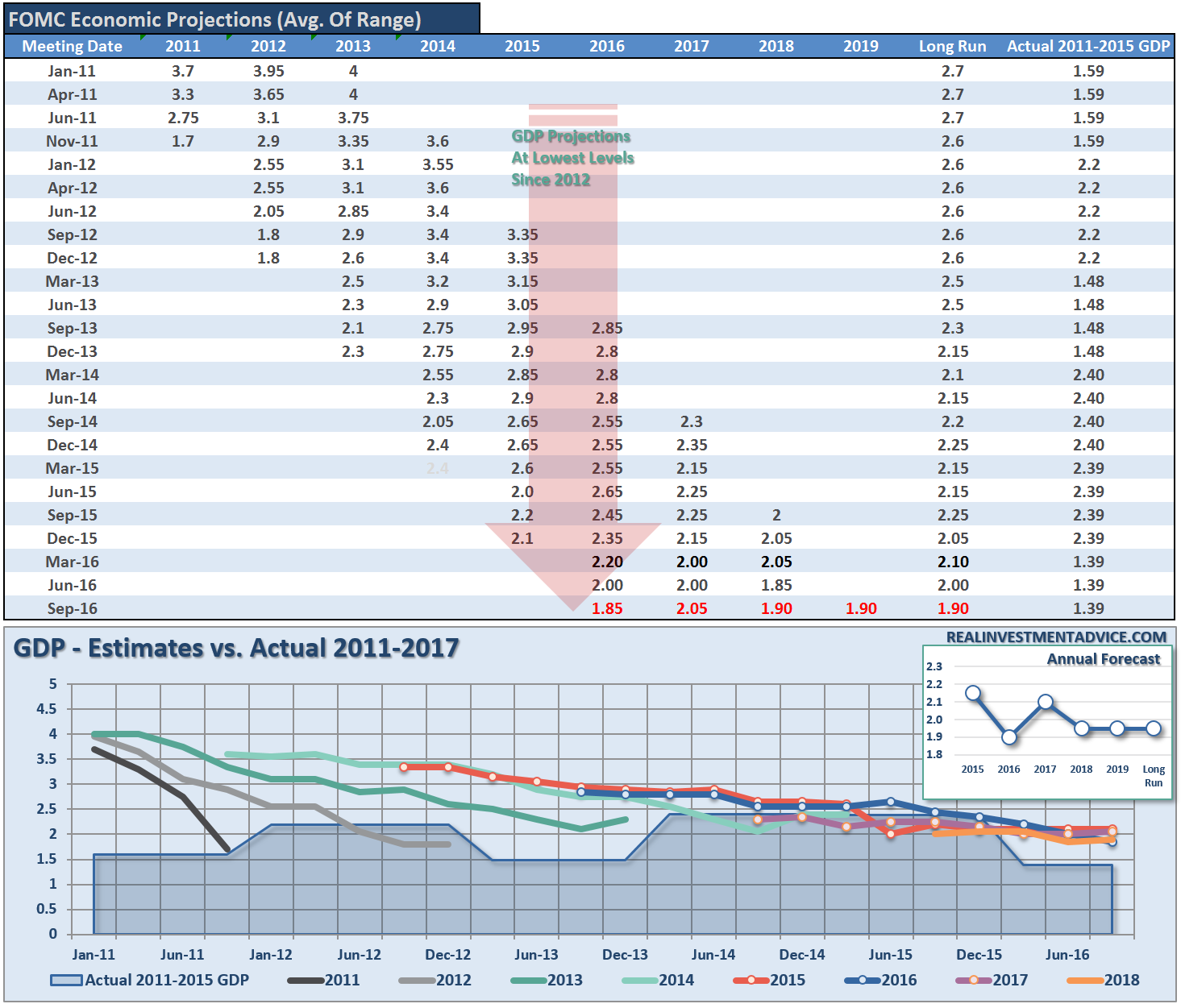
Chart Of The Day: Meet The Worst Economic Forecaster In The World—–The FOMC


Is This Why Deutsche Bank Is Crashing (Again)?

September 26th, 2016

Deutsche's dead-bank-bounce is over. The last few days have seen shares of the 'most systemically dangerous bank in the world' plunge almost 20%, back to record lows as the DoJ fine demands reawoken reality that the €42 trillion-dollar-derivative-book bank is severely under-capitalized no matter how you spin asset values.


Deutsche Bank closes at an all-time record low close...


More questions about DB are appearing, however, as MishTalk.com's Michael Shedlock asks -
Is Deutsche Bank cooking its derivatives book to hide huge losses...

Deutsche Bank's notional derivatives book had huge swings in notional value between its year-end 2014 report and its "passion to perform" year-end 2015 report.

Deutsche Bank did not list the notional value of its derivatives book in its 2016 Quarterly Report.

The bank would like us to take it on faith, that the positive value of its derivatives book is €615 billion while the net positive value of its book is around around €18 billion.

There's just one little problem: the market believes something is wrong. What is it? Derivatives or something else?

Reader Lars writes


Hello Mish,

I'm investigating changes in Deutsche Bank's derivatives book.


At 2014 year end, DB had derivatives which notional value was €52 trillion. The positive value was around €630 billion.


At 2015 year end, DB had derivatives which notional value was €42 trillion. The positive value was around €515 billion on total assets of €1.629 trillion.


So during 2015 derivatives exposure (notional) was reduced by €10 trillion or 19%.


As of June 30th 2016, DB does not give a number for notional value but the positive value has again increased to €615 billion. Total assets are €1.8 trillion.


Meanwhile the the net positive value of DBs derivatives portfolio is stable around €18 billion.


What's Happening?

It is possible that DBs derivatives portfolio has increased in value by €100 billion, roughly 19% in 6 months without the notional amount going up correspondingly?

Did DB offload €10 trillion worth of notional derivatives before year end 2015 only to pad it back later?

Book equity is €67 billion but it's trading at a 75% discount. The market values DB at €16.5 billion.

Tier 1 bond holders say pretty much the same thing. Bonds sell at a 22% discount to par.

Lars

Comments from Matterhorn Asset Management

I was involved in a three-way email conversation on Deutsche Bank with Lars and Egon von Greyerz at Matterhorn Asset Management AG.

Von Greyerz chimed in with …

Thank for this Lars.

I would not be surprised if they are moving balance sheet risk to derivatives. This is a very common trick to reduce official exposure. Greece did this with the help of Goldman Sachs.

Share price confirms something is seriously wrong.

I saw the "Big Short" for the second time on Saturday. It's a great film. I told my wife that what happened in 2007-2009 is a walk in the park compared to what we will see next. It's only a question of when.

Still only 0.5% of world financial assets are insured in the form of physical gold. Investors think that trees will continue to grow to heaven. What a shock they will get.

Kind regards

Egon von Greyerz
Founder & Managing Partner
Matterhorn Asset Management AG
GoldSwitzerland


Accounting Methodology Change

I dove into Deutsche Bank's 4Q/FY2015 Presentation which contained these statements on various pages.
Continued strong de-leveraging in the quarter of EUR 44 billion on an FX neutral basis, principally in derivatives.
Full year 2015 de-leveraging of EUR ~130 billion on an FX neutral basis.
Equity Derivatives significantly lower y-o-y driven by lower client activity exacerbated by challenging risk management in certain areas.
Lower loan loss provisions reflecting portfolio quality and the benign economic environment.
Despite adverse FX impact, non-interest expenses decreased mainly due to lower litigation and performance-related expenses.

De-risking activity was the main driver of Balance Sheet reductions in 4Q2015.

Consolidation & Adjustments


Income before income taxes (IBIT) does not look pretty, to say the least. And what's with these accounting methodology changes?

The Coming Bond Bubble Collapse

September 23rd, 2016

This week, Michael Pento, fund manager explains how the United States is fast approaching the end stage of the biggest asset bubble in history. He describes how the bursting of this bubble will cause a massive interest rate shock that will send the US consumer economy and the US government—pumped up by massive Treasury debt—into bankruptcy, an event that will send shockwaves throughout the global economy:

These are the most dangerous markets I have ever witnessed in my entire life, and I've been investing for over 25 years. Let's go over some numbers to let you know exactly how tenuous this bubble is. Its membrane has been stretched so wide and so tight that it's about to burst, and any semblance of even maybe a little sharp object, something even a hemophiliac wouldn't be afraid of, sends the market careening downward.

Global central bank balance sheets are up from $6 trillion in 2007 to $21 trillion today and they are still being expanded at the pace of $200 billion each and every month. What's happening is that the robotraders, the algorithms, the frontrunners on Wall Street and around the world are just gaming the system, looking for the next increase in central bank credit to take their collateral to the ECB or to the Bank of Japan or to the Fed and buy more stocks and bonds.

That's the game we're playing. Even a hint that it might someday end sends the entire investment community scampering for the door; and that door is very, very narrow and can only fit a few people through it. So let's go through a couple of more data points to emphasize just how big this bond bubble is and why it's so important.

So the European Central Bank is buying corporate bonds. I hope everybody knows that. So much that there's now 30% of investment-grade debt in Europe trading with a negative yield. This is not sovereign debt (as asinine as it is to ever be able as a sovereign nation to issue debt and get paid to do so). Investment grade bonds in Europe now trade with a negative yield.

The Bank of Japan owns 50% of all Japanese government bonds, JGBs.

About 25 percent (and this number vacillates between days where the German tenure goes north or south of the flat line) of global sovereign debt trades with a negative yield.

So what happened on September 8th? Last Thursday, Mario Draghi came out and gave a press conference after leaving rates unchanged in the European Union. The audience was asking questions like: Did you discuss helicopter money? No, we really didn't discuss it. Did you discuss extending the QE program beyond March of 2017? No, we didn't discuss extending the 80 billion purchases of assets beyond March. There was a stirring in the audience, the reporters were beside themselves. They couldn't believe that Mario Draghi, even though he didn't even hint about stopping QE, he didn't extend its duration or its quantity. That sent markets cratering. The Dow fell 400 points. The U.S. 10-year yield jumped from 1.52% to 1.68% in one day.

Now, the market had a bounce back the next day, then was down again more than 200 points on the Dow. So you can tell, anybody with any objective, critical, independent mind can tell this is an unsustainable, very ephemeral rally in stocks that has occurred since 2009. And when the bond market breaks, when that bubble bursts, it will wipe out every asset — everything will collapse together — because everything is geared off of that so-called 'risk free' rate of return.

If your risk free rate of return has been warped down to 0% for 96 months, then everything — and I mean diamonds, sports cars, mutual funds, municipal bonds, fixed income, REITs, collateralized loan obligations, stocks, bonds, everything, even commodities — will collapse in tandem along with the bond bubble burst.

Deutsche Bank: The BoJ is running out of options

September 26th, 2016

The Bank of Japan's recent policy evolution clearly shows that policymakers are running out of options. The BoJ's decision to raise its inflation target beyond 2% and shift from targeting the quantity to the price of money all along the yield curve, reflects a seismic shift in policy at the bank. Unfortunately, this policy change has sent a signal to the markets that the BoJ is running out of options, rather than a proactive shift to new easing — a signal the bank would have preferred to send to financial markets.


The BoJ's shrinking influence and lack of options will lead to further yen strength for three key reasons:

The Bank of Japan is giving up on driving real rates down

By specifically targeting nominal yields the bank is prioritizing financial stability and bank profitability over real rates. In today's world of record low interest rates, central banks have two opposing constraints: keeping real yields low to help the real economy but keeping nominal yields from falling further because they are damaging banks and credit creation.

Policy could lead to a self-fulfilling tightening
The Bank of Japan is relinquishing control of real rates by targeting nominal rates, creating a highly pro-cyclical policy asymmetry. A negative demand shock could raise demand for Japanese government bonds and depresses inflation expectations. In this scenario, the BoJ will end up reducing the amount of JGBs it buys and raising real rates. However, on the other hand, if a huge fiscal stimulus from the government put upward pressure on yields the BoJ would effectively monetize the debt raising inflation expectations even further.

Government invitation for helicopter money

In the past, yield targets have been put in place on sovereign bonds to help finance excessive, one-off spending plans such as wars. By adopting a yield target, the central bank is indirectly funding Treasuries, another form of "helicopter money." By targeting a specific JGB yield, the BoJ is indirectly shifting the onus of a "helicopter drop" to the government. Although Deutsche's analyst believes that until we see more convincing signs of a substantial and credible fiscal easing from the government, the BoJ's inflation target will lack credibility.

The BoJ's policy shift surprised the market initially, but the bank is beginning to lose credibility. Soon after the policy change announcement, the yen gave up most of its gains and started to strengthen, which really shows how little the market trusts the BoJ to hit its targets or reverse the economic stagnation that has plagued Japan for the last two decades.

Monetary policy is at the end of the line

Monday, September 26th, 2016

The last few days have made clear that monetary policy is having less and less impact as time goes along.In particular, the latest salvos from the Bank of Japan smack of desperation, as if BOJ Governor Kuroda has decided to throw everything but the kitchen sink into his grab bag of unorthodox monetary policy. Because the Bank of Japan is so far along the curve toward both secular stagnation and unorthodox policy to counteract that slowing, we should pay attention to how their experiments go. I do not expect good results.

How central banks operate

Let me start off with a baseline on how I think about monetary policy. I apologize if this is a bit wonkish. But I think it's important in understanding why central banks' unorthodox policy tool kits are limited.

The first and main tool in the arsenal of any central bank is interest rate policy. And this is because the central bank is a monopolist. In Japan, for example, the Japanese government is the monopoly issuer of Japanese currency, and has given the Bank of Japan monopoly power as its agent to control the reserve monetary base. The Bank of Japan exercises its monopoly power by targeting the overnight rate for money, currently at zero percent with an added tax on excess reserves to boot.

This is how all modern central banks operate. They have explicit targets or target ranges for the overnight interest rate and act within the reserve market that they control to ensure they hit their targets. The point of course is that modern central banks use a price or interest rate target, not a quantity target like targeting reserves or monetary aggregates. And since a monopolist can only control either price or quantity, not both simultaneously, central banks have to pick one or the other. The Volcker experiment at the Fed in the late 1970s and early 1980s made clear that quantity targets don't work. So central banks target interest rates i.e. price.

Now central banks can't do that unless they supply their banks with all the reserves that those banks desire to make loans at the target interest rate — meaning central banks must be committed to supplying as many reserves as banks want or need in accordance with the lending that they do. Failure to supply the reserves means failure to hit the interest rate target, since banks would bid up the price of reserves above the target.

The transmission mechanism

So how does this help or hurt the economy? First, when an economy is in distress — in recession or headed there — lower interest rates decrease interest payments and help reduce financial distress for the most precarious borrowers. Moreover, other borrowers benefit from lower rates too and are more likely to increase spending because of the increased disposable income. We see that with mortgage refinancing activity in the United States or lower mortgage payments on variable rate loans in the UK, for example.

Moreover, when an economy is in distress, lower base rates help banks by increasing net interest margins through steepening the yield curve. A lower overnight rate means that short-term interest rates are lower relative to long-term interest rates. And that's good for bank net interest margins. That affords banks the chance to build capital buffers. And since banks experience larger loan losses when an economy is in distress and must reserve against those losses, building those buffers is important to banks' willingness to lend as loan loss reserves affect the banks' capital position, which they use as the buffer between assets and liabilities to not only remain solvent but also to make loans. (As an aside, I should also point out that banks are never reserve constrained because the central bank supplies all the reserves banks need in order to hit the overnight interest rate target. They are capital constrained because they can't make loans unless they have enough capital to do so and remain a safe and sound financial institution.)

That's all fine and good. But then economists take it a step further and say that when the central bank lowers or raises interest rates, it raises or lowers demand for borrowing for investment by firms. But this simply isn't true. There is no empirical evidence that lower rates spur capital investment. Even studies by the Federal Reserve note this fact. In fact, as former UBS chief economist George Magnus recently pointed out regarding the Bank of Japan, what really happens with investment as central banks lower rates is that it creates a skew toward high risk investment due to investor's search for higher yield. It's not more investment that we see, but skewed investment toward projects with longer lead times and higher risk. As George puts it, "zombie companies are kept alive perpetuating a misallocation of capital, and retardingnew investment opportunities" (underlining for emphasis added).

What happens when rates are at zero

When the central bank has cut as much as it can i.e. to zero, you've got a big problem. First of all, the central bank can't lower interest rates further to help debtors in distress. It's already as low as it can go. Second, it can't lower them any more to help banks pad their net interest margins because – again – they're at zero. Basically the central bank is stuck. And that's where we  landed everywhere during the most recent financial crisis: in Europe, in Japan, and in the US. The central banks, thus in order to prove their potency, fabricated a bunch of unconventional policy tools they told us were just as good as interest rate policy. And they're using them.

We're talking about:

  1. Forward guidance: where the central bank tells you they will keep rates at zero for longer as a way of keeping long-term rates down too
  2. Quantitative easing (QE): where the central bank buys up financial assets with printed reserve money in order to boost asset prices and maintain lower interest rates. The Bank of Japan is even getting exchange-traded equity funds created to invest in.
  3. Negative interest rate policy (NIRP): where the central bank taxes the excess reserves it has created through quantitative easing in an attempt to make it onerous to have excess reserves in the first place, thinking banks might make more loans than otherwise.
The US has used the first two tools and Japan and Europe have employed all three. Yet growth remains slow, especially in Japan, which has been wracked by deflation for years. So the BOJ has upped the ante this week with two new policies
  1. A higher inflation target: where it has said it would permit inflation to go above its long-term inflation target, in order to get markets to expect higher inflation and, therefore, faster nominal GDP growth
  2. An explicit long-term rate target: where it says explicitly it will not allow the long-term 10-year interest rate to rise above zero, hoping the lower rates in the economy will increase borrowing for investment

It won't work

All of this is destined to fail. And it's clear from the framework I set out to begin with why.

  • Forward guidance and explicit long-term interest rate targets flatten the yield curve and reduce bank net interest margins. That's anti-stimulus. Moreover, lower interest rates reduce savings interest. And since the private sector in every advanced economy is a net receiver of interest, in a normal, growing, non-distressed economic situation, this factor swamps the benefits from relieving financial distress. When the economy is not distressed, net-net lower rates are not stimulative since the private sector is a net receiver of interest. They make it harder to save and could induce more savings and less spending.
  • Quantitative easing is based on quantity target thinking. And we already know that quantity targets don't work.
  • Negative interest rate policy is based on the flawed assumption that banks are reserve constrained when they're not. Nowhere where they have been implemented have negative interest rates resulted in increased lending. They are a tax. And as time goes on, this tax is likely to be passed on to bank customers, reducing aggregate demand.
  • Finally, there's the higher inflation target the Bank of Japan has just set. This won't work either. Just because the Bank of Japan says it is willing to accept higher inflation doesn't mean they will get higher inflation. And higher inflation doesn't mean higher real GDP growth, it could just mean an erosion of purchasing power, which would cause people to retrench.

All of these unconventional policies are poor substitutes for interest rate policy. And the only reason they are being tried is because policy rates around the world are at or near zero. If central banks could cut interest rates and steepen the yield curve, they would. But they can't and they have fallen back on this increasingly desperate set of alternative policy tools.

My view is that in the absence of increases in median wages in advanced economies, we are unlikely to see a meaningful and durable increase in growth in those economies. And the result is going to be not just low short-term interest rates, but low long-term interest rates. When recession hits, yield curves will flatten instead of steepen, since we are at the zero lower bound. And the full measure of loan loss distress will come to bear on bank balance sheets, restricting credit and deepening the downturn. At that point, we will just have to see when and whether we get a fiscal response and how effective that response is. Monetary policy is out of bullets.

sabato 27 agosto 2016

The Stock Market 2015-2016: Ugly Chopfest with an Equally Ugly Megaphone

There's something fishy about this "new all-time highs" rally of 2016.
It's interesting to take a longer-term view of the S&P 500 (SPX). Looking at a 10-year chart, the decline from almost 1,600 to 667 in the Global Financial Meltdown of 2007-2009 doesn't look like that big a deal, given the incredible 6-year uptrend since March 2009.

The boost phase of the rally lasted over 2 years, from 3/09 to 6/11, when the Greek debt crisis caused a temporary swoon in global markets.
Once central banks rescued markets (again), the rally resumed, but beneath the trend line.
This rally ran out of steam in early 2015. The marginal new highs in May 2015 and July-August 2016 are not even visible on this chart.
What is visible is a giant megaphone pattern that targets the old all-time high from 2007 around 1,600. A 600-point drop from 2,200 to 1,600 is of course "impossible" due to the Yellen/Kuroda/Draghi Put, i.e. central banks will buy "whatever it takes" to keep markets elevated forever.
Despite the visible "impossibility" of the SPX ever declining 600 points, that's what the pattern targets.
Even the casual observer is struck by the market's wild yo-yo'ing since early 2015--rather than trace out a definable uptrend, it's been a chopfest of dizzying declines and furious rallies.
This is not characteristic of a powerful Bull market. Rather, it is evidence of a Bull market faltering, eroding and being saved by increasingly outsized and visibly desperate central bank interventions.
$180 billion a month of additional stimulus is now required from the major central banks to keep the market afloat. Yet the returns continue to diminish.
What we have is a Red Queen's Market. The Red Queen's race refers to running fast just to stay in the same place. In a Red Queen's Market, central banks must continually increase their level of stimulus, intervention, jawboning, etc. just to keep the markets in the same place.
There's something fishy about this "new all-time highs" rally of 2016; the declines are deep but the new highs are modest. This is a tired Bull, and a spear tossed from somewhere in the restive crowd could bring it down all too easily.


mercoledì 24 agosto 2016

The Italian Banking Crisis would complete Europe’s “Doom Loop."


Italy's repeated attempts to stave off a full-blown financial crisis and breathe life back into its moribund banking sector can be summed up in four words: too little, too late.
In April, it set up a bad bank vehicle called Atlante that was expected to bail out the country's most troubled lenders as well as allay growing fears of a systemic crisis within the financial sector. With just €5 billion of funds to its name, it did neither.
Cue Plan B, which saw the EU in June grant permission for Italy to use "government guarantees" to create a "precautionary liquidity support program for their banks" worth €150 billion. On the surface it seemed like a lot more money, but in the end it amounted to little more than a PR stunt. The stampede out of Italian banks barely missed a beat.
Finally, at the end of July things got seriously serious with the unveiling of Plan C: a third, much larger rescue deal for Italy's chronically dependent and third largest bank, Monte dei Paschi. The deal involves a consortium of banks, led by JP Morgan, and in a secondary role, Italian investment bank Mediobanca, which will apparently help Monte dei Paschi raise €5 billion in new capital and sell €9.2 billion in bad loans at a deep discount to get them off its books.
As reported, the underwriting fees are going to be extraordinarily juicy, in particular for JP Morgan. For Monte dei Paschi, meanwhile, the impact could be somewhat more muted, especially given the immense difficulties it's likely to face offloading close to €10 billion worth of putrefying debt that nobody wants to touch, as The Economist points out:
As the Distressed-debt investors tend to buy loans in bulk, and hence prefer loans with easily recoverable, tangible collateral. The NPLs of stricken British, Irish and Spanish banks in recent years were largely mortgages: being backed by property, they could be valued from current real-estate prices. British and Irish courts are also pretty efficient at dealing with claims on collateral. Many Italian NPLs, by contrast, are uncollateralised loans to small businesses or consumers. Even when collateral has been pledged, Italian courts are much slower than those elsewhere to recover it.
This may help explain why since the announcement of its latest "rescue" on August 5, MPS' stock – reduced to a penny stock long ago – has plunged a further 8%, from €0.25 to €0.23.
If investors do not believe that even JP Morgan Chase, with the help of an all-star cast of global systemically important, precariously interconnected financial institutions, can sanitize a fraction of the bad debt putrefying on the balance sheets of the country's third biggest bank, then Italy — and by extension, the Eurozone — may have even bigger problems than previously thought. After all, Italy accounts for roughly one third of the Eurozone's estimated €1 trillion worth of non-performing loans.


But that hasn't stopped its banks from continuing to extend dirt-cheap credit to loss-making companies. Perpetual loss-makers such as fashion retailer Benetton and Feltrinelli, one of the country's largest booksellers, continue to receive ridiculously low-interest loans — all made possible, of course, by the liquidity glut conjured into existence by ECB Chairman Mario Draghi's negative interest rate policy (NIRP).
As happened in Japan at the beginning of its so-called lost decade, which to all intents and purposes continues to this day almost 30 years later, instead of biting the bullet and booking losses, large banks in Italy have kept credit lines open to borrowers even when it was clear they had no chance of honoring their obligations.
Where Italy differs from Japan is that it is already well into its second lost decade and the sheer scale of its problems are only just beginning to emerge, having been masterfully masked by an epic expansion of bad debt, which jumped from 5% of banking assets in 2008 (5% being the threshold for sound banking) to almost 20% today.
Yet despite — or perhaps because of — the unconditional generosity of Italian banks to Italian firms, the country's economy continues to stutter. It is smaller today than it was in 2008 and not much larger than in 2000. And according to Enrico Colombatto, a professor of economics at Turin University, the future holds even grimmer prospects:
Growth continues to disappoint and the estimates for 2017 have recently been cut, unemployment is relatively high, investment is stagnant and companies keep going belly up. Furthermore, Italian treasury bonds would be worth much less than their present price if the markets did not believe that, should the need arise, the European Central Bank would step in and bail out the Italian government.
That is precisely what the ECB and the European Commission will end up doing. The alternative is beyond unthinkable: Not only would it mean allowing bank bondholders — including very large foreign banks and hundreds of thousands of Italy small savers — to take a massive hit, potentially sparking a run on bank deposits; it would also trigger the final dreaded phase of Europe's so-called doom loop.
If Italian banks began falling like flies, it would only be a matter of time before investors began selling (or shorting) Italian bonds en masse, by which point the Doom Loop would be in full flow. The more the bond prices fell, the more impaired the banks' balance sheets would become since they hold a big chunk of these bonds. And it would speed up the stampede out of Italian bonds and banking shares. Rinse and repeat, until all that's left is a smoldering husk of a banking system.
The contagion effect would quickly spread beyond Italian shores. The total exposure of French banks to Italian debt exceeds €250 billion. That's triple the amount of exposure of the second most exposed European nation, Germany, whose banks hold €83.2 billion worth of Italian bonds. Deutsche bank alone has over €11.76 billion worth of Italian bonds on its books. The other banking sectors most at risk of contagion are Spain (€44.6 billion), the U.S. (€42.3 billion), the UK (€29.8 billion) and Japan (€27.6 billion).
Which is why, despite principled opposition from certain quarters, the monetary equivalent of the kitchen sink will end up being thrown at Italy's banking crisis. In all likelihood, it too will be too little, too late.
These big banks have every reason to try keeping Italian banks afloat.