MARKET FLASH:

"It seems the donkey is laughing, but he instead is braying (l'asino sembra ridere ma in realtà raglia)": si veda sotto "1927-1933: Pompous Prognosticators" per avere la conferma che la storia non si ripete ma fà la rima.


martedì 21 gennaio 2020

Platts: 7 Commodity Charts To Watch This Week

This week's pick of energy and commodity market trends kicks off with EU biofuels demand prospects and a window of opportunity for Australian crude oil grades. US and European gas market dynamics and Brazilian corn prices are also in the sights of S&P Global Platts news editors this week.

1. Renewables goals boost global biofuels demand

Goldman's Currie Is Watching Three Commodities Themes in 2020

What's happening? In 2020, each EU member country will need to meet specific national renewable energy targets set by the European Commission. One route is to blend more biofuels into road fuels, with more countries adopting E10 gasoline, which contains up to 10% ethanol, twice as much as the current E5 standard. In 2019, the Netherlands became the latest European country to introduce E10 gasoline, following Finland, Belgium, France and Germany.

What's next? In France, E10 sales have now overtaken E5 deliveries. Growth of the E10 ethanol blend have been hindered in Germany by consumer belief that it could harm car performance. Meanwhile, the UK has yet to introduce E10 despite a very ambitious clean energy target, because most fuel stations do not have enough tanks to offer both E5 and E10 simultaneously. The US adopted tier 3 standards on 1 Jan 2020, which means less sulfur in the fuel and lower exhaust emissions of nitrogen oxides. India will move to BS VI specifications which limit the sulfur levels for road fuels to a maximum 10ppm from April 2020. China is implementing Euro 6 equivalent fuel standards and favoring higher levels of ethanol and biodiesel in the blend. The move has been phased in from 2019 and should be completed country-wide by 2022.

2. Aussie crude grades command high premium in IMO 2020 setting
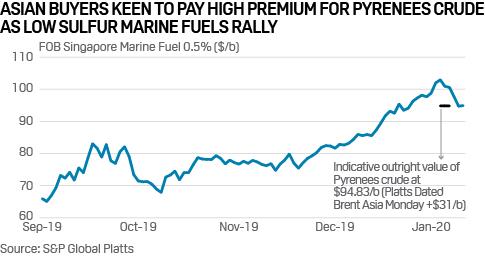
What's happening? Australian heavy sweet crudes including Pyrenees and Van Gogh are widely seen as ideal for blending into low sulfur marine fuels due to the grades' rich fuel oil yield, very low sulfur content and unique specifications such as low pour point and high flash point, industry and Asian refinery sources have told Platts. With demand for low sulfur fuel oil outpacing supply in Singapore, the world's biggest bunkering hub, the price of Marine Fuel 0.5% has spiked by more than 185% month on month, Platts data showed.

What's next? Australia looks set to reap the benefits of the International Maritime Organization's global sulfur cap as the country's heavy sweet crude oil is widely considered one of the best feedstocks for making IMO-compliant marine fuels – and many Asian refiners are willing to pay lofty spot premiums for it. Australian oil and gas producer Santos recently sold a 550,000-barrel cargo of Pyrenees crude for loading over March 4-8 to a Japanese buyer at a premium of around $31/b to Platts Dated Brent crude assessments on an FOB basis, essentially making the Australian oil the most expensive grade in the world. Asian refiners will likely compete for more Australian heavy sweet crude oil, with several cargoes of Van Gogh crude for loading in March up for grabs this week in the regional spot market.

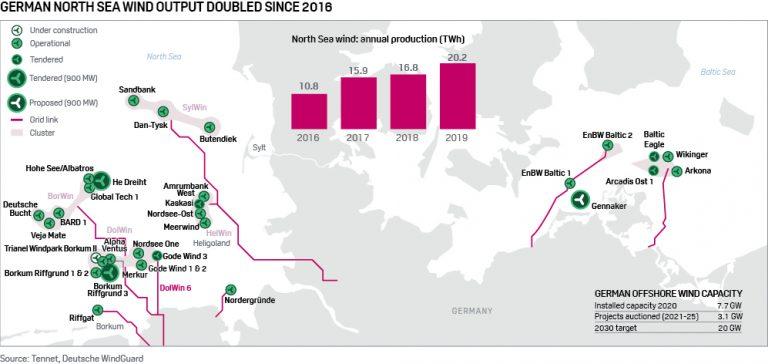
3. German offshore wind stepping up to energy transition plate
Click to enlarge

What's happening?  German offshore wind generation has doubled since 2016, with turbines in the North Sea generating as much electricity last year as two large nuclear power reactors running at baseload. Offshore turbines are playing an increasingly material role in wind's overall ascendancy to the Number One spot in Germany's generation mix. With over 7 GW installed in German waters, project commissioning in the North Sea is set to take a breather until 2022, with the focus switching to Baltic Sea projects.

What's next?  More is being asked of German offshore wind in the longer term. Berlin has upped its 2030 target by 5 GW to 20 GW, to help fill the gap left by nuclear and coal closures. The target is challenging because of grid constraints and reduced offshore acreage availability. One way to counter the grid constraint issue could be to produce green hydrogen at sea or coast. The concept is early-stage but the world's leading offshore wind developer, Orsted, has already bid a joint offshore wind/green hydrogen project into a Dutch auction and is determined to pursue the idea.

4. Specter of negative gas prices looms over Permian Basin…

What's happening? Balance-2020 forwards gas prices at the West Texas Waha hub tumbled to a record low in mid-January as the market outlook for available pipeline capacity exiting the Permian Basin continues to deteriorate. At market close on January 15, the forward curve dipped to its lowest on record at just 49 cents/MMBtu. Shoulder season prices for this year have faced even more downward pressure with the April contract falling to just 7 cents/MMBtu.

What's next? As Permian output continues to build, hitting a record high at 12.4 Bcf/d recently and averaging 11.5 Bcf/d over the past month, market jitters over midstream constraints have reemerged. Concerns about the possible return of negative prices this year were exacerbated following Kinder Morgan's third-quarter earnings call in October when executives announced a three-month delay to startup of the company's 2.1 Bcf/d Permian Highway Pipeline. The pipeline was originally scheduled to enter service in late 2020 but has since been delayed to Q1 2021.

5. …while EU's huge gas overhang limits Ukraine transit

What's happening? Natural gas stocks across the EU are currently at around 77 Bcm – some 18 Bcm above the levels at the same time last year – helping to keep a lid on prices already pressured by warm weather and weak demand. To put that surplus into context, the additional stocks represent only a little less than the total pipeline exports from Algeria – considered a key European gas supplier – to Europe in 2019. Stocks across Europe were built up to record highs by the end of 2019 on fears that Russian gas transit via Ukraine to Europe could be disrupted.

What's next? Withdrawals across the EU have stepped up since the start of 2020 to some 450 million cu m/d as Russian deliveries slumped despite the transit deal. Gazprom itself was aiming to build up more than 11 Bcm in storage in Europe and may be withdrawing that gas rather than flowing via Ukraine to avoid keeping gas in storage any longer than necessary.


6. Ethanol, meat industry keep Brazil corn prices supported
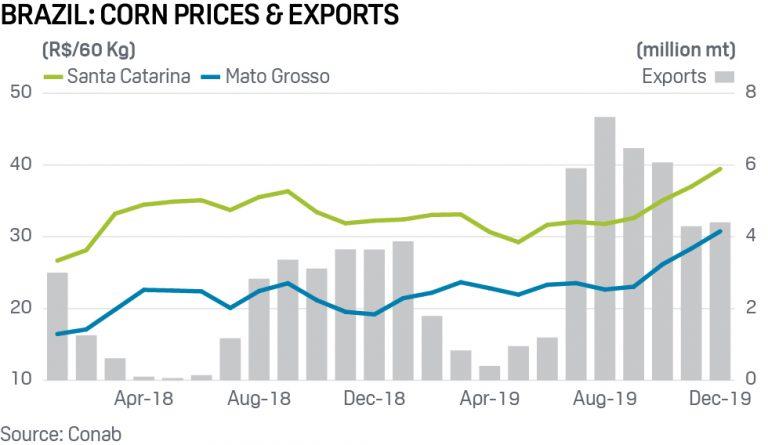
What's happening? Corn prices in Brazil, the world's largest corn exporter in 2019, have risen considerably over the last few months. Mato Grosso, the largest grain-producing state in the country, saw a sharp price increase because of record exports in 2019 and higher consumption by the ethanol industry. The feed industry in southern states also drove up prices as they paid a higher premium for corn to secure food supply for pork and poultry farms.

What's next? Domestic corn prices in Brazil are seen firm as meat exports from the country are expected to rise in 2020 on higher demand from Asia. Higher prices for corn in Brazil, especially in southern states, are likely to force the animal protein industry to buy more corn from neighboring countries. Moreover, higher local corn prices could also reduce the availability of the grain for exports.

7. Renewables focus could expand reach of US cap-and-trade
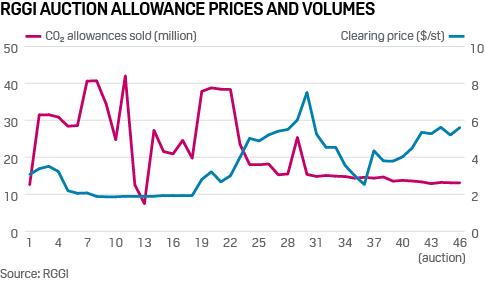
What happening? The Regional Greenhouse Gas Initiative issued the auction notice for the 47th quarterly carbon dioxide allowance auction that will take place March 11. There will be 16,208,347 CO2 allowances for sale, 24% more than the previous auction, with a minimum reserve price of $2.32/st. Plants in RGGI states must purchase an allowance for each ton of CO2 that they emit. Applications must be submitted by January 29.

What's next? As the focus on renewables intensifies in the US and the RGGI market matures, more states are looking to join the regional cap-and-trade program. RGGI states currently include Connecticut, Delaware, Maine, Maryland, Massachusetts, New Hampshire, New Jersey, New York, Rhode Island and Vermont. New Jersey rejoined January 1 after an eight-year hiatus. Other states that could join RGGI include Virginia, whose joining has been postponed, and Pennsylvania, whose governor issued an executive order in October instructing the state Department of Environmental Protection to join RGGI.


Baltic Dry Continues Epic Plunge As IMF Slashes Global GDP Forecast

The Baltic Exchange's main sea freight index hit a nine-month low on Monday, dragged down by falling rates of capesize and panamax segments as world trade continues to slump. 

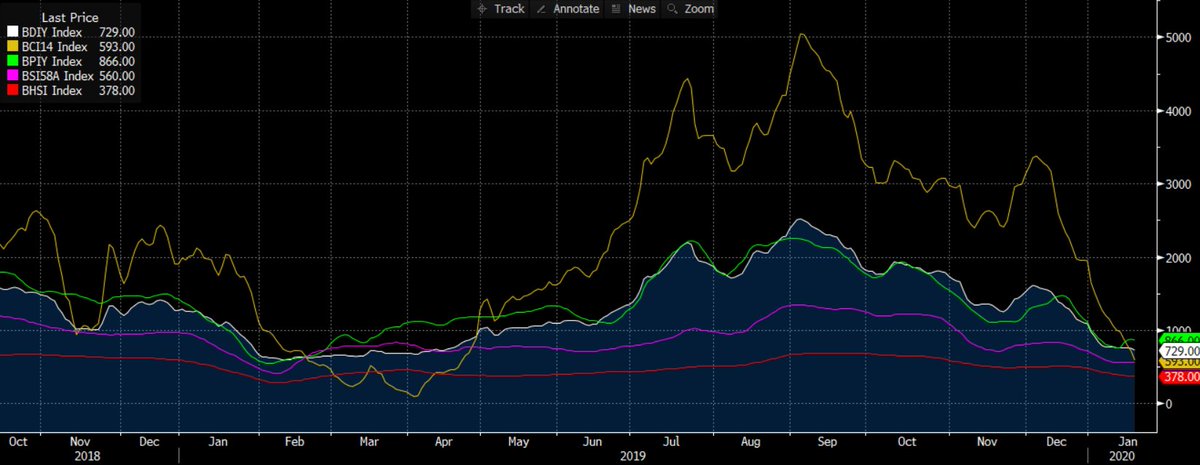
The Baltic Dry Index, which tracks rates for capesize, panamax and supramax vessels that ferry dry bulk commodities across the world, dropped 25 points, or 3.3%, to 729 (according to Refinitiv data), the lowest level since April 2019:

  • The capesize index .BACI dropped 119 points, or 16.7%, to 593 - its lowest since April 23.The index registered its 27th straight session of losses, and also its largest daily percentage loss since early April.

  • Average daily earnings for capesizes, which typically transport 170,000-180,000 tonne cargoes including iron ore and coal, fell $592 to $7,760.

  • The panamax index .BPNI lost 4 points, or 0.5%, to 866.

  • Average daily earnings for panamaxes, which usually carry coal or grain cargoes of about 60,000 tonnes to 70,000 tonnes, declined $39 to $7,791.

  • The supramax index .BSIS remained unchanged at 560 points.

IMF Trims Global Economic Outlook But Tones Down Risk Warnings

We've noted how the "front-loading" effect ahead of tariff deadlines ended in late 3Q19 when the first signs of a trade resolution emerged between the U.S. and China. 

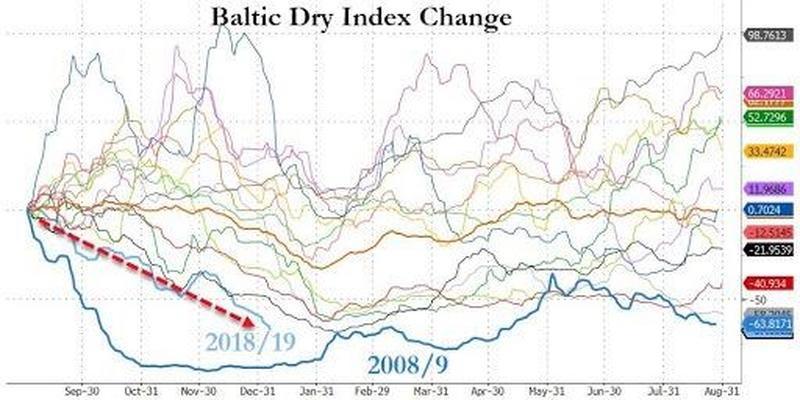
In the last four months, the Baltic index has crashed 70%, the most since 2008, and has confirmed our slowbalisation thoughts.  

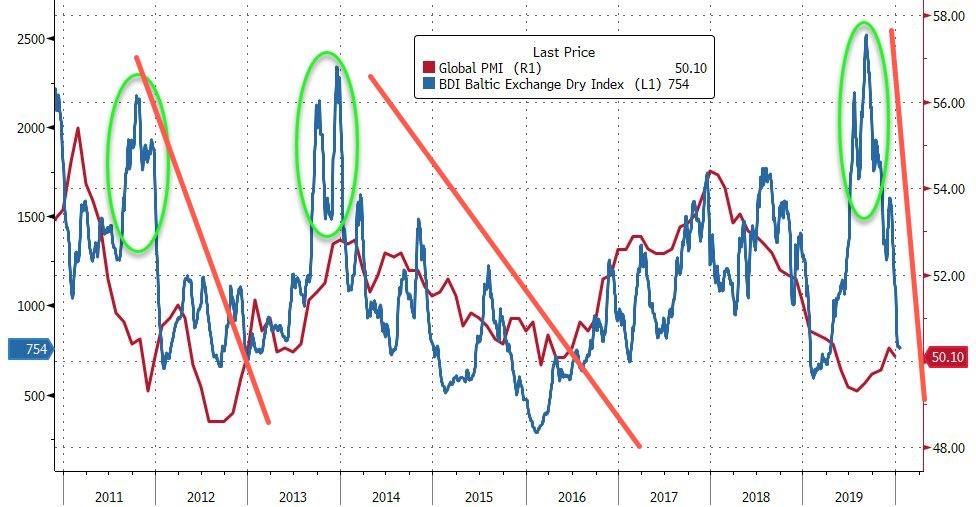
The chart below makes clear that the spike in shipping rates was a one-off event spurred by importers front-running tariffs in 2019, now that is over, shipping rates are plunging as a manufacturing recession in the U.S. deepens and across the world. 

And it was no surprise to us Monday that the IMF slashed the global economic outlook for 2019 to 2.9% in October, the lowest since the financial crisis, and warned that global trade growth is "close to a standstill." 

The Baltic Dry Index is seen as a leading indicator that provides a clear view of the global demand for commodities and raw materials.  

The IMF also downgraded its forecast for global GDP for 2020 and 2021, its sixth straight reduction, although in a sliver of optimism, global GDP in 2020 is now expected to post a modest rebound from 2.9% to 3.3%, (down from 3.4% in October) and to 3.4% in 2021 (down from 3.6%) as the IMF says "there are now tentative signs that global growth may be stabilizing, though at subdued levels."

However, the IMF warned that there are "few signs of turning points are yet visible in global macroeconomic data."

domenica 5 gennaio 2020

U.S. Risks Becoming a Technological Runner-up

America's no.1 futurist George Gilder, fears the U.S. has lost its technological and entrepreneurial edge. China has instead emerged as the next global technological leader. Today Mr. Gilder defends a controversial Chinese company against accusations by The Wall Street Journal, and shows you why the U.S. is in no position to complain.

On Christmas day, overflowing with holiday cheer and bursting with goodwill for all men, I decided I could let pass the latest Wall Street Journal resentful essay against China's emergence as a global leader in technology.

There it sat on the front page, one more egregious slander, this time in the form of a "special report" portraying the telecommunications giant Huawei as a dependency of the Chinese government.

Ah, but it was Christmas and to the intrepid — and far as I knew, merry — gentlemen of the Journal I was content to wish God's rest and the good tidings of the day.

Now, after winging my way back to China, I am feeling a tad less noble about letting the Journal get away with one more entry in a propaganda campaign as absurd as it is dangerous for the U.S.

The basis of the latest charge is a bold venture in investigative journalism — the reporters read Huawei's annual reports and a few other public documents.

Much Ado About Nothing

They came away with the breathtaking conclusion that Huawei received some $1.8 billion in Chinese government grants since 2008 or about $180 million a year on average

For 2019, Huawei's revenues look to come in at around $122 billion. I wonder what they would have done without that $180 million per year.

China, like the U.S., does make grants to firms making progress in key technologies. I would be unsurprised to discover Chinese bureaucrats — who tend to be actual scientists and engineers — do a better job at rewarding actual merit than we do.

Also gravely suspicious to the Journal's merry men were substantial local subsidies in the form of discounted real estate, tax breaks, and even government-built housing for Huawei employees, offered by municipal governments desperate to get one of the world's great companies to locate in their region.

This would never happen in the U.S. where state and local governments exhibit a pristine indifference to where, oh, say, Amazon decides to put down new roots.

But consider the facts. Part of the private sector, Huawei rose to the top by outperforming all the state-owned enterprises, such as ZTE, that previously dominated China's telecom sector.

Its accountants at Price Waterhouse show no exceptional debt or government subsidies. Under staunch entrepreneurial leadership from Ren Zhengfei, son of a "capitalist roader," Huawei is probably more independent than most. It is a multinational with operations in 170 countries and about a third of its executives are non-Chinese.

The U.S. Does the Same Thing

It's a different world. Twenty years ago, I spent most of my time celebrating the entrepreneurial break-throughs of American technology leaders.

I was regularly beset by advocates of central planning buzzing in my ear about how the real credit belonged to DARPA (Defense Advanced Research Projects Agency) which "really" created the technology.

Meanwhile, carped the critics Texas Instruments, which manufactured the first reliable silicon transistors or, Fairchild Semiconductor.

Which in turn invented the integrated circuit and would have gone broke without massive military "subsidies."

That's exactly how they portrayed the military's purchase of never-before-possible electronics that could sustain the stress of flying in jets or rumbling around in tanks.

Certainly, the U.S. military's desperate need for a solid-state helped power the fledgling U.S. semiconductor industry. Entrepreneurs need customers, and well-funded customers demanding levels of previously unavailable levels of performance can be a great spur to creativity.

Nevertheless — in terms of actual products that made it to market or manufacturing processes as fantastic as the devices themselves — the contribution of the U.S. government to the semi-conductor industry was trivial at best and possibly negative.

The Anti-capitalist Chorale 

The anti-capitalist chorale is always with us. In those same old days, the American press and politicians convinced themselves that Japanese government planners were the reason that nation had joined the first rank of industrial powers.

Their solution: we needed more politicians of our own, were we ever to regain our competitive edge. And yet in those years one barely heard a peep from the politicians about China, then still a dreadful tyranny holding the world's record for murders of its people.

Only as China has become capitalist have U.S. politicos and media concluded it is it not a partner in wealth creation but an implacable enemy.

Even my conservative friends — lifelong defenders of capitalism and deriders of central planning — seem to suddenly have decided that in China, central planning and government subsidies work, and brilliant firms like Hua Wei owe all their success to government-controlled banks and bureaucracies.

Critics say the current Chinese model is self-defeating. Less-deserving companies receive most of the financing and opportunities. The staggering misallocation of capital is only worsening, they say.

But the misallocation of capital in the U.S. is far greater. We are subsidizing useless wind mills across the country in a demented campaign against delusions of climate change. We have devastated and paralyzed our companies with lawsuits. We suppress manufacturing with lawyers and luddites. We are now moving on to tie down our social networks and high-tech goliaths with regulatory chains.

By contrast, the Chinese built 106 new cities, most of them viable. They continue to open new "free zones," such as the 13,000-square mile island of Hainan in the South. They are favoring an efflorescence of high-tech ventures and promoting new industries such as AI and blockchain.

Unlike in China, where IPOs and high technology startups have boomed, the government sector in the U.S. has been growing far faster than has the private sector. U.S. politicians and journalists should halt their increasingly outlandish efforts to blame China for the effects of our own mistaken socialism, mercantilist trade war, educational and monetary manipulations.

The U.S. Risks Becoming a Technology Runner-up

Meanwhile, I've been focusing on the titanic and widely underestimated technical challenge of 5G networks. High-frequency transmissions at high power across a range of competing channels are the nightmare of telecom engineers — and the absolute requirement of 5G.

Neither this challenge, nor that of realizing artificial intelligence's full potential, or creating the inherently secure internet, can be fully met by the U.S. alone. We need all the brains and all the entrepreneurial energy in the world.

U.S. politicians without the slightest grasp of this challenge are trying to isolate China from the rest of the world. As the world realizes that it needs China more than it needs us, it is the U.S. that may be cut off.

And it's the U.S. that risks being reduced to a technology runner-up.

I, Who Vowed to Never-Ever Short Stocks Again, Just Shorted the Entire Market

The setup is just too juicy.

In my decades of looking at the stock market, there has never been a better setup. Exuberance is pandemic and sky-high. And even after today's dip, the S&P 500 is up nearly 29% for the year, and the Nasdaq 35%, despite lackluster growth in the global economy, where many of the S&P 500 companies are getting the majority of their revenues.

Mega-weight in the indices, Apple, is a good example: shares soared 84% in the year, though its revenues ticked up only 2%. This is not a growth story. This is an exuberance story where nothing that happens in reality – such as lacking revenue growth – matters, as we're now told by enthusiastic crowds everywhere.

Until just a couple of months ago, the touts were out there touting negative interest rates soon to come to the US and thus making stocks the only place to be. Those touts have now been run over by reality. Now they're touting QE4 by the Fed, or whatever. And people were looking for any reason to buy.

The unanimity of it all was astounding. I've seen this before, but not in this magnitude.

And there is this: As stocks were surging over the past few months, investors with large gains who wanted to sell didn't sell before year-end in order to defer that income for tax considerations. So there was reduced selling pressure from that group that would have liked to sell, and that will sell after the new year starts.

So I shorted the stock market today, December 30 – me who is on record of saying repeatedly that I would never ever short anything ever again, after the debacle of November 1999 when I shorted the most obviously ridiculous Nasdaq high-fliers a few months too early. They collapsed to near-zero, but not before ripping off my face.

But I changed my mind. The setup is just too perfect. A year ago, on December 22, 2018, as stocks had been plunging, I wrote, Nothing Goes to Hell in a Straight Line, Not Even Stocks. That turned out to be true – practically nothing goes to hell in a straight line. I expected a bounce. I didn't expect that the bounce would be this huge. But now it's part of the setup for shorting the market.

  • I sold short the SPDR S&P 500 ETF Trust [SPY] the biggest and most liquid ETF tracking the S&P 500 index. It's up nearly 29% in 2019, from already wildly overvalued levels a year ago, despite the drop it had gone through.
  • And I sold short the Nasdaq 100 Invesco QQQ ETF [QQQ], which tracks the NASDAQ 100, the largest most liquid tech-focused ETF. It's up 42% in 2019.

I have spoken out against shorting because the risk-reward relationship is out of whack. If you short individual stocks, the maximum gain if the shares go to zero is 100%, while the maximum loss is theoretically unlimited and can easily exceed the entire value of the bet. And betting against stocks by buying put options leads most investors to pay the premium and watch those options expire worthless.

The only way you can short stocks and make money reliably is if you have a large megaphone that is closely followed by algos, traders, and the entire financial media. You quietly take your short position in a stock and then announce it, and algos and traders react, and the shares plunge. That's the only reliable way to make shorting work.

My little website isn't followed by algos and can't move markets or stocks or anything else, and that's a good thing. I can say whatever I want, and nothing big happens as a result of it.

Shorting is socially frowned upon. It's like you're willfully trying to destroy people's constitutional right to the pursuit of happiness. Back in 2017, NYSE Group President Tom Farley, famously told Congress, "It feels kind of icky and un-American, betting against a company."

But I still won't short individual stocks because they can get too crazy – especially Tesla, one of the most obvious shorts with an enormous amount of short interest outstanding. This in itself is practically a guarantee the stock cannot crash because short sellers become buyers to take profits when the price drops enough, and they put a floor under the shares. And the massive short interest makes TSLA prone to violent short-covering rallies.

This stock is a prime example of how crazy the market is. In the US, there were fewer new vehicles sold in 2019 than in 2000. Similarly, in Europe and in Japan. Even formerly booming markets, such as China and India, have now hit the skids in auto sales. For growth, every automaker needs to take market share away from other automakers – a tough game in a no-growth environment.

Tesla's revenues fell 7.3% year-over-year in the third quarter, a steeper decline than the revenue declines at other US automakers.

At $412 a share, Tesla is valued at $75 billion. This is over three times 12-month revenues ($24 billion).

GM is valued at $52 billion. This is just 0.36 times 12-month revenues ($144 billion). By this measure of the price-to-sales ratio, Tesla, if it ever becomes profitable on an annual basis, is overvalued by a factor of 10 compared to GM.

GM at this price is still a sell, in my view. As for Tesla, in the optimistic scenario that it makes an annual profit of $1 billion, it's shares would have to drop to $41 before they're on the same level of overvalued as GM, and both would still be a sell at those levels.

So Tesla at the current price is one of the most obvious shorts in history. But I wouldn't short the shares because they're just too crazy, and because the short is too obvious.

Given how eagerly investors are betting on a big plunge, deeply out-of-the-money Tesla put options carry a big premium. For example, one contract (representing 100 shares) that expires in January 2021, with a strike price of $290, which is about 32% below today's share price, traded today at $2,625 — another sign that Tesla has become one of the most obvious shorts out there. And that takes it off the table for me.

In terms of my SPY and QQQ short positions: they're trades, not a prediction of where the market will be a year from now. They represent my expectations that the market will drop enough to make this worthwhile over the next few months.

If this math is successful, and I cover those shorts with a gain, it doesn't mean that I therefore turned bullish on the market. On the contrary. In the larger scheme of things, stocks would have to tank a whole bunch more before I'd take a buy-and-hold position in the overall market. Happy New Year!

"Our Entire Society Is Mentally Ill" - Notes From The Edge Of The Narrative Matrix

Start over in the new year. Also, start over at any other time during the rest of the year, whenever you want, as often as you like. Time is an illusion anyway.

I cannot assure you that things will get better in the '20s. I can't assure you that they'll get worse, either. What I can absolutely guarantee is that things are going to keep getting weirder and weirder. At this point in time the only reliable pattern is the disintegration of patterns.

The mainstream worldview isn't mainstream because it is more fact-based, logical, or makes better arguments than other potential worldviews, it's mainstream because vast fortunes are poured into keeping it mainstream.
"Why do those people hate us?"
"We destroyed their country."
"We should leave the Middle East then."
"We can't"
"Why not?"
"Israel."
"What about it?"
"Those other countries hate it."
"Why?"
"It destroyed the country it was built on top of."
"Well maybe we and Israel should leave, then?"
"Nazi."
The empire's overall strategy toward Iran seems to be to crowd the area with an increasingly intrusive military presence, then react disproportionately in "self defense" when anything happens. It's like an older sibling's "I'm not touching you" car ride teasing, but with an entire region.
Not hearing any urgent concerns about that horrible horrifying epidemic of antisemitism that was pervading the Labour Party anymore. I guess they all stopped being antisemites all of a sudden.

"You defend Assad!" No I don't, idiot. I attack the US-centralized empire for pouring billions and billions of dollars into actual terrorist groups in Syria with the goal of effecting regime change, causing hundreds of thousands of deaths. I don't play defense, I play offense.
I'm still tripping on how the latest WikiLeaks drops are getting literally zero mainstream media coverage, and yet people on the internet still get mad at me for writing about them. Even one indie blogger talking about these authentic documents is unacceptable to some people.

Everyone involved in getting the OPCW leaks out did the right thing but the MSM. The inspectors did the right thing, the whistleblowers did the right thing, WikiLeaks did the right thing… then the media refused to report it and gave control of the narrative to fucking Bellingcat. The facts are right there online right now, staring us all right in the face, but because coverage is being suppressed and the conversation controlled, I have people in my social media notifications at this very moment regurgitating old establishment Syria narratives as gospel truth.
Imagine living in Nazi Germany and only ever talking about Jim Crow laws in the American south. That's what it's like when people who live in the US-centralized empire focus on the alleged misdeeds of non-aligned nations.
Our entire society is mentally ill. What our mentally ill society labels "mental illness" is actually just a small slice of the broader mental illness spectrum — those who are impaired in their ability to participate in the consensus mass delusions shared by the rest of society.

Sometimes I can only stop and stare slack-jawed at all the extreme hate and vitriol that gets directed at anti-imperialists online. I mean, you'll get called all sorts of names, get called evil and a monster, for advocating peace. PEACE! Really shows you the power of propaganda.
Mentally mute the narrative soundtrack about Obama changing things after Bush and Trump presenting a radical deviation from all US norms, and what you see is a government continuing along pretty much the exact same trajectory with only cosmetic changes between administrations. World minus narrative is night-and-day different from world plus narrative.

Wars aren't good vs evil; usually they're geostrategic agenda vs geostrategic agenda. But Hollywood always portrays war as good vs evil, which is why empire apologists always bleat "You're saying Dictator X is a Good Guy!" whenever you oppose interventionism in X targeted nation. Without that conditioning by professional storytellers, it would never occur to us to try and find the "good guys" in the chaos of a military conflict. We're trained to think there must be a Good Guy and a Bad Guy, and that if a side isn't one then they're the other.

Capitalism is literally a game. It's based on completely made-up rules with a completely made-up points system just like any other game. The only difference between this game and the others is this one gets taken so seriously that losing can kill you in real life.
Arguably the only people who actually truly understand the highly unscientific and completely made-up field of economics are those who manipulate the economy for their own benefit. And they only understand it because they're the ones authoring its self-fulfilling prophecies.


Sometimes it's funny to think about how humanity fought two world wars for basically no reason. World War 2 sprung directly from the effects of World War 1, and hardly anybody can give a coherent explanation for why World War 1 happened. Certainly nobody can justify why World War 1 was necessary. Our species fought two world wars (or arguably one world war with a long intermission to grow more troops) for no justifiable reason at all.
Keep paying close attention to Syria. I know they're saying "Assad won" and there's a lot of other stuff going on in the world, but the battle for narrative control over Syria is hotter than ever and we're going to see even more information emerge to discredit the imperial press.
"I hope those folks in Hong Kong and Iran obtain democracy like we westerners have. Lemme log off this search engine algorithmically stacked toward billionaire CIA-tied media and ponder whether I want Donald Trump or Joe Biden to continue the wars and oligarchic exploitation."
It can be fun to debate political and ideological solutions to humanity's problems. Also, it's worth noting that every one of those problems would disappear very quickly if we all just stopped taking our own mental chatter so seriously.