MARKET FLASH:

"It seems the donkey is laughing, but he instead is braying (l'asino sembra ridere ma in realtà raglia)": si veda sotto "1927-1933: Pompous Prognosticators" per avere la conferma che la storia non si ripete ma fà la rima.


martedì 31 dicembre 2019

The Hour Is Getting Late

So here we are in Year 11 of the longest economic expansion/ stock market bubble in recent history, and by any measure, the hour is getting late, to quote Mr. Dylan:

So let us not talk falsely now
the hour is getting late
Bob Dylan, "All Along the Watchtower"


Sony Says Image Sensor Demand Outstripping Supply


The question is: what would happen if we stop talking falsely? What would happen if we started talking about end-of-cycle rumblings, extreme disconnects between stocks and the real economy, the fact that "the Fed is the market" for 11 years running, that diminishing returns are setting in, as the Fed had to panic-print $400 billion in a few weeks to keep this sucker from going down, and that trees don't grow to the troposphere, no matter how much the Fed fertilizes them?

When do we stop talking falsely about expansions that never end, and stock melt-ups that never end? Just as there is a beginning, there is always an ending, and yet here we are in Year Eleven, talking as if the expansion and the stock market bubble can keep going another eleven years because "the Fed has our backs."

Take a quick glance at the chart below of the Fed balance sheet and tell me this is just the usual plain-vanilla, ho-hum, nothing out of the ordinary Year 11 of a "recovery" that will run to 15 years and then 20 years and then 50 years--as long as the Fed panic-prints, there's no end in sight.

So after 9 years of "recovery," the Fed finally starts reducing its balance sheet, peeling off about $700 billion over the course of 18 months.

Nice--only $3 trillion more to dump to return to the pre-crisis asset levels of less than $800 billion. In other words, the Fed's "normalization" was a travesty of a mockery of a sham, a pathetically modest reduction that barely made a dent in its bloated balance sheet.

Knock a couple trillion off and we'll be impressed with your "normalization."

But wait--what's this panic-printing expansion of $400 billion practically overnight? Is this just your typical "mid-cycle adjustment" in Year 11 of a 25-year expansion / stock market bubble? Or is it an "early cycle adjustment" because the Bull Market Bubble will run 50 or 100 years without any pesky recessions or crashes?

After 11 years of "the Fed is the market" expansion, the Fed has now reduced its bloated balance sheet by 6.7%. This is normal, right? Just your typical "mid-course adjustment," right?

Clearly, we can't stop talking falsely now because acknowledging the precarious state of the expansion and bubble is too dangerous: merely acknowledging reality might trigger a collapse.

But really: if everything is nominal, why did the Fed respond to an unannounced financial crisis with such panic? Why panic-print over $400 billion in a few weeks if everything is running hot and true?

Do your own analysis of this chart, but please stop talking falsely about how much longer this can run on Fed panic-printing: the hour is getting late.


Dallas Fed Contracts For 3rd Straight Month, Confirming Regional Survey Slump

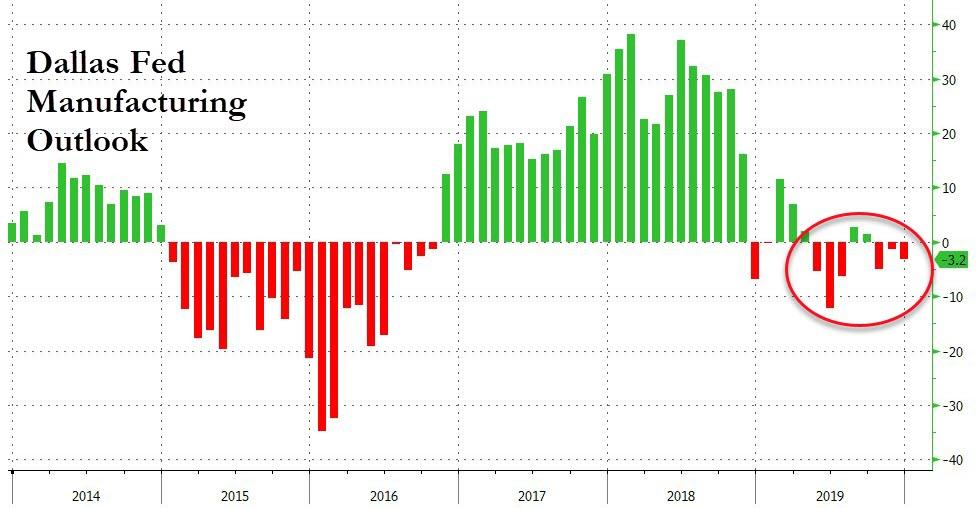
Against expectations of a rebound to 0.0, The Dallas Fed Manufacturing Outlook survey disappointed in December, sliding from -1.3 to -3.2 - in contraction for the 3rd straight month...

The Dallas Fed survey has been in contraction for 7 months this year...

Source: Bloomberg

Fed's Kaplan Sees Risks to Outlook as 'Fairly Balanced'


Under the hood was just as unimpressive with New Orders Growth rate contracting and Finished goods contracting along with the six-month outlook dropping further.

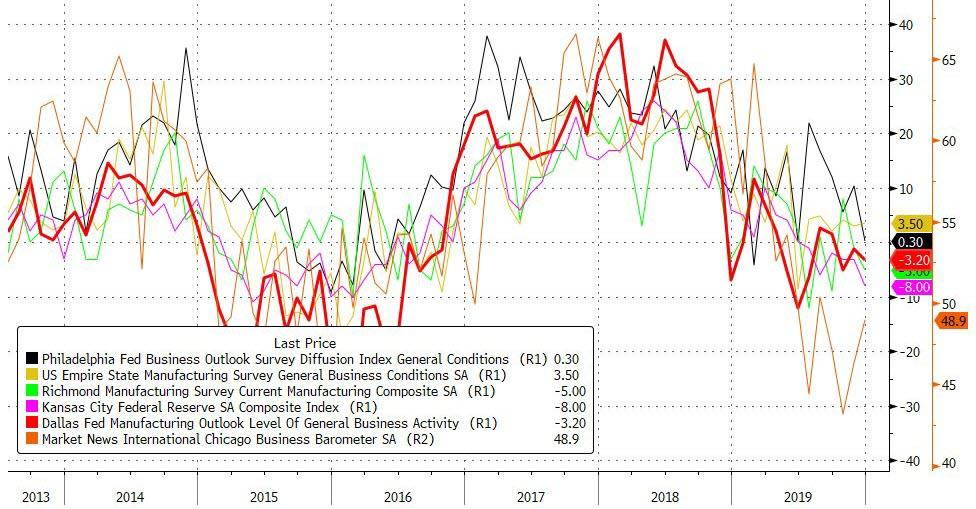
Dallas joins, Philadelphia, Kansas, Chicago, and Richmond in their regional weakness in December..


Source: Bloomberg

But, but , but, The Fed is on hold!?

Yardeni Warns 20% Pullback Could Strike Early Next Year

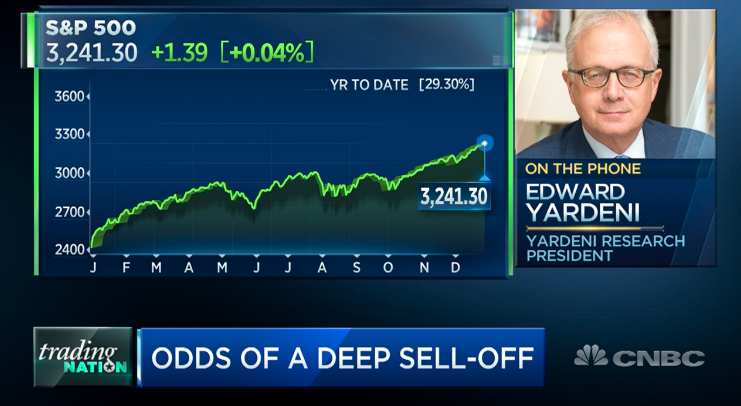
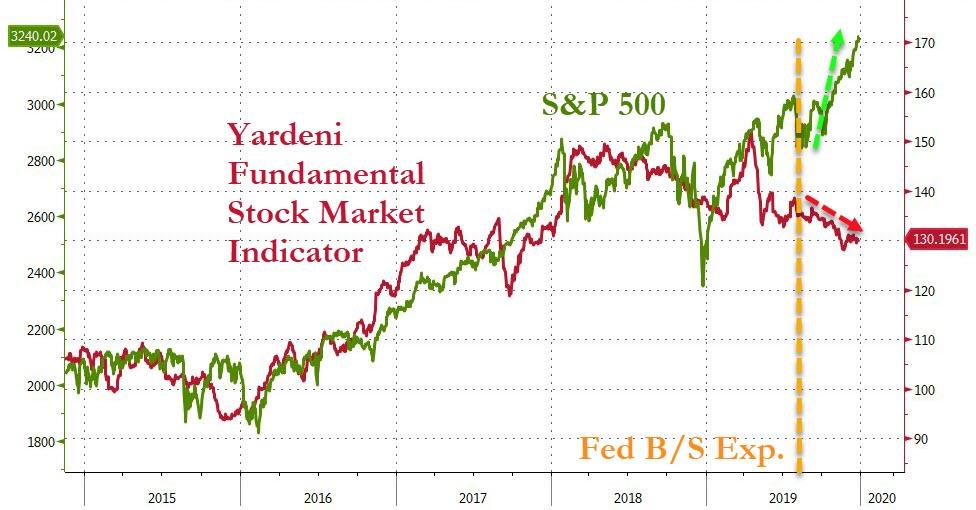
Veteran Wall Street strategist and Yardeni Research founder Ed Yardeni told CNBC on Friday that the stock market melt-up could run into exhaustion because valuation multiples are getting too rich.

"I'm concerned about a possible melt-up here," Yardeni said. "I've been shooting for 3,500 for the S&P 500 by the end of next year, and we're getting closer. Faster than I would have expected."

He warned: ″[A] 10% to 20% [correction] would be quite possible if this market gets to 3,500 well ahead of my schedule." 

Yardeni said he's concerned about the market's latest melt-up and how everyone isn't worried anymore. 

"This is not a cheap market," Yardeni said. "In early October, I looked around and said, 'you know, maybe there's some value overseas. So maybe you really got to look at emerging markets.'" 

Several months ago, Yardeni sounded more carefree, appearing on CNBC to discuss his 2020 year-end S&P 500 target of 3,500 (about 8% higher from Monday morning prices). 

In Nov., he warned valuations might have finally become stretched to the point that dangerously rapid "melt-ups" to new ATHs could prove destabilizing. 

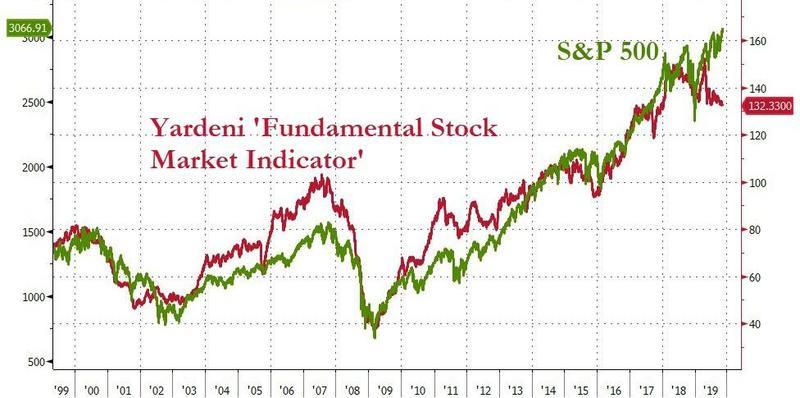
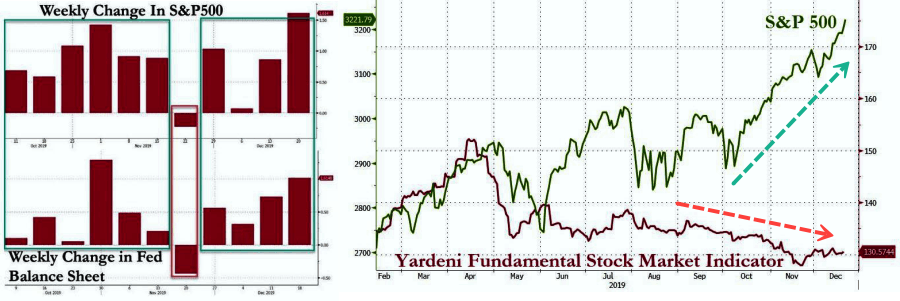
He also said that if the S&P 500 forward earnings multiple hits 19 or 20 (compared with roughly 17 right now, which is above the long-term norm of 15-16), investors could risk sparking a "nasty correction." However, Yardeni focuses on forward earnings in his interview; his propriety Yardeni fundamental indicator is also beginning to reflect euphoric sentiment.

A close-up suggests why the decoupling occurred...


The surge of liquidity via the Federal Reserve's NOT 'Quantitative Easing' has been responsible for the market rising every single week since the program was activated, despite collapsing fundamentals. 

Yardeni warned he wouldn't be buying US stocks at the moment and said wait for the next pullback. 

lunedì 30 dicembre 2019

Visualizing Key Commodities & Energy Themes In 2019

In a volatile year for commodities and energy, S&P Global Platts' news, pricing and analytics teams explored many of the biggest themes and trends through infographics. Here are a selection.

Tariff disputes weigh on commodities trade

After around two years of trade tensions between the US and China, S&P Global Platts analyzed the impact on global product flows.


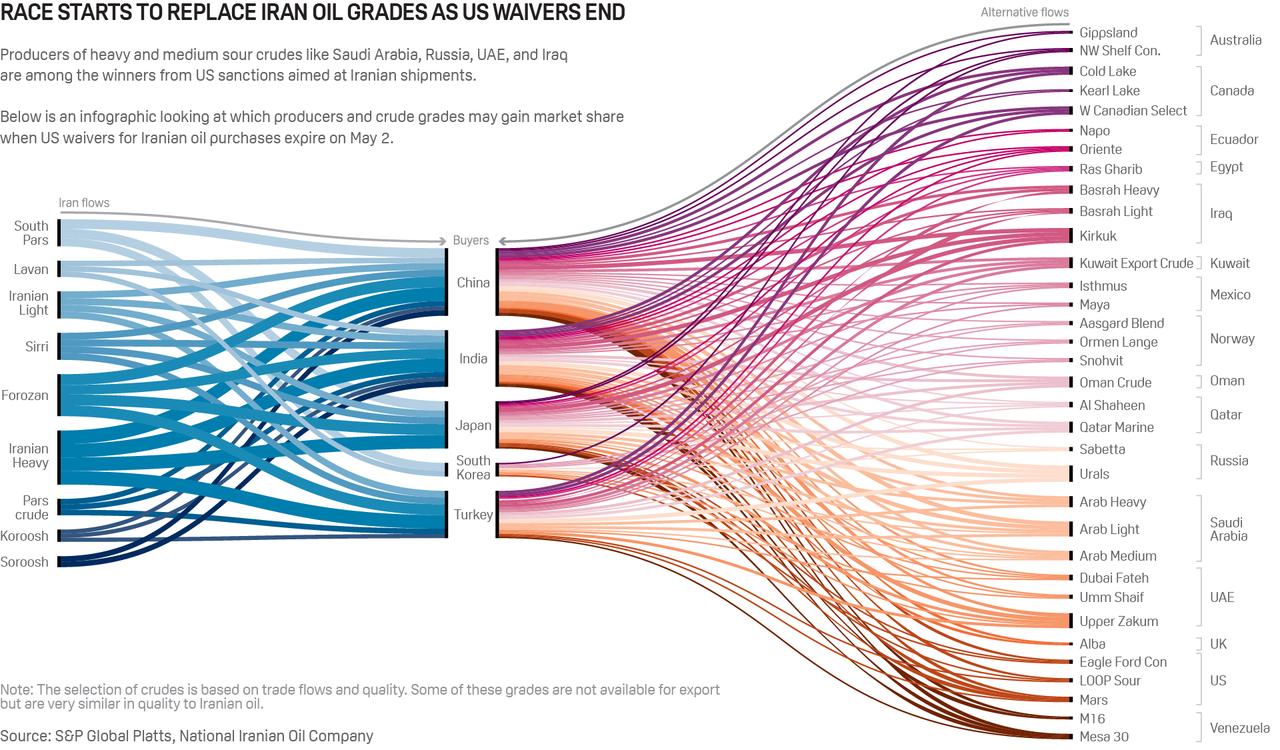
How to replace Iranian oil?

After US sanctions on Iran tightened with the non-renewal of waivers for oil importers, there were still plenty of options on the table to replace specific Iranian crude grades.


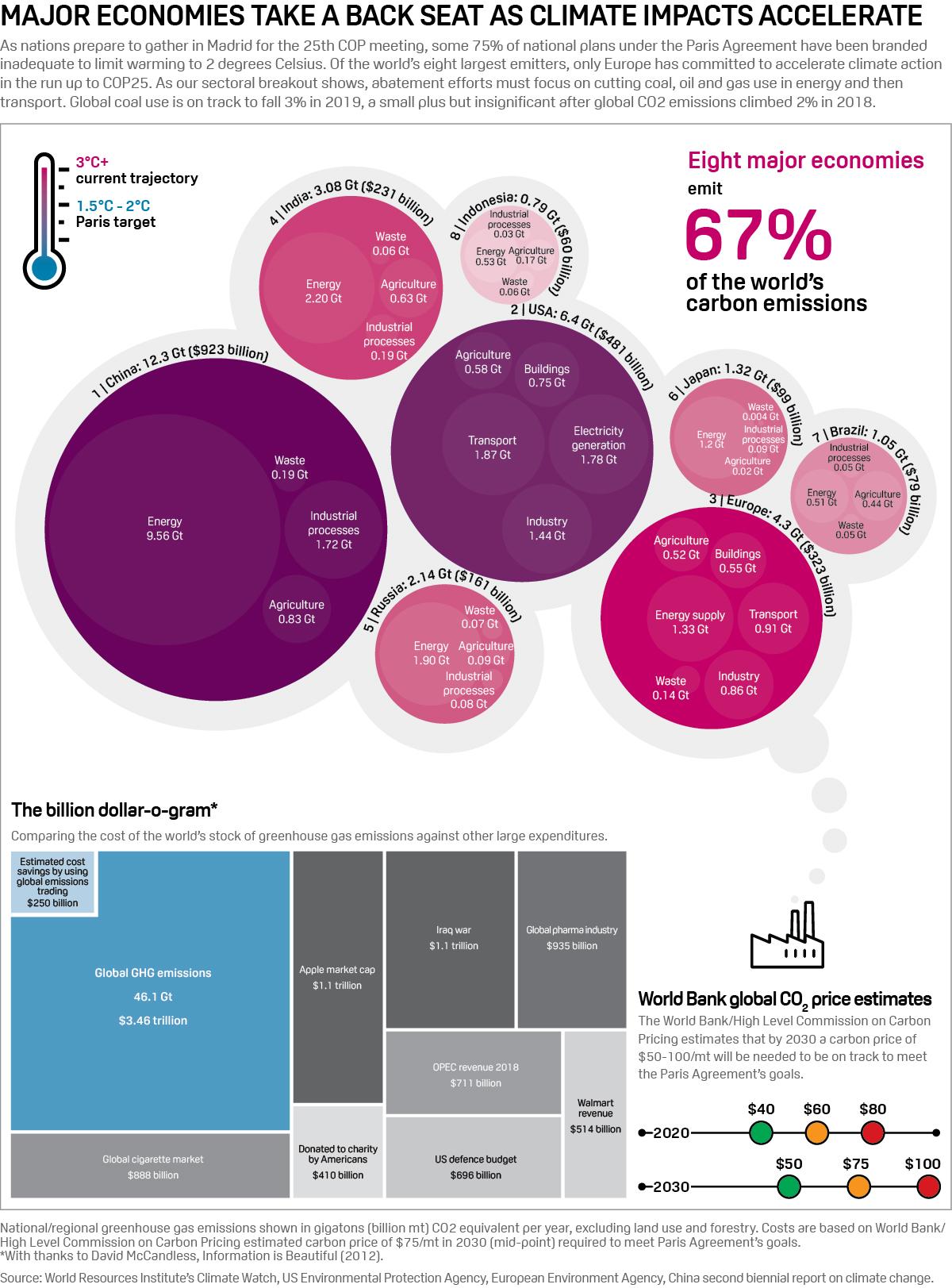
The biggest carbon emitters

Ahead of COP 25 in Madrid, S&P Global Platts crunched the numbers to show carbon emissions of the biggest global economies, and their costs compared to other major expenditures.


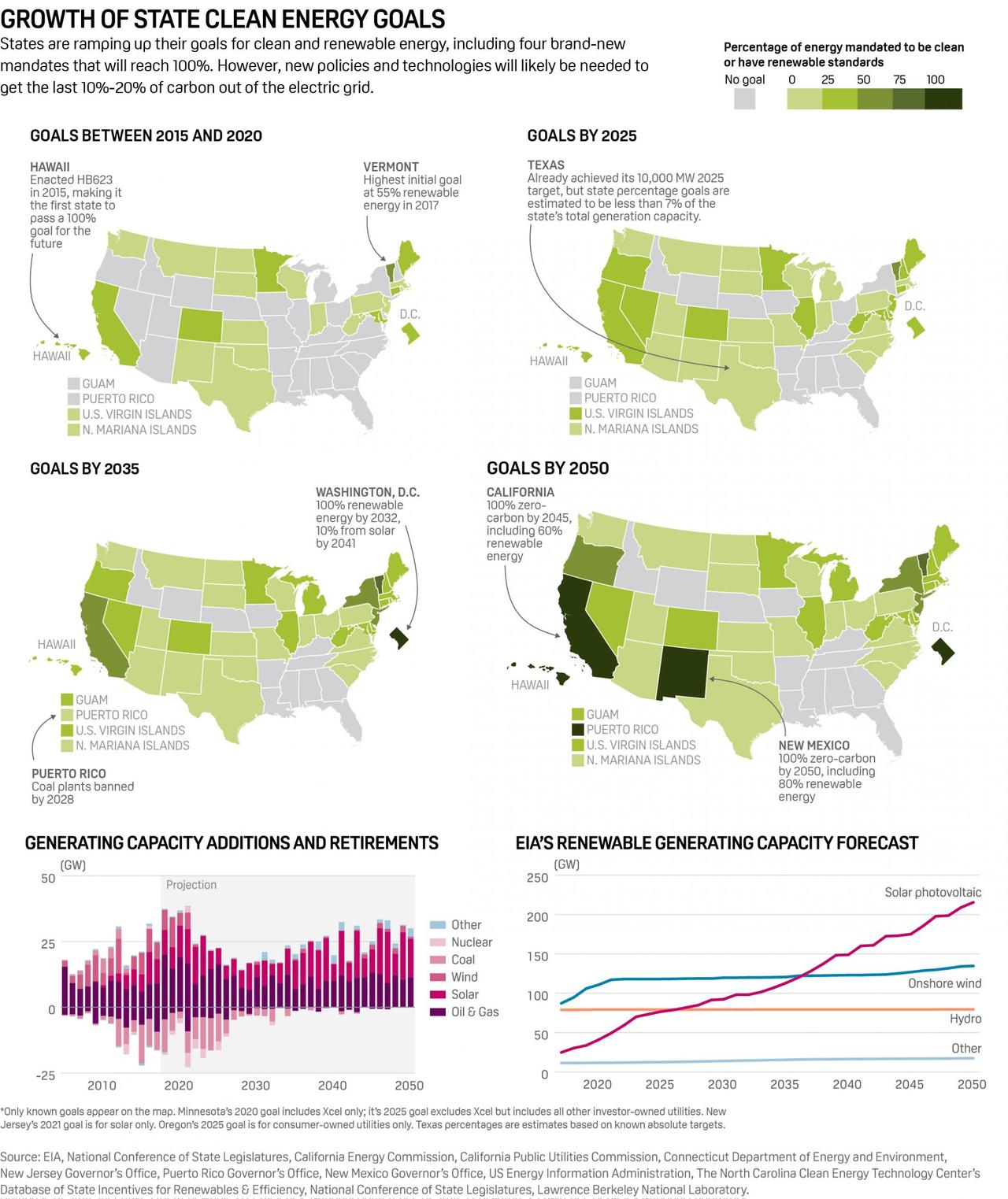
US states ramp up clean energy goals

President Trump may have disengaged from global efforts to tackle climate change, but individual US states are still pushing ahead with ambitious targets to ramp up renewables.


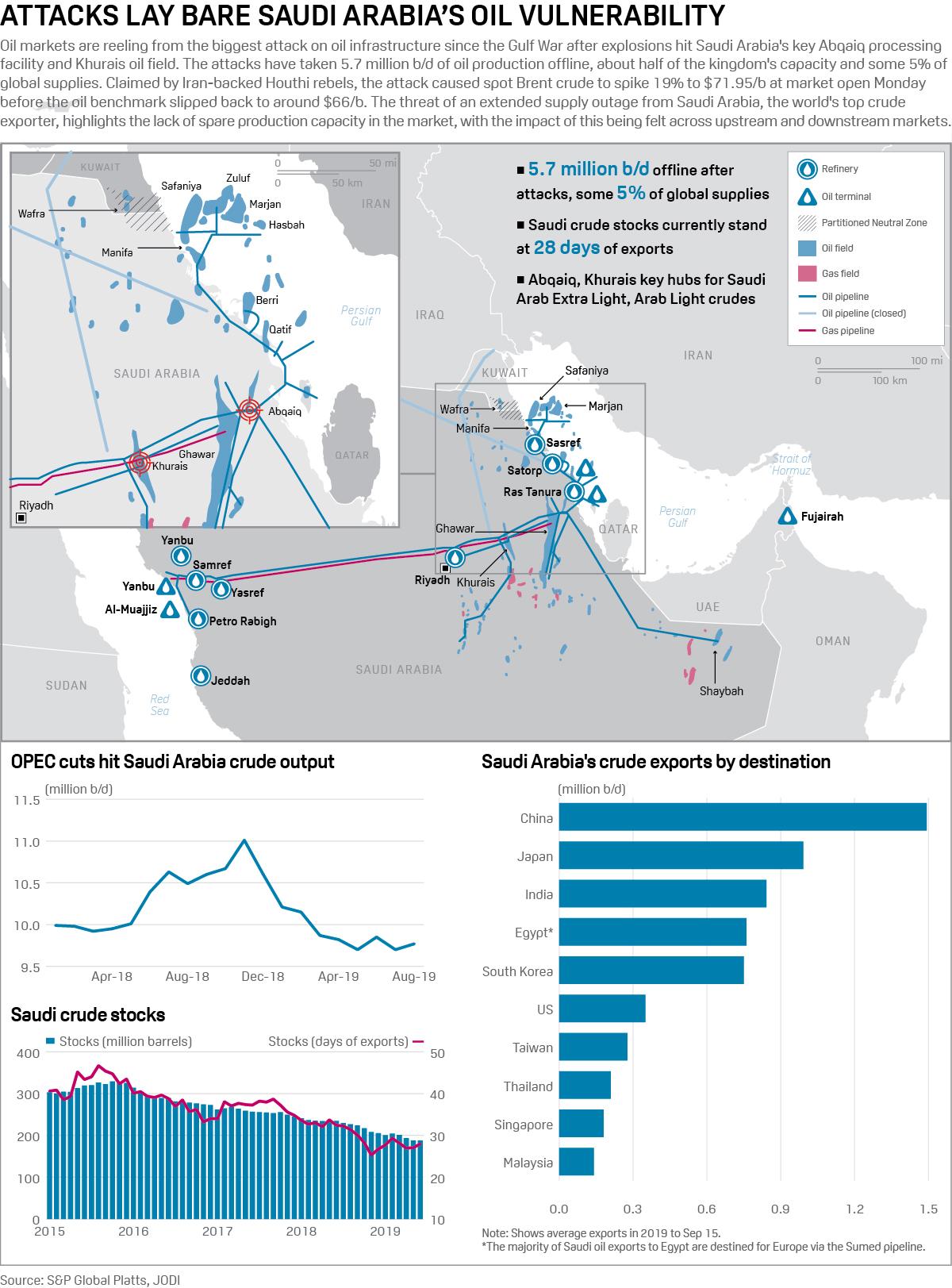
Middle East oil supply vulnerability

The succession of attacks on Middle Eastern oil infrastructure had a short-lived effect on crude oil prices, but was a reminder of how exposed a large portion of the world's supply really is.


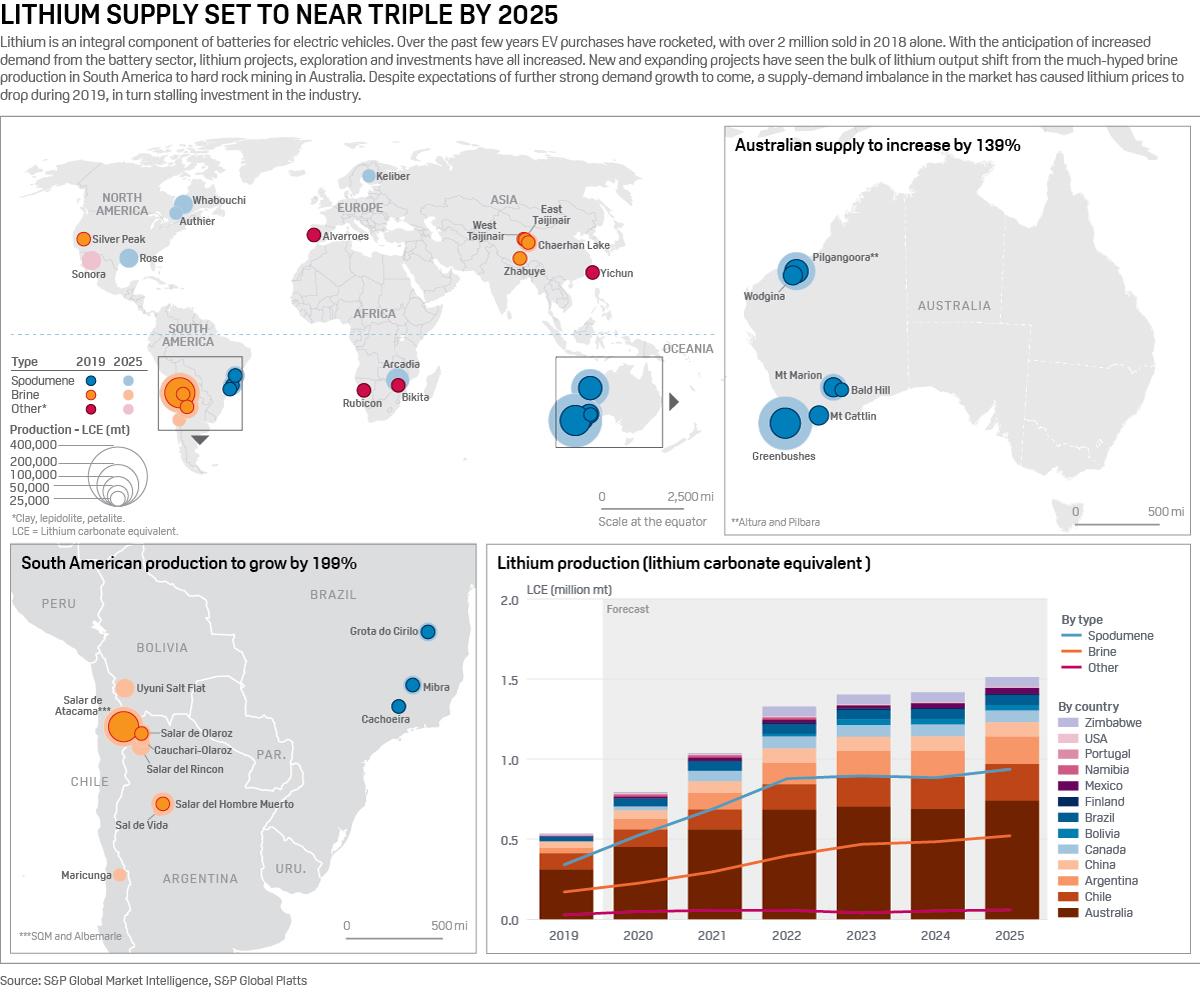
Lithium supply in the age of EVs

Amid tumbling prices, can lithium supply keep up with demand going into the next decade? S&P Global Platts looked at global production hotspots and market fundamentals.


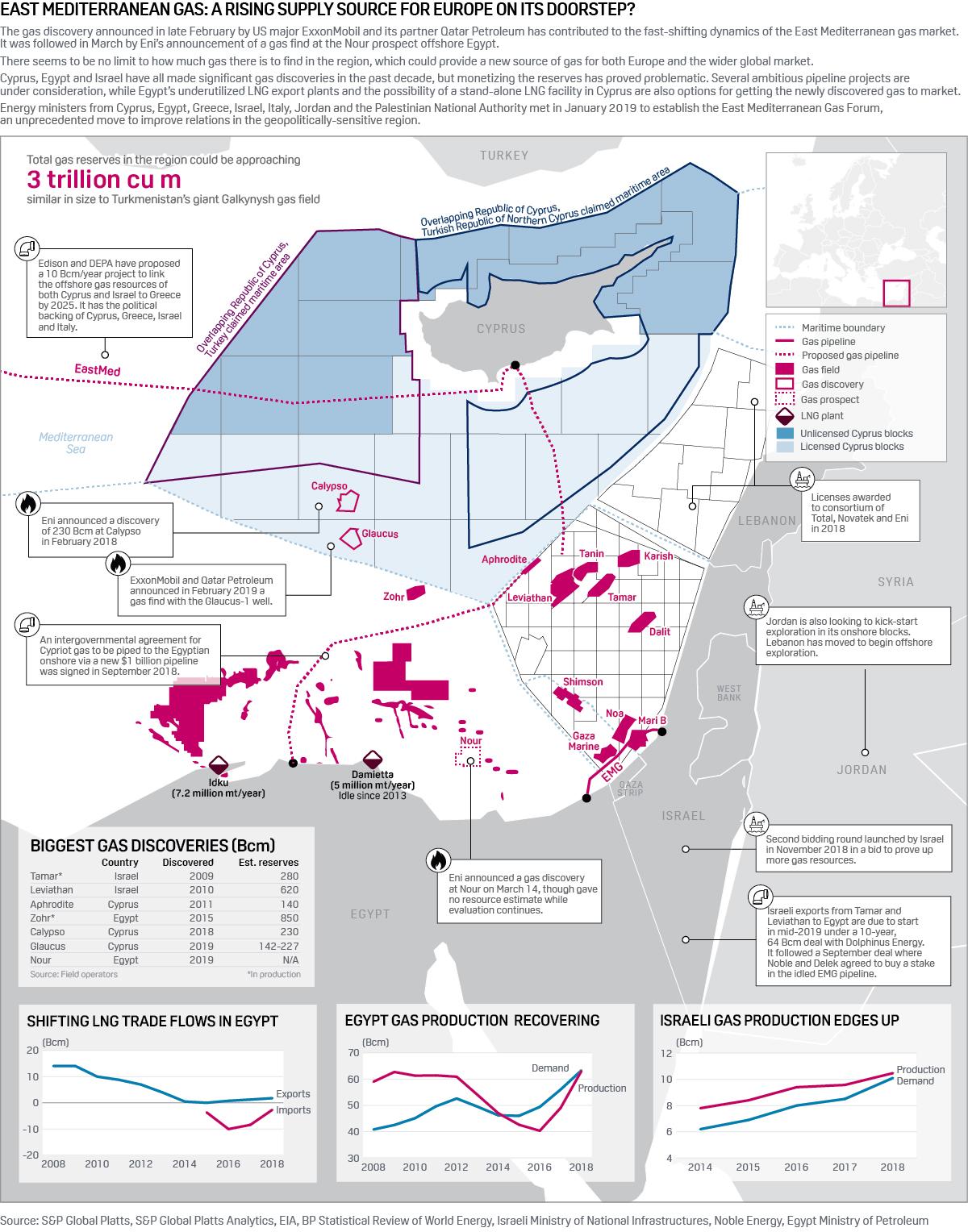
East Med a burgeoning gas supply hub

New discoveries this year elevated the East Mediterranean's position as a gas supplier. Egypt has begun exporting LNG again, and hopes also to capitalize on rising Israeli gas production.

Bank Of America: Trend For 2020s Will Be The "End Of Globalization"

Bank of America says that one of the dominant trends for the 2020s will be the "end of globalization" as countries increasingly realize that the phenomenon has brought unsustainable "social disruption."

In a report mapping out what to expect over the next decade, BofA analysts said that largely unchecked globalization, which ran roughly from 1981-2016, "is coming to an end."

This change will take place due to "the widespread recognition that while globalization has meant lower consumer prices, it has also meant slower growth, precarious employment and social disruption."

This massive shift will make commodities like precious metals and real estate safer investment because governments will move to impose protectionist economic policies.

"Countries will develop explicit national industrial policies and boost spending on R&D to foster local innovation, protect nascent industries, and shield national champions from hostile foreign takeovers," the analysts said.

The transhumanist pursuit of "immortality" will also come to the fore in the next decade, as will a new tech arms race between the U.S. and China, dubbed the "Splinternet."

China will eventually win the race, allowing Beijing "to reach national superiority in technology over the long term vis-a-vis Quantum Computing, Big Data, 5G, Artificial Intelligence, Electric Vehicles, Robotics, and Cybersecurity."

"Ubiquitous connectivity" will also change the fabric of society, according to the report, with the 'Internet of things' embedded into virtually every new physical product, a development that critics argue will create an omnipresent Minority Report-style mass surveillance grid.

Although the forecast is full of trepidation, the fact that globalism is coming to an end and that we will begin to see the possible reversal of mass immigration should offer hope for many on the right.

"Party Like It's 1998": A Quarter Of $3.2 Trillion In BBB-Rated Bonds May Be Junk

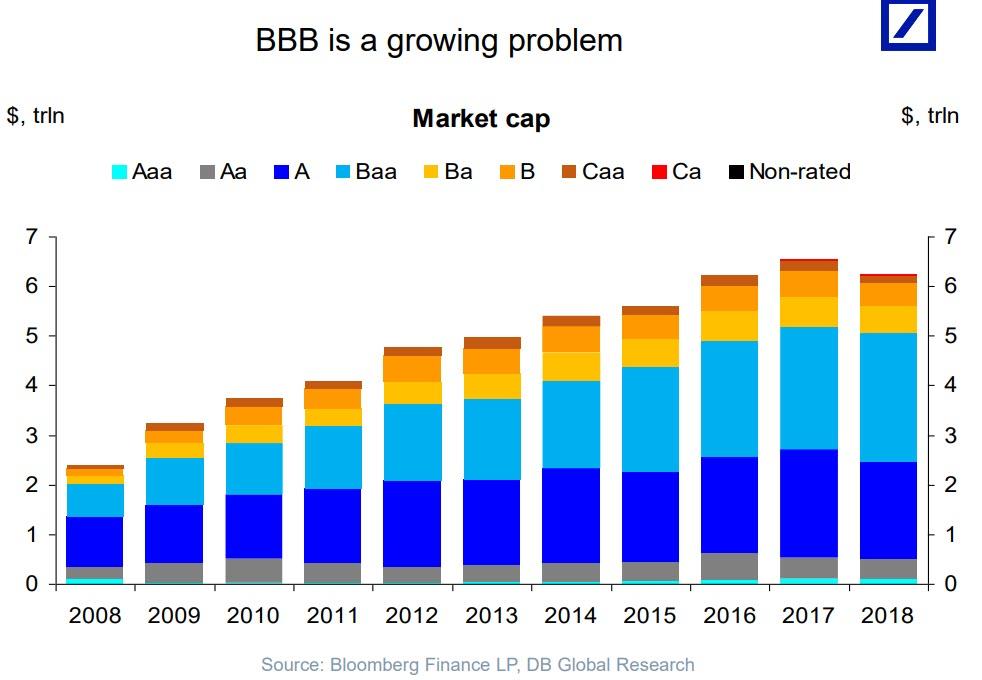
Over the past two years there has been growing investor unease (if not when the Fed is actively involved in propping up risk assets) and much speculation that the massive increase in corporate US debt over the past decade, and specifically the record accumulation in the lowest investment grade-rated, BBB debt, would eventually hit a tipping point, sparking a credit crisis.

Shown visually, the problem roughly reduces to the following: corporate debt has doubled from $5 trillion in 2007 to $9.5 trillion halfway through 2019 with corporate debt-to-GDP now back to levels which traditionally presage a recession.

Amid this massive debt increase, the principal risk is that the biggest growth was that in BBB-rated debt (which now amounts to over $3.2 trillion), is just one downgrade away from junk, and is also why many skeptics have been warning of a barrage of "fallen angels" before or during the next recession. 


Hilltop's Kozlik 'Cautious' on State, Local Government Debt

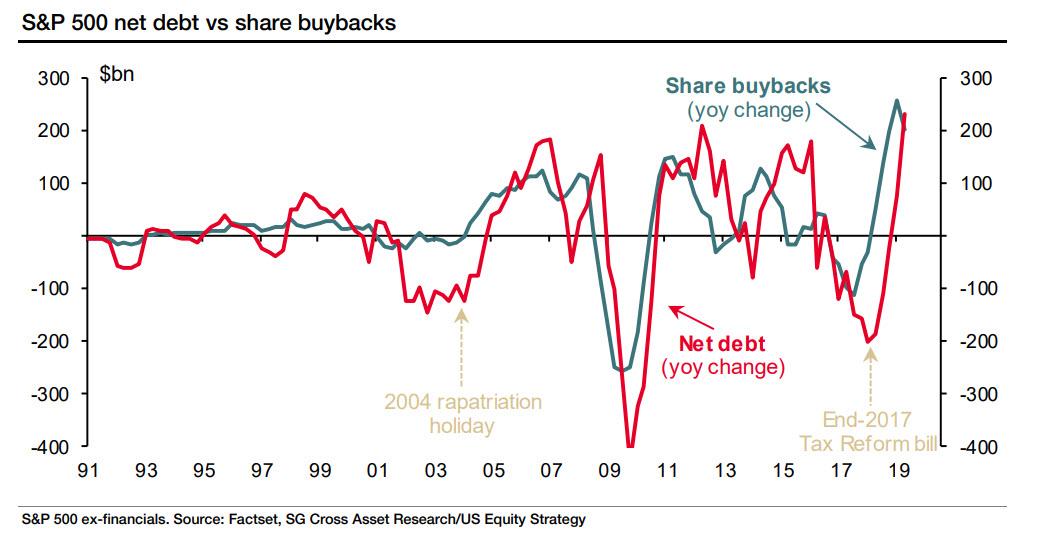
The biggest culprit for this surge: trillions in debt was sold in the past few years by BBB-rated "investment grade" companies who used the proceeds to buyback their stock...

... a concern that is only compounded by the fact that rating agencies appear to be well behind the curve, or as Morgan Stanley (and Jeff Gundlach) have shown, despite its BBB rating, 55% of BBB corps should have a junk rating already based on leverage alone.

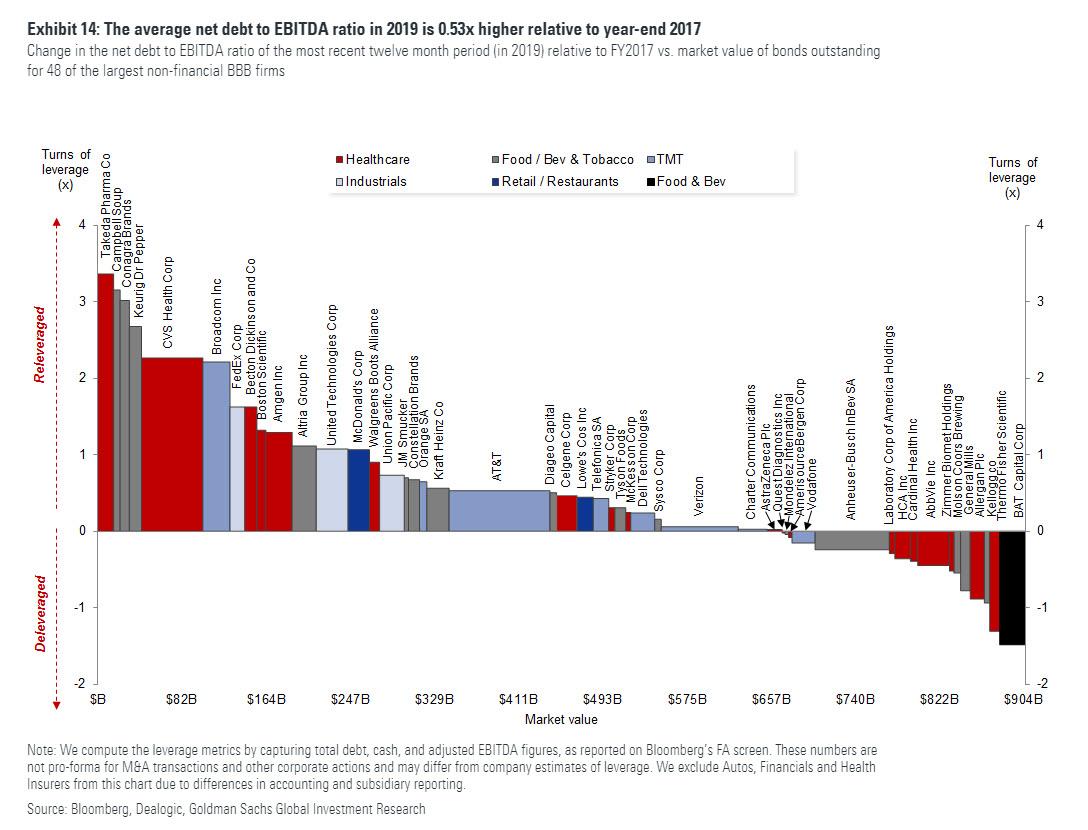
Finally, as overall corporate leverage hit record levels, for the low end of the IG rating spectrum one of the side effects of the slowdown in earnings growth has been a delay to the deleveraging plans for most issuers, despite continued commentary emphasizing a focus on gross debt pay down. In fact, according to Goldman, for 48 of the largest non-financial BBB firms – a group which captures over $900 billion of index-eligible debt across the TMT, Healthcare, Food & Beverage and Industrial sectors – the average net debt to EBITDA ratio in the most recent 12-month period (2019) is actually 0.53x higher relative to year-end 2017.

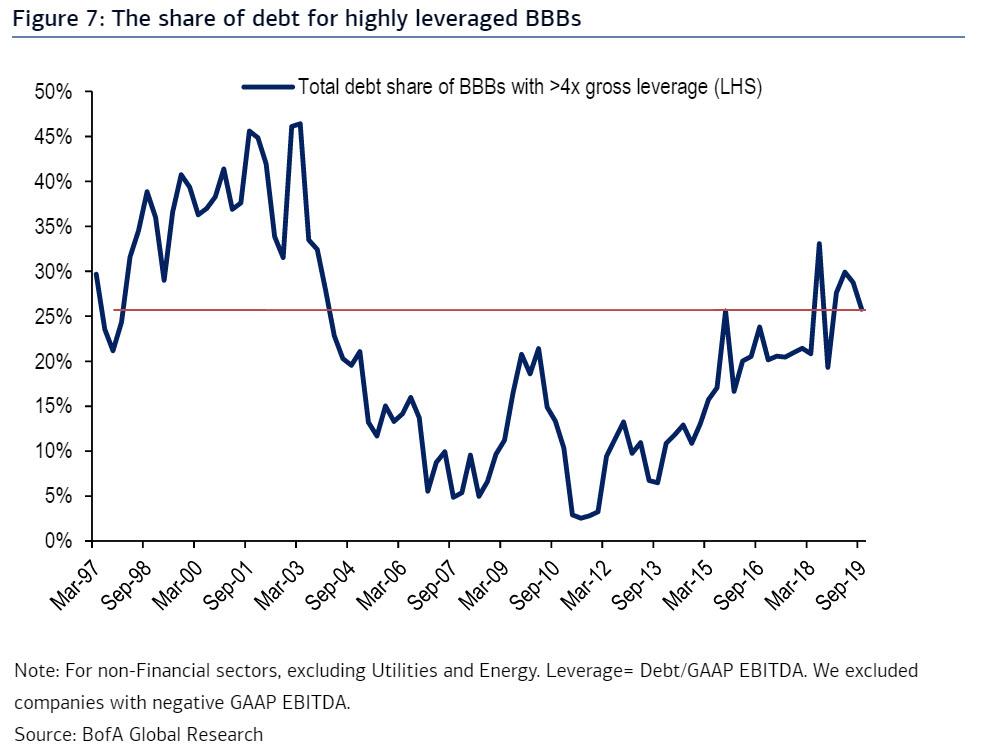
We discussed many of these dynamics, and especially the risk that much of the BBB-rated universe is far weaker than its ratings would suggest, one month ago in "Meanwhile For Bonds, It's Going From BBBad To Worse." Now, picking up on the topic of overestimated BBB-strength, is Bank of America which writes, that there are currently 26 US BBB-rated non-(Financial, Utilities and Energy) issuers (out of 198 so 13.1%) with high gross leverage (>4x), which is traditionally associated with junk bonds.

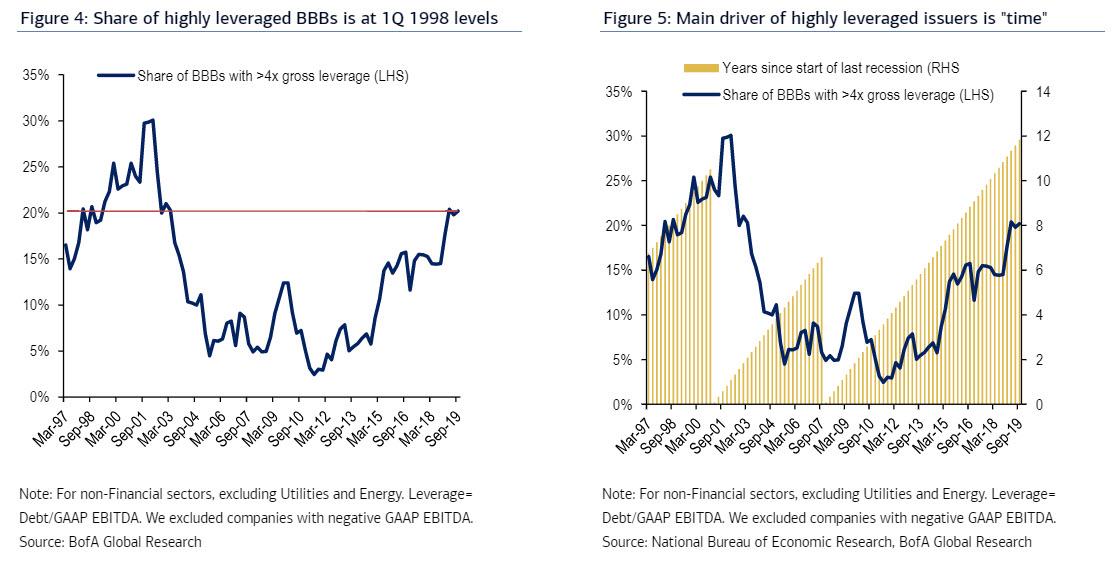
And since investor perception is that this number is much higher than in the past, and in fact some are unable to recall more than just a few examples from before 2015, one of the most frequent questions Bank of America gets is whether rating agencies are being more lenient these days - for example by giving companies credit for deleveraging plans they never fulfill? And since > 4x leverage is more apropos to high yield companies (as shown in the blue chart above) "the fear is that rating agencies getting their act together eventually leads to many downgrades to HY", according to BofA's Hans Mikkelsen.

First, some facts on GAAP vs. adjusted EBITDA

As BofA adamits, its statistic of 13.1% highly leveraged BBB companies is based on leverage defined as Debt/LTM adjusted EBITDA. However, is using GAAP EBITDA instead there are many more highly leveraged BBBs, or about a quarter of all (specifically 23.7%), as for example one-time charges can skew the numbers during the year they pass through LTM calculations.

Since historically BofA only has GAAP numbers available, any comparison to current levels should be based on the adjustment-free 23.7% number. Here, if one eliminates issuers with negative EBITDA, which in IG is mostly due to one-offs, leaves 20.2% companies with >4x leverage. Which in the context of nearly $3 trillion in BBB-rated bonds is a dangerously high number if indeed up to a quarter of this is investment grade only thanks to non-GAAP EBITDA adjustments.

In any case, even assuming the more optimistic 20% number is appropriate to describe the number of 4x+ levered companies, this matches the level seen more than twenty years ago in 1Q 1998, and is why BofA says it's time to "Party Like It's 1998."

So first the good news (at least according to BofA): in terms of the cycle back then "this was exactly three years before the early-2000s recession, which timing-wise appears to us similar to where we are today." Let's also recall that that particular "expansion" culminated with the Fed's legitimate asset bubble, that of tech stocks, which we are of course seeing again with the FANGs. The outcome also wiped out roughly 80% of the Nasdaq and forced the Fed to reflate the housing bubble to offset the collapse in wealth effect as a result of the bursting of the dot com bubble.

Now the not so good news: just as the 2000 bubble ended with a massive repricing of the IG space, with the number of BBB-rated companies carrying a 4x+ leverage plunged from 30% to 5% in just a few years, such a furious deleveraging by "quality" companies in the near future would lead to catastrophic consequences for risk assets. It also confirms that rating agencies are once again behind the curve, just as they were back in 1998.

Here, for all those who blame the raters for being behind the curve, BofA has a contrarian point:

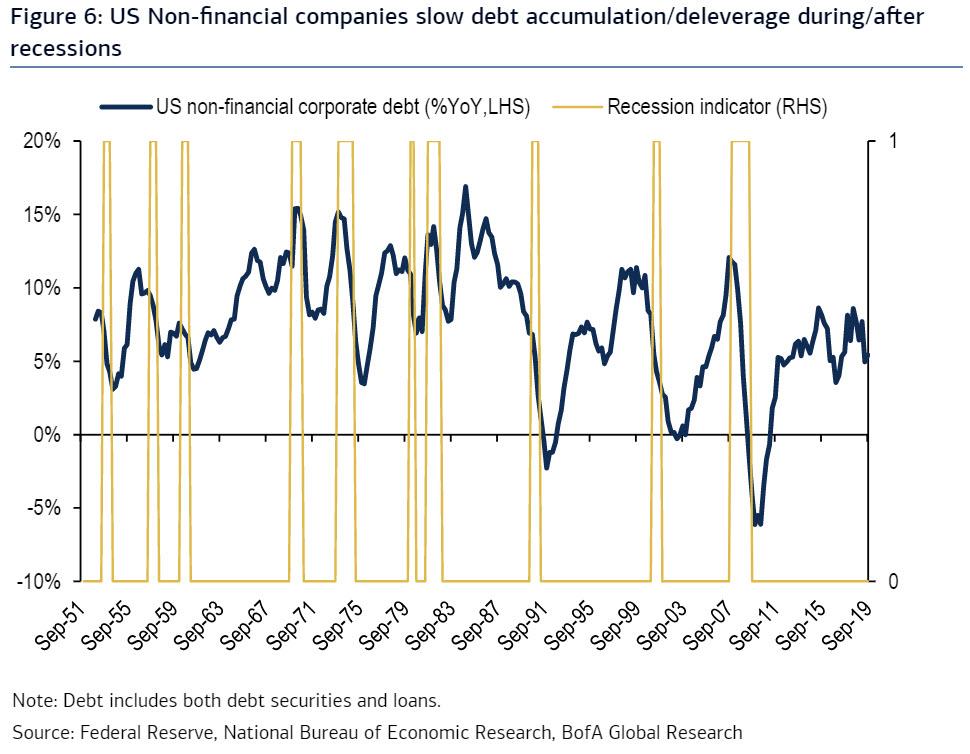
Using nearly seventy years of historical data from the Federal Reserve for all US companies we see clearly how companies increase indebtedness in expansions. This activity then slows during and in the aftermath of recessions, and the last three cycles we even saw some outright deleveraging (Figure 6). Clearly since the mid-2000s expansion was relatively short, US companies only had time to increase debt levels by 32% of pre-recession levels much less than the 83% achieved in the 1990s expansion (vs. 64% so far this expansion). With strong EBITDA growth during the mid-2000s as well there simply were not enough companies around with leverage >4x so that rating agencies could rate many BBB. This is the main reason for the low share of highly leveraged BBBs in the mid-2000s - rather than the agencies being stricter back then.

Pouring some cold water on this optimistic spin, however, is the observation that while the share of BBB issuers with high leverage is 20.2%, their share of the total gross debt is even higher at 25.8% currently (calculated in a similar way, specifically based on GAAP numbers and excluding issuers with negative LTM EBITAs). Incidentally, the share of debt was also higher back in 1998, and the current reading matches the level in 1998 (Figure 7), similar to the chart based on the share of issuer.

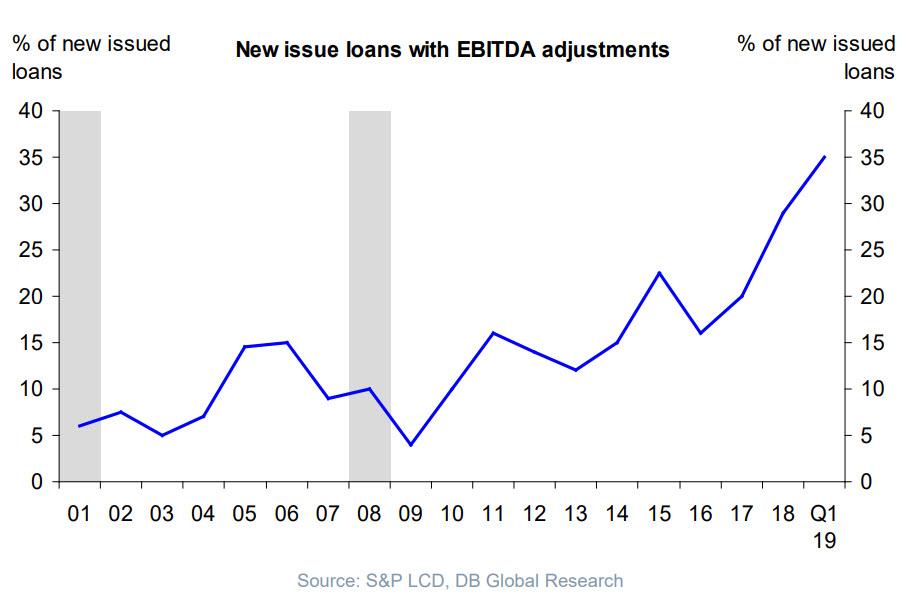
In short: in a best case scenario, US corporations have about 3 years before history rhymes again, and the massive corporate debt burden becomes untenable in a time of declining corporate profits, leading to the long-awaited BBBoom. The worst case scenario: the real level of EBITDA, excluding adjustments, is far lower than our worst case assumptions (which as we have shown previously can amplify the non-GAAP number by up to 200%) and even a modest change in economic conditions would result in a violent shortfall in interest coverage, a self-fulfilling prophecy where BBB-rated companies are suddenly aggressively downgraded (contrary to what had happened in the past decade), and a cascade of defaults follow unleashing the next financial crisis in the process.

venerdì 27 dicembre 2019

2020s to Stagnate If Private Debt Overhang Is Not Reduced

Will OPEC+ Members Comply With Its Production Targets in 2020?

SBTV guest, Professor Steve Keen, who was credited as the first Australian economist to have warned of the 2008 financial crisis years before it happened. Steve Keen believes the global economy is stuck in a 'lost decade' type of credit stagnation which will continue into the 2020s if private debt levels are not reduced.

venerdì 20 dicembre 2019

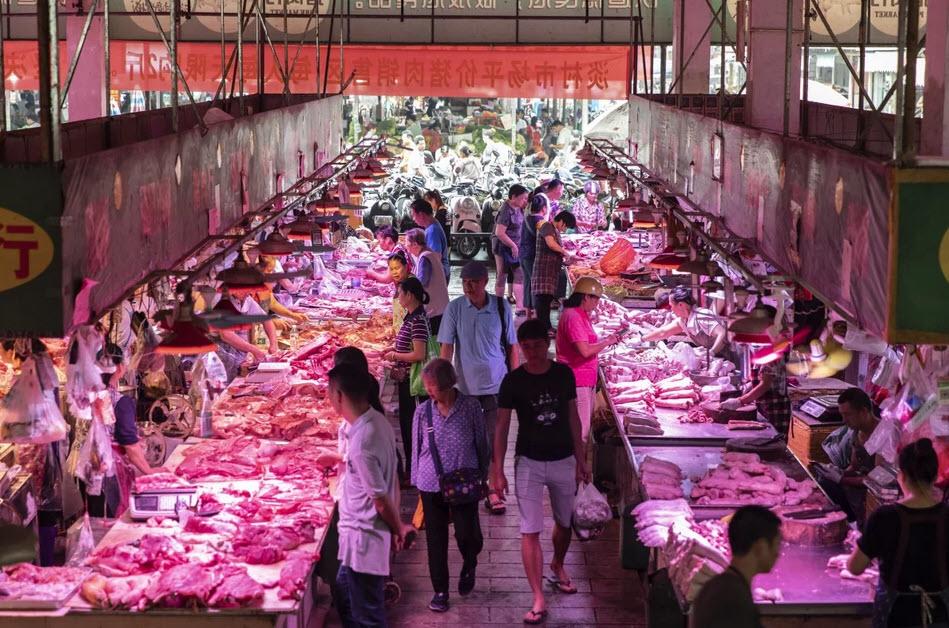
Cash-Strapped Chinese Banks Are Offering Pork To Lure New Depositors

In the peak days of the European financial crisis, when Spanish banks were on the verge of collapse and were desperate for depositor funding as the ECB scrambled to come up with a viable rescue scheme, one bank - the soon to be insolvent Bankia - had a "clever" idea: offer a Spiderman Beach Towel in exchange for a €300 deposit.

Fast forward 7 years when the cash-strapped banks of another country have come up with a similar trick to entice depositors: a growing number of small local banks across China have conceived of a "brilliant" scheme to lure new depositors: handing out servings of expensive pork as a reward for opening an account, the SCMP reports.

As we discussed in recent months, China's smaller banks were hit by a perfect storm of falling rates and declining state support, which culminated in bank runs and the nationalization of several small and medium banks. And since there is little hope that the status quo will change any time soon, Chinese banks - which on top of everything are facing a $400 billion liquidity shortfall in January  - are forced to go to greater lengths to attract new deposits, since they generally earn less money from lending and have fewer funding options than their larger peers.

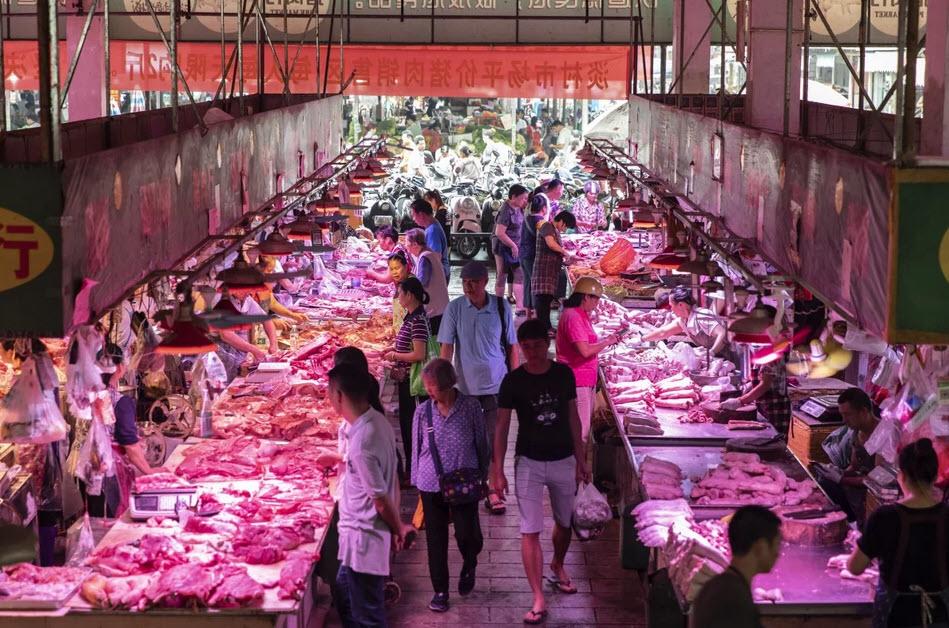
Unlike Spain, Chinese banks are offering a product which is in great demand for the nation that is reeling as a result of "pig ebola": pork. Indeed, as SCMP adds, the fact that pork could be seen as a desirable reward for opening a bank account also speaks to the country's massive shortage of its favorite staple meat.

Who knew the intersection of the supply and demand curves would be marked by a pound of pork.

On Monday, clients who deposited 10,000 yuan (US$1,430) or more in a three-month time deposit at the Linhai Rural Commercial Bank in Duqiao in Zhejiang province were then eligible to enter a lottery to win a portion of pork ranging from 500 grams (18 ounces) to several kilograms.

"The money is still my own, and the interest is good. I'm happy to receive a piece of pork in addition," one female client, who deposited around 20,000 yuan (US$2,900), was quoted as saying by the Metropolitan Express. Unfortunately for said client, she failed to grasp that any bank that is resorting to such ham-headed measures to boost depositor interest will likely not be around for long, and her entire deposit will likely vaporize in the coming weeks.

In any case, the gimmick is working: according to the Express, the bank distributed 1,097 deposit rewards on Monday after scores of mostly elderly clients queued up in front of the bank from early that morning.

"It was quite a good idea and very popular among locals, especially the elderly," said a bank staff member, who did not offer his name. He also refused to comment on how much money the bank had received in new deposits due to the promotion.

In retrospect, it is a brilliant solution: instead of offering higher rates which only accelerate the banks insolvency as these require higher payouts on deposits, the bank is instead making a one-time payment, and the novelty of the "handout" is enough to get substantial new deposits.

Other rural commercial banks in northern China's Hebei province and western China's Guizhou province have also launched similar pork rewards programs. Dushan Rural Commercial Bank, located in the remote mountainous county in Guizhou, offered a coupon for 10 yuan (US$1.4) worth of pork for every 10,000 yuan of new deposits.

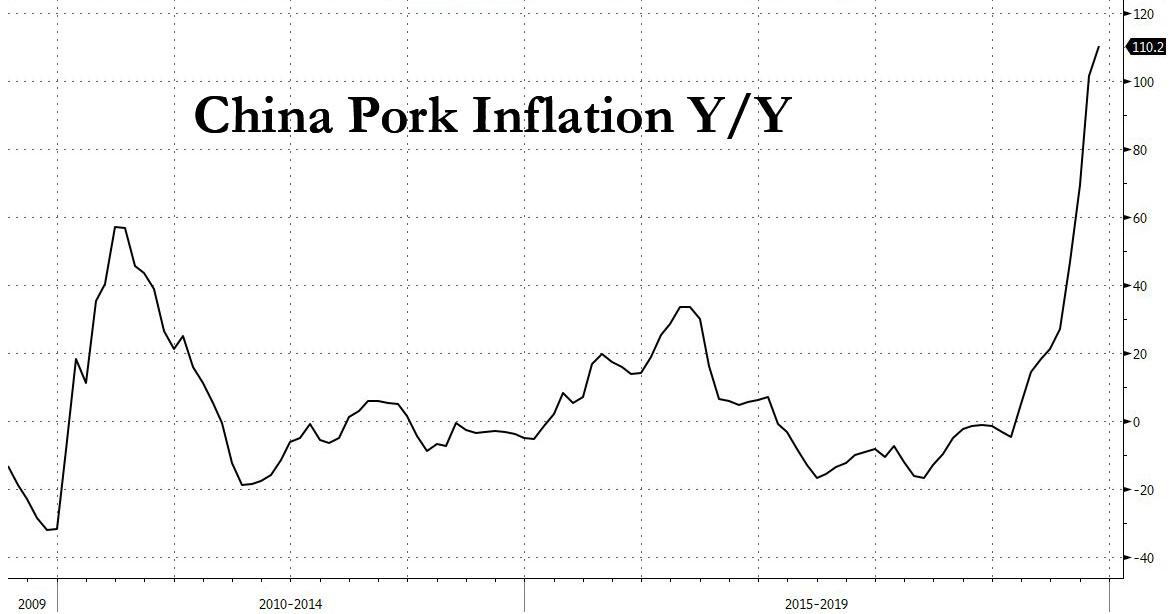
The reason behind China's infatuation with pork is familiar: the outbreak of African swine fever, which is reported to have killed over 100 million pigs in China, has sent the price of pork skyrocketing, with November's consumer price index rising 4.5 per cent from a year earlier, up from a 3.8 per cent gain in October, in large part due to a 110.2 per cent increase in the price of pork.
There were some signs of improvement: China's pig population actually expanded in November for the first time in a year, while the price of pork price has fallen in recent weeks. The pig population in 400 counties monitored by China's Ministry of Agriculture and Rural Affairs grew 2% in November from October, the first monthly rise since November 2018, while the number of breeding sows rose 4% from a month earlier. Wholesale pork prices last week fell back 0.8 per cent from the previous week, the fourth straight weekly decline, according to the latest data released by the Ministry of Commerce on Wednesday.
Wholesale pork prices last week fell back 0.8 per cent from the previous week, the fourth straight weekly decline
China's pig population, though, is around 40% smaller than it was a year ago, according to data from China's agriculture ministry.

Still, despite recent signs of improvement, experts said the crisis may worsen further next year before it improves.

"It depends on what you mean on whether the worst is over because it's already killed most of [China's pigs]. There aren't as many pigs to kill as there were before," said E. Wayne Johnson, a veterinarian consultant at Enable AgTech Consulting in Beijing.

"We expect that there will be outbreaks in the wintertime because it's very difficult to clean the trucks, particularly in the north of China, and the virus is preserved by cold weather. Plus, you have the fact that the infected pigs are continuing to go into the slaughterhouses, and everybody sends their trucks to the slaughterhouse. So the disease is being spread on the highways just as it was a year ago. There's no reason to think that it's over with."

With peak seasons for pork consumption just around the corner – with celebrations for the winter solstice this week, the new year holiday on January 1 and the week-long Lunar New Year holiday starting on January 25 – the pressure on the price of pork is set to increase due to limited supplies. To alleviate the coming demand surge, on Tuesday, the government announced that it would release an additional 40,000 tonnes of frozen pork reserves on Thursday, on top of the previous round of 40,000 tonnes released a week ago.

China also announced earlier this month that it would waive import tariffs on some pork shipments from the United States. In total, China will purchase over 3 million tonnes of pork this year, more than twice as much as last year, confirmed Commerce Ministry spokesman Gao Feng at the end of last month.

Beijing has also called for a relaxation of restrictions on pig farming on land normally reserved for forests, with the land only returning to forestry production after the pork supply crisis
has been resolved, according to a document from the National Forestry and Grassland Administration dated Monday and seen by the South China Morning Post.

"These [recently announced] measures are very positive and effective moves," said Wang Zuli, a research fellow with the Chinese Academy of Agriculture Sciences. "But pork reserves have been unable to fully resolve the supply problem, so it is hard to say whether the measures are sufficient."