Economic commentaries, articles and news reflecting my personal views, present trends and trade opportunities. By F. F. F. Russo
(PLEASE NO MISUNDERSTANDING: IT'S FREE).
MARKET FLASH:
"It seems the donkey is laughing, but he instead is braying (l'asino sembra ridere ma in realtà raglia)": si veda sotto "1927-1933: Pompous Prognosticators" per avere la conferma che la storia non si ripete ma fà la rima.
Chinese premier Li Keqiang was quoted on state television by Reuters on Thursday as saying the economy could face tremendous downward pressure in 2020.
Li said the downward pressures could be even greater than what was seen in 2019; he made no mention of the possible trade resolution with the US would correct economic growth.
He said the government would implement monetary and fiscal policies to keep the economic expansion within a consistent range throughout 2020. This could be the latest confirmation that China's GDP could slip underneath 6%.
A similar warning was echoed by an advisor to the People's Bank of China (PBoC) last week, who said China's economy might not recover for the next five years.
Liu Shijin, a policy adviser to the PBoC, said the country's GDP will decelerate through 2025 and could print in a range of 5 to 6%.
Shijin warned that excessive monetary policy is failing to stimulate the economy and could cause it to decelerate in the year ahead.
Last month, we noted that China's credit growth plunged to the weakest pace since 2017 as a continued collapse in shadow banking, weak corporate demand for credit, and seasonal effects all signaled that China's economy, nevertheless, the global economy, will continue to slow in 2020.
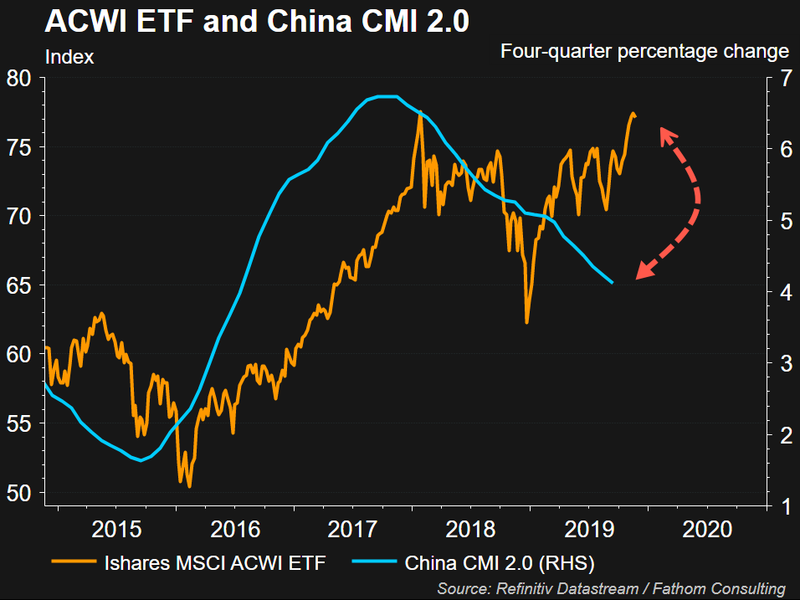
A further deceleration in China's economy could ruin the party for equity bulls, who have already priced in a massive 2016-style rebound in the global economy for 1Q20. A slowing China means the world could fail to rebound, though we don't discount the stabilization narrative.
With China's economy unlikely to sharply rebound early next year, global investors could find themselves repricing growth in the near term as global equities are at all-time highs thanks to massive money printing by central banks.
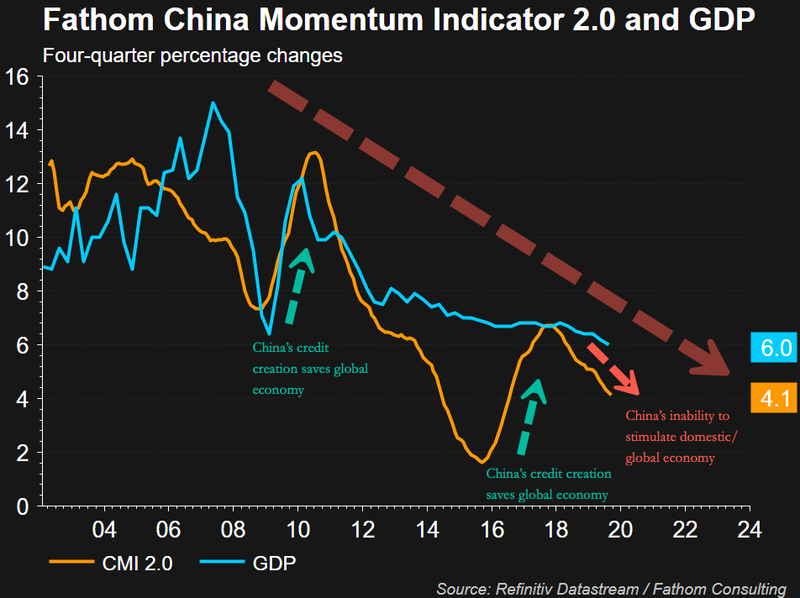
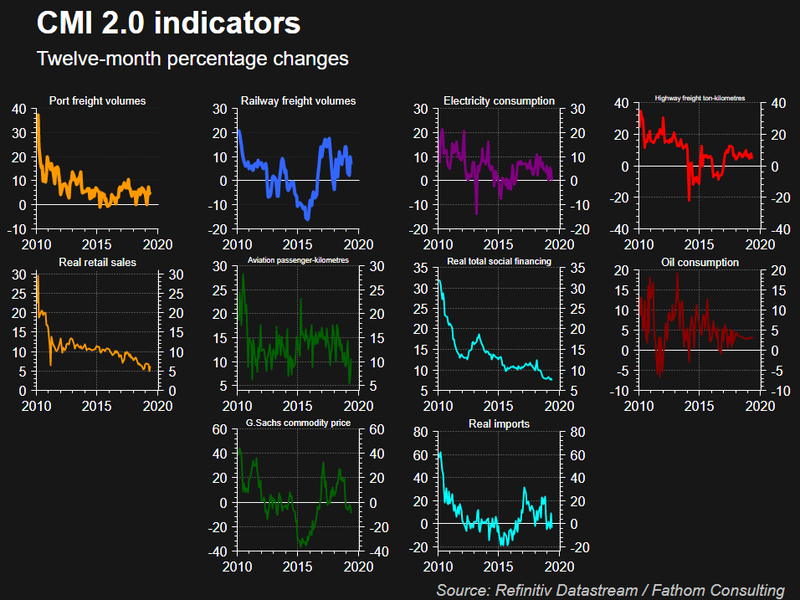
To gain more color on China's extended slowdown, Fathom Consulting's China Momentum Indicator (CMI) provides a more in-depth view of China's economic activity than the official Chinese GDP statistics.
CMI is based on ten alternative indicators for economic activity; some of those indicators include railway freight, electricity consumption, and the issuance of bank loans.
Fathom has stated that in CMI, the calculation of the index avoids measuring construction activity, and instead focuses on shadow measures of economic activity. The consulting group says this allows the index to be "less prone to manipulation than the headline GDP figures."
"In 2014, when China's traditional growth model was running out of steam and vulnerabilities were rising, authorities toyed with credit tightening and an enforced rebalancing. But at the end of 2015, when growth slowed too sharply, they quickly threw in the towel, resorting to the old growth model of credit-fuelled growth. With growth once again slowing, and past precedent suggesting credit has neared its limit, China finds itself at a crossroad," Fathom recently said.
China's failure to stimulate its economy suggests CMI will continue a downward trajectory that has been underway for the last decade.
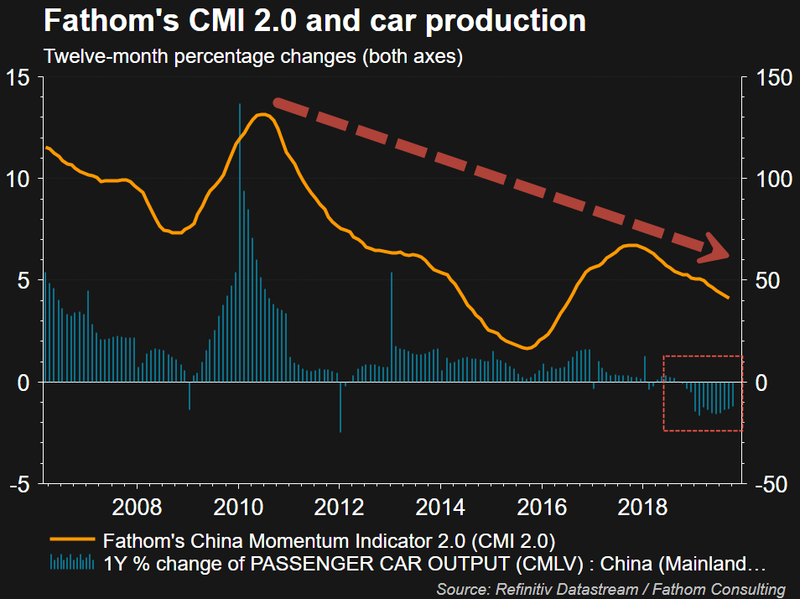
We've recently outlined the bust of the global auto industry has weighed down the Chinese economy. With no signs of an upswing in the auto market, China's economy will remain depressed in the years ahead.
As China's economy slows, global commodity prices are stuck in a deflationary spiral.
China's slowing economy warns that global equities have mispriced growth for early 1Q20.
Looking for signs of life in the Chinese economy -- there aren't any at the moment.
Société Générale's latest report shows employment in China contracting across manufacturing and non-manufacturing, outlining how the slowdown is broad-based.
Bloomberg has compiled a list of long-time China watchers that are warning about an extended slowdown.
George Magnus, a research associate at Oxford University's China Centre and author of "Red Flags: Why Xi's China is in Jeopardy:"
In the spirit of self-criticism, I'd say my best call on the economy was an early spot of the huge demographic shift that kicked off in earnest in 2012, an abiding assertion that China's elevated growth rates could not be sustained, and anticipation of a financial crisis that turned up in 2015-16. Worst call was thinking that crisis might turn into a 'Minsky Moment' for China, as per 2007-08, and failing to integrate properly the tools the state has to prevent catastrophic failure.
I expect China to flirt with officially recorded growth of around 6%, but the reality is that the tempo of growth is ratcheting down to somewhere between 3% and 4%. In 2020, perhaps 5.8% to 6%, officially, not least because the economic news has to remain upbeat ahead of the CCP centenary in 2021. The consequences of over-indebtedness, demographic change, inadequate wealth transfer and income redistribution policies, and stagnant total factor productivity growth associated with institutional flaws are the main drags on growth. The 2020s will be a challenging time for China.
Jim O'Neill, the former Goldman Sachs Group chief economist who coined the term BRIC:
The BRICs path assumed China would grow 5% a year in the decade 2020-29 and I have no reason for changing this. If it does, and so long as the renminbi doesn't decline a lot in value, then by the end of the decade, China will be very close to being as big in current dollar terms as the US.
As this decade nears its end, China has major problems positioning itself in the world. As evidenced by the Uighur situation, China's approach to life now gets much more global attention than when it was smaller. In the coming decade, China has to somehow develop a more subtle and sophisticated stance on many of these issues, and I am not sure Beijing fully realizes this yet.
Edward Yardeni, president and chief investment strategist at Yardeni Research:
Demography is starting to really weigh on China's growth. China is rapidly evolving into the world's largest nursing home.
They are going to have to provide a social safety net for these folks who are going to get older and need health care. If they don't do that, they are going to depress their consumers. When you want to be a superpower, there are a lot of factors that matter, and demography is certainly one of them.
The biggest takeaway is China produced 60% of the world's debt over the last ten years and is the biggest driver in global economic growth. A slowing China means the global economy will likely remain stagnate in 2020.
Markets, despite their collective expertise, are apparently destined to repeat history as irrational exuberance is followed by an equally irrational despair. Periodic bouts of chaos are the inevitable result.
Financial crises have been an unfortunate part of the industry since its beginnings. Bankers and financiers readily admit that in a business so large, so global and so complex, it is naive to think such events can ever be avoided. A look at a number of financial crises over the last 30 years suggests a high degree of commonality: excessive exuberance, poor regulatory oversight, dodgy accounting, herd mentalities and, in many cases, a sense of infallibility.
William Rhodes has been involved in the industry for more than 50 years and has lived through nearly every modern-day financial crisis, many of which are detailed in his book, "Banker to the World". As he puts it, there is a common theme of countries and markets wanting to believe that they are different and that they are not as connected to the rest of the world's economy. In his view, many aspects of the Latin American debt crisis of 1982 have been repeated a number of times and there is much from this crisis that we can apply to what is currently happening in Europe and beyond.
LatAm sovereign debt crisis – 1982
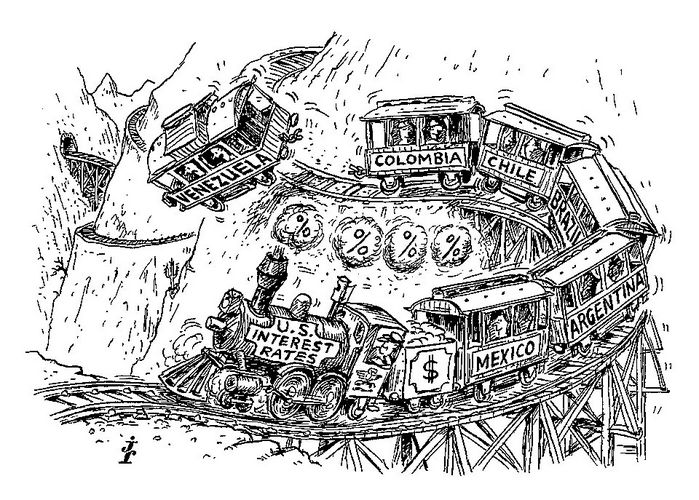
This crisis developed when Latin American countries, which had been gorging on cheap foreign debt for years, suddenly realised they could not repay it. The main culprits, Mexico, Brazil and Argentina, borrowed money for development and infrastructure programmes. Their economies were booming, and banks were happy to provide loans to the point where Latin American debt quadrupled in seven years. When the world's economy went into recession in the late 1970s the problem compounded itself. Interest rates on bond payments rose while Latin American currencies plummeted. The crisis officially kicked off in August 1982 when Mexico's finance minister Jesus Silva-Herzog said the country could not pay its bills.
It took years to sort out the crisis, with Latin American nations eventually turning to the IMF for a bailout in exchange for pro-market reforms and austerity programmes. It also led in 1989 to the novel creation of Brady bonds, which were designed to reduce debt in these countries by converting distressed sovereign debt into a number of different types of bonds. Furthermore, banks could exchange claims on these debts for tradable assets, which enabled them to get the debt off their balance sheets.
Rhodes recalls it as a tense period, but says that strong political leadership enabled them to get through the crisis. He laments, however, that the lessons of the crisis weren't heeded.
"Time and again, be it in the Asian crisis or the eurozone crisis, we have seen how governments have failed to draw lessons from the Latin American crisis," he said. "They have repeatedly taken the view that their countries and regions are different and unique and, therefore events in other parts of the world cannot provide any relevant lessons for them.
"And yet key developments seen in the Latin American crisis – the dangers of contagion, the need for urgent and bold political leadership, the risks of over-leveraged banks – have been characteristics of every sovereign debt crisis since then."
Savings and loans crisis – 1980s
While the solution to the Latin American crisis was being put together, a domestic one was happening right in front of the US regulators. The so-called savings and loans crisis took place throughout the 1980s and even into the early 1990s, when more than 700 savings and loan associations in the US went bust.
These institutions were lending long term at fixed rates using short-term money. As interest rates rose, many became insolvent. But thanks to a steady stream of deregulation under President Ronald Reagan, many firms were able to use accounting gimmicks to make them appear solvent. In a sense, many of them resembled Ponzi schemes.
The government responded with a set of regulations called the Financial Institutions Reform, Recovery and Enforcement Act of 1989. While the act tightened up the rules on S&Ls, it also gave Freddie Mac and Fannie Mae more responsibility for supporting mortgages for lower-income individuals.
Someone who remembers the savings and loan crisis all too well is William Black. During the 1980s he served as litigation director for the Federal Home Loan Bank Board and deputy director of the Federal Savings and Loan Insurance Corp. He was instrumental in the investigation into one of the most notorious S&L villains, Charles Keating, who infamously sent a memo saying he wanted Black dead.
In Black's view, the act didn't go nearly far enough and in many ways contributed to the continuation and expansion of predatory lending that would ultimately become a huge factor in the 2008 financial crisis.
"The credit crisis is a continuation of the savings and loan crisis," he said. "It's not that they did nothing about it, it's that they undid everything that worked. They could have thought, 'we've seen this before, this is bad, this is disastrous' and we had regulations that worked and could have reinstalled."
When asked why the government's solution to the S&L crisis was to some degree to regulate the industry even less, and why people such as Keating maintain that excessive regulation was the cause of the S&L crisis, he says: "One is ideology. They hate government involvement of any kind. Second, imagine yourself answering the … question of why did none of you get this right? You're 55 years-old, are you going to say, 'sorry, everything I've ever said and written and worked on is false? And everything I've said created a criminogenic environment? And by the way, I have no useful skills'? Maybe one in 1,000 would say that, but it's not likely."
Stock market crash – 1987
Despite the shock of the savings and loans crisis, two more crises took place before the 1989 Act. The most memorable was the 1987 stock market crash. On what became known as Black Monday, global stock markets crashed, including in the US, where the Dow Jones index lost 508 points or 23% of its value. The causes are still debated. Much blame has been placed on the growth of programme trading, where computers were executing a high number of trades in rapid fashion. Many were programmed to sell as prices dropped, creating something of a self-inflicted crash.
Roger Ibbotson, a finance professor at Yale University and chairman of Zebra Capital, has written extensively about the crash. He recalls teaching a class when it was happening, and every few minutes a new student would drop in to his class saying the market had hit another low.
"The whole week was chaos," he said. "The futures market was a mess, but you could actually make good money if you were up for some risk. A lot of people tried to set up brokerage accounts to take advantage of some of the valuations."
Yet one of the oddest parts of such a significant crash, he recalls, was how little effect it seemed to have. It was ultimately a short-lived event. The market continued to fall into November, but by December it was up and it ended the year positively. Ibbotson says things basically just went back to normal. A few changes were made, notably the introduction of circuit breakers that could halt trading, but apart from that, many people just shrugged and went back to making money.
Junk bond crash – 1989
Next up was the 1989 junk bond collapse, which resulted in a significant recession in the US. There is some disagreement as to what caused it, but most point to the collapse of the US$6.75bn buyout of UAL as the main trigger. Others point to the Ohio Mattress fiasco, a deal that would become known as "burning bed" and remains widely considered to be among the worst deals in modern finance. The culmination of the crash is considered to be the collapse of Drexel Burnham Lambert, which was forced into bankruptcy in early 1990, largely due to its heavy involvement in junk bonds. At one point it had been the fifth-largest investment bank in the US.
Ted Truman, now a senior fellow at the Peterson Institute for International Economics, was then director of the international finance division at the Federal Reserve. He remembers the crisis as having similar undertones to the more recent financial and sovereign debt crises, where banks were underwater and the government had to bail out various institutions to avert further problems.
"You essentially had at the same time the last phase of the S&L crisis," Truman said. "To some degree this was the mop-up phase. There is a view out there that any time there is a rescue, it encourages people to take risks. That's the moral hazard issue. But I think that's a little unfair because most people who get rescued pay a high price in the process. The system is rescued not the perpetrators. Reputations are besmirched."
Tequila crisis – 1994
In 1994 a sudden devaluation of the Mexican peso triggered what would become known as the Tequila crisis, which would become a massive interest rate crisis and result in a bond rout. Analysts regard the crisis as being triggered by a reversal in economic policy in Mexico, whereby the new president, Ernesto Zedillo, removed the tight currency controls his predecessor had put in place. While the controls had established a degree of market stability, they had also put an enormous strain on Mexico's finances.
Prior to Zedillo, banks had been lending large amounts of money at very low rates. With a rebellion in the poor southern state of Chiapas adding to Mexico's risk premium, the peso's value fell by nearly 50% in one week.
The US government stepped in with a US$50bn bailout in the form of loan guarantees. Yields on Mexican debt shot up to 11%, and capital markets activity ground to a halt not only in Mexico but across the entire region, especially in Argentina – where yields went as high as 20%. It also hit markets across the developed world.
Eventually, the Mexican peso stabilised and the country's economy returned to growth. Three years later it was able to repay all of its US Treasury loans.
Martin Egan, global head of primary markets and origination at BNP Paribas, as well as the firm's UK head of fixed income, says that of the moments of crises he has experienced, this one sticks out particularly strongly.
"1994 is still quite vivid. Numerous rate increases including a 0.75 basis point upward movement on November 16 as the Fed attempted to control inflationary pressures resulted in a dramatic collapse of market activity," Egan said.
"If you look at what happens now, sensitivity to rate changes is always around and markets like to have visibility. Back then we knew rates needed to go up, but the speed and swiftness of the move derailed the market for a long time and we saw a dramatic collapse in volumes, and serious strains in the financial system.
"Confidence started to rebuild eventually, but it was brutal because it dragged the markets into an awfully defensive mode. It was one of the most problematic years ever in fixed income. It was a reminder to all participants that this is the real world and the real economy at stake."
Asia crisis – 1997 to 1998
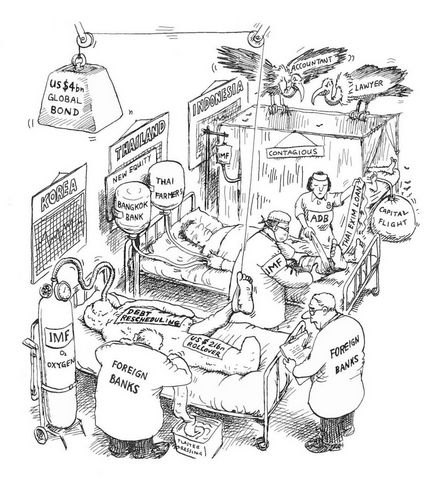
More than 15 years after the Latin American debt crisis of 1982, history would indeed repeat itself in Asia. In July 1997 Thailand's currency, the baht, collapsed when the government was forced into floating it on the open market. The country owed a huge amount of debt to foreign entities that it couldn't pay even before the currency plummeted. Similarly to what was experienced in Latin America in the 1980s and present-day Europe, the crisis spread across the region, with South Korea, Indonesia, Laos, Hong Kong and Malaysia also affected. Rhodes says he spent considerable time warning Asian governments about the risks they faced, but that his concerns were largely ignored.
"I was told by the Asians: 'We're different from Latin America because we have Asian values and because we work harder and have a savings culture'," Rhodes said. "But they were involved in the same practices of overlending to the consumer area and in real estate. There is a similar phenomenon in all of these crises, which is that people like to think they are different and that experiences elsewhere do not apply to them."
The crisis certainly took many by surprise. Most Asian governments believed they had the right economic and spending policies in place, but nonetheless the crisis necessitated a US$40bn bailout by the IMF. Only one year later, in 1998, a nearly carbon-copy crisis happened in Russia.
Dotcom bubble – 1999 to 2000
Markets would yet again forget the lessons of the past in the dotcom bubble and subsequent crash in 2000. As in most crises, it was preceded by a bull rush into one sector. In this case it was technology and internet-related stocks. Individuals became millionaires overnight through companies such as eBay and Amazon. The hysteria reached such a pitch that the inconvenient fact that few of these companies made any money scarcely mattered. By 2000, however, the game was up. The economy had slowed and interest rate hikes had diluted the easy money that was propping up these companies. Many dotcoms went bust and were liquidated.
Kay Steffen, head of syndication and corporate broking at DZ Bank, was involved in bringing more than 80 of these companies to the market. He believes the dotcom crash was simply a case of a feeding frenzy that went out of control, and was a symptom of the market's underlying irrationality.
"Everyone knew this was something that was not sustainable, but it's not always easy to take that view and resist all the different groups that want in on the market," he said. "I feel this is just the natural behaviour of people. We see this happen every few years in various market segments. We see it happening today in some bonds. People are looking for yield and if they see a 7% coupon they neglect what is behind it."
Global financial crisis – 2007 to 2008
It was only a few years later that an even nastier crisis would hit the entire world's financial markets. In many ways it has still has not ended, with the billions in losses and slowing global economy manifesting themselves in the current European sovereign debt crisis. It resulted in the collapse of a number of large financial institutions and is considered by many economists to be the worst crisis since the Great Depression. While the causes are numerous, the main trigger is considered to be the crash of the US housing market.
Jean-Pierre Mustier was at the forefront of the crisis as the head of Societe Generale's corporate and investment bank, and had to manage the aftermath of rogue trader Jerome Kerviel's €4.9bn trading losses. In his mind, the crisis has changed banking for the better, and he is a supporter of the new regulations as well as simpler business structures.
"To a certain extent, people became too dependent on models," says Mustier, who is now head of CIB at UniCredit. "Suddenly, the crisis showed that you should not rely on models only and more on common sense. What you do has to be connected to reality. I think the combination of the Basel III approach and leverage ratio is actually a good thing, but I also think the lesson we learned is, let's use our common sense and not blindly accept models."
Lessons learnt?
Is financial history destined to repeat itself? It would appear to be something of a result of the way markets function. A boom creates excessive interest and lofty prices. The ensuing crash results in "never-again" style regulations, only for another crisis to pop up, sometimes as soon as the next year. Most recently, the world has had to cope with the European sovereign debt crisis, a problem that never seems able to go away entirely and seems to get worse with each ensuing multi-billion dollar bailout.
Rhodes argues that many of these incidents are avoidable, but in many ways what is more important is how they are resolved. Above all, he sees strong political leadership as one of the most crucial elements, along with a competent plan that the populace will understand as being good in the long term.
"One of the things that is clear in all of the crises is that strong leadership is crucial," he says. "To take some international examples, such as Brazil in 1994, South Korea in 1998 and Turkey in 2001, the heads of state and finance ministers sold their programmes to their citizens saying that while these included tough measures, they were well planned and would lead to growth – and they did. This kind of leadership is missing in Europe."
In this issue of The Institutional Risk, we feature a timely conversation with Dr. George Selgin, senior fellow and director of the Center for Monetary and Financial Alternatives at the Cato Institute and Professor Emeritus of Economics at the University of Georgia. He is the author of a number of books, including Floored! How a Misguided Fed Experiment Deepened and Prolonged the Great Recession (The Cato Institute, 2018) and writes frequently on monetary policy, payments and related topics for Alt-M. We spoke to Dr. Selgin last week from his office in Washington.
The IRA: George, thank you for taking the time to speak with us today. Let's start with the snafu in the world of repurchase agreements and short-term money markets and then move to the equally important question of payments. First thing, how do you explain the liquidity problems seen in the REPO market over the past year to ordinary citizens and particularly members of Congress? More important, how do you link the policy narrative coming from the Federal Open Market Committee with what the Fed is actually doing in the markets? The two often seem disconnected.
Selgin: Those are some big questions. You start by observing that for some decades now the Fed like other central banks has insisted that its task is to regulate short-term interest rates. So, when interest rates do something that the Fed has not planned for them to do, that's a problem. If the Fed isn't able to control interest rates, then what is it doing and what is it able to do? I'd start with that premise, that the Fed is supposed to be able to keep interest rates on the desired target or target range, but in fact has been having trouble doing so. It had trouble keeping rates in line in September and it may soon have trouble doing so again.
The IRA: Well, investors may not cooperate. The whole idea of targeting interest rates, as you noted in your book "Floored," essentially amounts to the nationalization of a heretofore private financial market. But do continue.
Selgin:The second point to make is that under the post 2008 system, banks are supposed to have all kinds of liquidity; they should have so much liquidity that they never have to resort to borrowing from other banks to cover shortfalls in reserves. But things haven't turned out that way. It was the desire of some banks to cover reserve shortfalls, for example, plus the unwillingness of other banks to lend was the proximate cause of problems in September and may become one again.
The IRA: Indeed. Isn't it remarkable to see Fed Governor Randal Quarles at the Fed and Zoltan Pozsar at Credit Suisse (CS) each put various pieces of the puzzle forward for our consideration, but no one really talks about your point namely the idiosyncratic behavior of individual banks. Wells Fargo (WFC), for example, has 15% more liquidity than it needs to fulfill the liquidity coverage ratio (LCR) and other tests. JPMorgan Chase (JPM) likewise is no longer providing liquidity to the markets as year-end approaches. Trillions of dollars in liquidity is essentially out of the market.
Selgin: That's right. There are two ways to understand why reserves ended up in short supply. One which the Fed has tended to emphasize is that the Fed miscalculated how many reserves would be required to keep the system flush, particularly in making plans for reducing the size of the balance sheet starting in October 2017. Consequently, it seems to have overdone things a little bit.
The IRA: Ya think? Do our colleagues in the Fed system appreciate just how close we came to running the ship aground? Last December particularly?
Selgin: I think they do now! What they don't appreciate enough, but are coming around to appreciating, is that the problem is not simply that there are not enough total reserves in the system, but that those reserves are concentrated in a few large banks, including Wells but also others. And they failed to reckon with the fact that, even though these banks on paper had sufficient liquidity to meet the LCR rule and other liquidity requirements, in fact they did not feel comfortable lending out what seems to be a surfeit of reserves—not even in response to high rates and for short periods.
The IRA: Or even to their own people. We reported on one case where the bank side of a certain money center essentially told the capital markets desk of the same bank that they had to pay those elevated market rates.
Selgin: There are subtle regulatory constraints, including some rules that are unwritten, or written as it were on the margins of the regulations. Those rules are constraining banks more than the Fed and other regulatory authorities, or the bankers' themselves, expected. The Fed is learning that the banks are interpreting the rules in such as way that they really need to keep more liquidity than was once thought necessary.
The IRA: To that point, isn't the "island of liquidity" notion adopted by the Fed and other prudential regulators, where a large money center bank need not transact with the market for 30 days or more, a little extreme? It reminds us of the ridiculous requirement in the Volcker Rule that banks not trade around their treasury portfolios, a requirement that killed liquidity in the bond market. The cumulative effect of all of these rules is to reduce market liquidity.
Selgin: I think it probably is a little excessive. After every major financial crisis, the tendency isn't just for the regulatory authorities to shut the barn gate after the horses have bolted. They slam the gate shut so tight that you can't get new horses out for exercise. That's what's happened since the 2008 crisis; that the regulatory pendulum has swung too far in the direction of stringency. Now we have a system where in theory there are plenty of reserves, way more than 2008, but various requirements, some interacting in subtle ways, mean that all of that liquidity is frozen. It does not move around that way it did pre-2008. So, you have large amounts of reserves that can't go where they're needed. As I said in a Tweet recently, something can be liquid or it can be frozen. Today the liquid reserves of the banking system aren't really liquid because they're frozen.
The IRA: Hasn't this been the approach all along, going back to the 1990s to reduce liquidity via regulation? In the 1990s, when the SEC changed Rule 2a-7 and essentially made it impossible for nonbanks to sell pass through securities to money market funds, we created a monopoly on short-term funding for banks. The regulators keep taking functionality out of the money markets, then they wonder why there is a liquidity problem to your point.
Selgin: That's right. But you can go back a lot further than the 1990s. You can go back to the 19th century, when countries, including the United States, started to experiment with various types of reserve requirements. What most nations eventually discovered is that, when you make these requirements strict enough, the reserves simply don't do what you want them to do. That is, the banks can't use them when it would benefit them and the economy for them to do so. Uniquely among industrialized nations, the United States still has nominally fixed reserve requirements for banks. Most other nations got smart and dispensed with them years ago. They came around to the view that, while liquidity is very important, rigidly enforced reserve requirements did not make banks more liquid. If anything, they made them less liquid. History now seems to be repeating itself in the US, where Basel and other rules have made banks less rather than more liquid.
The IRA: Based upon the Fed's clumsy handling of the liquidity issue, we'll not hold our breath waiting for a comprehensive fix of the problem you describe. Moving now from the money markets to payments, let's talk about why the Fed seems intent upon creating a new payments system to compete with the Clearing House Association. The Fed today enforces a monopoly on payments reserved exclusively for insured depository institutions, but now the central bank seemingly wants to compete with the private sector.
Something went wrong. Please refresh and try again.
Selgin: It's generally true that if you want to have innovation in payments, you must have a system that interacts with the established banking system payments network. That is the big one. There are other networks out there that could potentially support important payments systems, such as Facebook (FB) with its proposed Libra exchange medium. Still, the banking system has a huge advantage when it comes to dollar-based payments, and when it comes to dollar payments would-be non-bank innovators must be able to tap into the bank-based payments network. This creates a huge problem for non-banks that want to get a piece of the action in payments without needing the cooperation of a potential rival. That's one challenge. The other challenge for innovation is that banks themselves have to work with the Fed. The big challenge for banks is that the Fed can itself compete with their efforts to expedite payments. Everybody is talking about FedNow, the Fed's plan for a new real-time retail payments system. FedNow will compete with RTP, a private real-time payments network created by The Clearing House (TCH). which has been up and running since 2017. Another challenge is getting the Fed to improve those portions of the dollar payments system that it monopolizes upon which other payments service providers depend. This is really the elephant in the room when it comes to payments.
The IRA: Well, the future of payments is FedNow, right? The Fed is a GSE just like Ginnie Mae and the Federal Home Loan Banks. No private entity, even a big bank, can compete with a GSE.
Selgin: Not easily. And the Fed regulates the banks behind RTP, the system FedNow will compete with TCH.. Does competition from the Fed help or hurt consumers of payments services? There is a fundamental conflict of interest for the Fed to be competing with the banks that it regulates. But the bigger issue is not FedNow or the huge amounts of money that the Fed is likely to spend creating its alternative instant payments system. It's what the Fed is not planning to do. There needs to be more discussion of how the Fed can improve the payment services it already provides, especially by extending the operating hours of its wholesale payments services, FedWire and the National Settlement Service. By enhancing those systems it would help to support private-system payment system innovations, like RTP. Instead of competing with RTP, the Fed would do more good by improving the speed and efficiency of the wholesale payment services upon which all existing non-cash retail dollar payments depend. All of the payments systems that exist or are contemplated depend upon one or both of the Fed's wholesale payment services.
The IRA: So how should the Fed proceed?
Selgin: The entire legacy payments system sits atop the FedWire and the National Settlement Service foundation. All ACH payments, all check payments, are settled using one or both of those services. Why is it that ordinary payments between two US banks can take days to clear? Hold onto your hat: FedWire and the National Settlement Service are not open on weekends or holidays. In fact, the business-day hours are so limited as to substantially reduce the extent to which ACH payments can be completed on a single day.. Simply extending those services' hours, including keeping them open on weekends and holidays, would enormously enhance the speed and efficiency of traditional payments. Just keeping the system open another 30 minutes each weekday would make a great difference. Instead of working on a controversial, expensive and possibly redundant FedNow system, why doesn't the Fed first improve its existing, core payments services?
The IRA: And who knows, accelerating the velocity of payments might even have economic benefits! Imagine that! Thanks George.
With the federal deficit running 22% higher during the first ten months of 2019 compared to the same period last year ($800bn vs. 655bn), student loans and other federal programs which increase the Treasury's overall borrowing are running somewhat lower. Given the latest numbers, Deutsche Bank estimates Treasury's total 2019 borrowing will come in at around the same level as 2018, at $1.1 trillion. Looking ahead to 2020, the bank projects the deficit will be $1.01 trillion, assuming similar levels of borrowing for federal loan programs as in 2019 and an unchanged Treasury cash balance. Given these figures, Treasury's borrowing needs will be around $1.08 trillion in 2020.
Looking ahead, Deutsche Bank's Steven Zeng writes that the current auction calendar is well set up to meet Treasury's 2020 financing needs. Against unchanged coupon auction sizes, the Treasury will raise $830bn in coupon issuance. T-bills will be used to plug the roughly $250bn gap. Bills will represent 23% of next year's net issuance, just below the 25-33% target the Treasury Borrowing Advisory Committee has recommended.
So who will fund this third consecutive trillion dollar budget?
Unlike the last three years during which the Fed was tightening financial conditions, keeping POMO, QE and debt monetization in check, and was engaging in Quantitative Tightening, in 2020, Deutsche Bank calculates that the Fed will buy an estimated $420bn Treasuries through open-market operations, or 40% of net issuance (which includes Bills) as it continues implementing its balance sheet policy of building higher level of reserve balances and returning to an all-Treasury portfolio. In coupon securities, DB estimates the Fed will buy $153bn or 18% of net issuance next year (MBS principal payments are assumed to average out to $15 billion per month and 85% of that amount will be reinvested into coupon Treasuries.)
The Fed steps back into the bond market at a crucial time, just as foreign demand for US Treasuries at auction is weakening substantially.
One widely discussed reason for this decline is that the widening of policy rate differential between the Fed and other central banks has increased the hedging cost for dollar assets, diminishing Treasuries' attractiveness to foreign buyers. Another reason could be the diversifying away from dollar assets by foreign reserve manager. Indeed, Treasury's TIC data shows that foreign official institutions were net sellers of Treasuries in 2019, which is consistent with the decline in the Fed's foreign custody holdings.
On the other hand, the growing share of negative-yielding debt in many developed markets seem to continue driving foreign capital into the Treasury market, especially for private investors who according to Zeng do not need to currency hedge. A disinversion of the yield curve could also motivate central banks that have been investing in repo markets to buy more bills and coupons again.
Between the two, foreign private investors are a bigger source of duration demand in Treasury market (their holdings are on average 10-year maturity versus 5 years for foreign official institutions). Looking ahead, Deutsche Bank thinks foreign demand could be more modest but still positive in 2020; should it turn out to be "more negative", expect more "unexpected" repo market fireworks which will allow the Fed to intervene more forcefully in the bond market, soaking up even more of the net supply, all under the guise of "fixing" the repo market.
Shorting companies can get uncomfortably personal. Carson Block, the founder of Muddy Waters Capital, has faced death threats and menacing messages referring to his wife and his father by name. "Security is certainly something that I've invested in," he says. "Certainly more than long-only investors."
No doubt betting on a company's decline can be an awful affair on both sides of the wager. Short-sellers call out unethical behavior, make allegations of corporate fraud, and point out fundamental flaws that may have escaped the notice of investors who they believe are overvaluing a business. "In what we do there's a lot of antipathy," notes Block, an outspoken 42-year-old who made a name for himself warning about the activities of Chinese companies. "We get called morons," he says. "Oftentimes we'll be accused of being criminally manipulative."
It's easy to imagine why a company targeted by short-sellers would reject a suggestion that its business is set to deteriorate, or that its shareholders have been snowed. Chief executives want to see their companies' stock go up, as do investors seeking gains from long-term growth. The thinking of short-sellers can also run contrary to research on Wall Street — which, true to form, they view skeptically, partly because banks may do business with companies covered by their analysts.
Now the nine-year bull market is punishing these defiant minority investors to the point where it's become hard to stay relevant as a group. A stretch of disappointing performances has made attracting assets more difficult, even as recent bouts of volatility raise questions over whether bearish bets may soon pay off.
Hedge Fund Research stopped publishing data on its short-bias index at the end of last year because there were no longer enough funds focused on the strategy, according to an HFR spokesman. For those that remained in the index, 2017 was, on average, a disaster: They were down 9.75 percent, the worst annual performance since plunging 18.6 percent in 2013. The sole gain over the past five years came in 2016, when the short-bias index returned 1.22 percent.
"It used to be a lot easier to make money as a short-seller," says Block. "There's so much inflation of assets since the financial crisis."
Bull markets may help mask problems at companies with questionable business plans, or no earnings, as investors piling into equity markets push their valuations ever higher. Along the way speculative companies get the benefit of the doubt.
Takeovers, which tend to rise when investors are upbeat, can also hurt short positions, as shares of companies targeted by a buyer tend to jump on the news. The peril is prevalent. Short-sellers have been navigating record levels of mergers and acquisitions, with little sign of a slowdown this year. The $1.7 trillion of deals announced globally through April was up 67 percent from the same period in 2017, according to Thomson Reuters data.
"It's been a hell of a current to try and swim against," says Block, who declines to disclose Muddy Waters' performance.
Although a bullish environment may provide short-biased fund managers with glaring opportunities for profit, they're battling animal spirits and the prevailing optimistic views of the companies they're betting against. True short-sellers — those who focus on picking companies to bet against as opposed to creating a short book to hedge long positions — tend to be outsiders their entire lives, according to Block.
"They're seeing things differently," he explains. "As a group these people tend to be somewhat socially awkward."
Carson Block, founder of Muddy Waters Research. (Anthony Kwan/Bloomberg)
Not fitting in with the crowd has its price. It's one thing to break an explicit rule, where an infraction can be pinned down, and quite another to go against the zeitgeist, according to Robert Sternberg, a professor of human development at Cornell University and an eminent psychologist. Breaking from the tribe makes people even more uncomfortable, he says.
"People get pissed by the crowd defiers," explains Sternberg. "They are actually afraid they may know something they don't know."
Yale University finance professor William Goetzmann estimates that far fewer than 10 percent of professionals in the $3.2 trillion hedge fund industry are pure short-sellers. These financial detectives have long been treated like "pariahs," he says, as people view them as profiting off the misery and failure of others.
Take legendary short-seller Jim Chanos, who founded Kynikos Associates in 1985. He famously made waves — and money — by pointing out red flags in Enron Corp.'s accounting before it plunged into bankruptcy in December 2001.
Though not all short bets involve allegations of fraud, they can — and almost always do — get under the skin of chief executive officers. Chanos's high-profile short bet against Tesla, the electric-car maker based in Palo Alto, California, set the stage for a battle with its CEO and oft-hailed visionary, Elon Musk. Lately the winds are turning in favor of Chanos's wager, as both equity and debt analysts have raised concerns about the company's liquidity.
Moody's Investors Service lowered Tesla's credit rating to B3, six levels below investment-grade, in late March, citing a "significant shortfall in the production rate" of its latest vehicle, the Model 3. The carmaker is facing "liquidity pressures," Moody's said, because it's burning cash ahead of looming bond maturities. Delivery delays have bedeviled Musk, who recently took to sleeping on the factory floor as Tesla has struggled to meet its production goals.
Concerns about the Model 3's production rate prompted Goldman Sachs Group analysts to lower their six-month target for Tesla's shares to $195 from $205, according to an April 10 research report. The revised price then represented a potential 33 percent drop in Tesla's shares.
"Place your bets . . .," Musk tweeted the day of the report, presenting a possible challenge to short-sellers. The trades are in.
In an interview with Rolling Stone last year, Musk called short-sellers "jerks who want us to die," accusing them of making up false rumors and amplifying negativity. "It's a really big incentive to lie and attack my integrity," he said. "It's really awful."
Yet there's a less confrontational way to think about the role of investors like Chanos and Block. Charles Jones, a finance professor at Columbia Business School in New York, sees short-sellers as a positive force in the world.
"They're really important to financial markets," he says. "We need to have optimists and pessimists helping to determine stock prices." Otherwise, there is a risk of asset prices rising too high for certain companies and sectors. "We're going to have bubbles; we're going to have too much capital flowing into that industry," Jones warns.
Short interest in U.S. equity totaled about $747 billion as of April 27, little changed from the start of the year but up 14 percent from the beginning of 2017, according to S3 Partners. The most heavily shorted industries were biotechnology, internet software and services, and semiconductors.
"Our whole system is predicated on having stocks that are right and helping people understand where capital should be deployed," notes Jones. Although he sees short-sellers playing a needed role in this dynamic, he agrees that they tend to be vilified — particularly, he says, by CEOs who want their stock prices to be as high as possible.
"CEOs don't care about the stock price being correct," says Jones. "They want them to be high, and short-sellers get in the way of that."
Agitated companies will sometimes push back through lawsuits.
Fairfax Financial Holdings — whose CEO, Prem Watsa, is known as the Warren Buffett of Canada — sued Steve Cohen; his former hedge fund firm, SAC Capital Management; and other fund managers almost 12 years ago for allegedly engaging in a short-selling conspiracy to drive down its stock price. The fund managers reaped "immense ill-gotten profits," the Toronto-based company said in a 2006 complaint filed with the Superior Court of New Jersey in Morris County.
Fairfax, an insurance and financial services firm, alleged the fund managers accumulated short positions in Fairfax before "unleashing" a massive disinformation campaign, according to the complaint. The insurer said in the document that the "attack" against it had been "aimed at damaging, if not destroying, Fairfax" so short-sellers could profit from a drastic drop in the stock price. (The suit, which included Kynikos among the defendants, was dismissed.)
Investors have been cool to short-selling strategies — but recent data shows that might be changing.
Deutsche Bank's annual alternative-investments survey, released mid-February, showed the bank was optimistic about hedge funds, with long-short equity back in demand. Deutsche probed 436 investors overseeing $2.1 trillion in hedge fund assets, finding that fundamental long-short equity was second only to event-driven strategies in popularity. "Going into 2017 a lot of investors said that long-short equity was at the bottom of the list," says Marlin Naidoo, global head of capital introduction and hedge fund consulting at Deutsche Bank. "It completely flipped this year."
Investors plan to direct an average 20 percent of their hedge fund allocations to long-short equity strategies, according to the survey. Private bank and wealth managers are most enthusiastic, expecting to allocate 47 percent to the category, whereas endowments and foundations were the least interested, with a planned exposure of 15 percent.
According to Naidoo, investors are evaluating long-short managers with "proven" track records on the short side. "They are more confident that people will very soon have an ability on the short side to make money," he says, adding that private bank and wealth managers plan to more than double their exposure to long-short equity in 2018.
For fund managers focused on short-selling, though, attracting assets remains challenging, Naidoo notes. "We're not seeing them allocate to pure short-sellers."
Investors stung by the strategy may be slowly wading back into the territory by first increasing exposure to hedge funds with long and short strategies. Although the bull market has been tough for long-short managers with "fairly sizable short books," says Naidoo, their long bets may mitigate the risk of short bets gone bad.
There's another factor driving demand for long-short equity funds: Many asset allocators have spent the past few years consolidating their holdings in the strategy after finding a "high degree" of overlap in technology stocks, says Naidoo. As a result, they now want to add fund managers focused on sectors such as financial services, industrials, and consumer. They're also spending time looking at long-short managers with international bets in countries like China, Naidoo notes.
Muddy Waters' Block has seen investor interest changing with the ups and downs of the market this year. "Every time there's a bit of turbulence, that's when the phone calls come in," says Block, who oversees $150 million of assets. "When it snaps back to normal, some of that interest tails off."
Block discloses his short bets on the website of Muddy Waters Research, which he founded to help investors assess the value of companies. The firm says on the site that it "peels back the layers, often built up by seemingly respected but sycophantic law firms, auditors, and venal managements."
Block remains concerned that Chinese companies can defraud investors on a massive scale through U.S. listings. China Internet Financial Services, a Beijing-based company that last year went public on the NASDAQ under the ticker CIFS, has caught his attention. Block disclosed his short position on Muddy Waters' website in December, calling CIFS "just another worthless China fraud."
Shares of CIFS, which provides financial advice to small to medium-size businesses, have since plunged, prompting the company to announce on April 10 that it's monitoring its stock price and is fully cooperating with an independent investigation conducted by KPMG Advisory (China). Tony Tian of Weitian Group, an investor relations contact for CIFS, didn't respond to a phone call and emails seeking comment.
"It's amazing to me that we completely forget the lessons of 2011 and 2012," Block says of his concern that Chinese companies may be duping U.S. investors.
It was in 2011 that Block gained fame for accusing Canadian-listed Chinese company Sino-Forest Corp. of being a Ponzi scheme. Sino-Forest, which had a market value of about $6 billion before he made his allegations, filed for bankruptcy the following year. In 2017, after a long regulatory investigation, the Ontario Securities Commission ruled that the company had knowingly defrauded investors by engaging in "deceitful or dishonest conduct" tied to its standing timber assets and revenue.
"I'm rooting for a world in which we're asking tough questions," says Block.
A willingness to endure the pressure, hostility, and ridicule that can go along with rejecting the status quo may well be part of someone's personality long before that defiance crystallizes into a career, according to Sternberg. There's a "frig-you attitude" that guides such people to take a different direction than the crowd, he says. For most people that's hard to do.
"Who wants to spend their lives dealing with enemies all the time, especially when you haven't done anything wrong?" asks Sternberg. "You're not a law breaker. You are a zeitgeist breaker."
Though investors reacted swiftly to Muddy Waters' claims about Sino-Forest, the real-time warnings delivered by short-sellers can go on for years before they're heeded — if they're ever believed at all.
But the consequences of ignoring short-sellers — if they're actually proven right — can be devastating.
Valeant Pharmaceuticals International was a popular long bet among hedge funds before its shares plunged in 2016. Chanos had been short the company, pointing to concerns about the accounting practices the company used for drug acquisitions fueling its growth. Valeant's market value tumbled to about $10 billion in 2016, down from as high as $90 billion the year before.
For those who were long Valeant, it was a painful fall. "Clearly, our investment in Valeant was a huge mistake," Bill Ackman, the founder of Pershing Square Holdings, said in the firm's 2016 annual report.
For Ackman more pain would soon follow, from a years-long short wager on Herbalife. This year he gave up on the bet he'd made against the nutrition products company in 2012 on the belief that it was a pyramid scheme. Pershing said in its 2017 annual report, released in March, that Herbalife was a losing position unwound for technical reasons that had squeezed the billionaire hedge fund manager.
"While we continue to believe our analysis of Herbalife's business remains correct, the shares have become a highly risky short sale in light of the extremely limited free float, and as a result, we have exited this investment," Ackman said in the report.
Other high-profile hedge fund managers have wagers against the top-ten shorted U.S. companies that aren't paying off.
For example, David Einhorn, founder of Greenlight Capital, has short bets against e-commerce giant Amazon.com, whose shares were up 34 percent this year through April, and Netflix, the video streaming company whose stock has soared 63 percent in the same period.
The hedge fund firm, which manages a mix of long and short positions, lost 13.6 percent in the first quarter, net of fees and expenses, according to Greenlight's April 3 letter to investors.
For the small group making a living betting against companies they believe are doomed to fall, the constant stream of positivity emanating from Wall Street — the CEOs talking up their businesses, the sound of optimism ringing from investors clamoring for the next best-selling deal — may amount to little more than background noise. They hear it. They just don't buy it.
They resolutely hold their positions because their own homework has led them to different conclusions. They know the best ideas may well turn out to be those bets where most people were on the other side.
Surviving those positions is another matter.
Short-sellers may make losing bets in any part of the economic cycle, but for now, even with the return of volatility in the stock market, the wind isn't at their backs. As Block points out, being right about a company doesn't guarantee making money on it — particularly in bullish markets when it's cheap and easy for companies to access capital. Even this year, with investors showing signs of nervousness, money isn't flooding through their doors.
In the meantime, Block is well aware that short-sellers aren't celebrated for being outspoken about their positions — which only cements their status as outsiders, he says. But then again, he's not the old-school gentleman short-seller quietly taking positions that go against the grain. And he's mentally prepared for any blowback.
"It is street fighting," Block says. "You have to have thick enough skin so it doesn't bother you."