MARKET FLASH:

"It seems the donkey is laughing, but he instead is braying (l'asino sembra ridere ma in realtà raglia)": si veda sotto "1927-1933: Pompous Prognosticators" per avere la conferma che la storia non si ripete ma fà la rima.


lunedì 24 giugno 2019

What The Fed Said, Didn't Say, & What Happens Next

In the recent past it was suggested taking profits and reducing risk in portfolios after a stellar run from the beginning of the year. There was made specific recommendations:

"A common theme through today's report is 'Profit Taking.' Over the last couple of weeks, we have continued to discuss taking profits and rebalancing risks. Yesterday we sold 10% of our many of holdings prior to earnings to capture some profits. We also added to some of our Healthcare holdings, which have been under undue pressure and represent value in a market that has little value currently."

Was also said:

"From a portfolio management standpoint, the reality is that markets are very extended currently and a decline over the next couple of months is highly likely. While it is quite likely the year will end on a positive, particularly after last year's loss, taking some profits now, rebalancing risks, and using the coming correction to add exposure as needed will yield a better result than chasing markets now. Given that every given year has some corrective action in it, betting this year will be different is a low probability event."

What wasn't known at the time is that the May sell off would start the next week. 

Then, June 1st:

"In the vry short-term the markets are oversold on many different measures. This is an ideal setup for a reflexive rally back to overhead resistance."
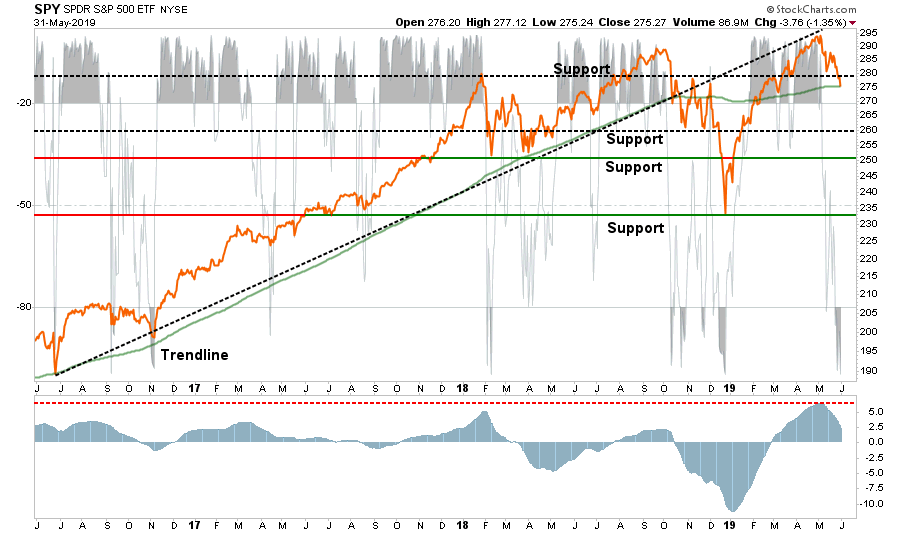
  • The "buy" signal in the lower panel was massively extended, as noted several weeks ago, which as we stated, suggested the reversal we have seen was coming.

  • The correction last week has set up a tradeable opportunity into June.

  • Short-Term Positioning: Bullish

    • Last Week: Add 1/2 position with a target of $290.

    • This Week: Hold position (full weighting)

    • Stop-loss remains at $275

The rally we have been discussing since the beginning of June has been a good trade and increased the value of our portfolios. 

However, for most investors, it has simply been a recovery back to the same level almost 2- months ago. 

This is why managing risk is important. 

Okay, now that you are up to date, let's talk about what the Fed said, didn't say, and what it means from here.

What The Fed Said, & Didn't Say

On Wednesday, the Federal Reserve completed their two-day FOMC meeting (Federal Open Market Committee) and provided their prepared statement afterward. 
It is worth noting it is the SAME statement following each meeting with only slight wording changes each time. The text below shows those red lined changes in the release from the last two meetings. I am only excerpting the more important points for today's discussion.

"Information received since the Federal Open Market Committee met in Marchyindicates that the labor market remains strong and that economic activity rose at a solid is rising at a moderate rate. Job gains have been solid, on average, in recent months, and the unemployment rate has remained lowGAlthough growth of household spending and business fixed investment slowed in the first quarter appears to have picked up from earlier in the year, indicators of business fixed investment have been soft.

The Committee continues to view sustained expansion of economic activity, strong labor market conditions, and inflation near the Committee's symmetric 2 percent objective as the most likely outcomes. In light of global economic and financial developments and muted inflation pressures, the Committee will be patient as it determines what future adjustments to the target range for the federal funds rate may be appropriate to support these outcomes,but uncertainties about this outlook have increased. In light of these uncertainties and muted inflation pressures, the Committee will closely monitor the implications of incoming information for the economic outlook and will act as appropriate to sustain the expansion, with a strong labor market and inflation near its symmetric 2 percent objective.

Wall Street voraciously searches for these changes to try a derive the Fed's intention about future policy actions. It is akin to reading the "tea leave" in the bottom of a cup.

It was the last sentence above which got the bulls excited as it was interpreted to mean rate cuts.

However, what the "bulls" missed is the Fed DID NOT say the "would" cut rates, only that they would monitor incoming data and act appropriately. 

"The Federal Reserve on Wednesday said it does not expect any rate cuts this year, but did forecast one for 2020." – CNBC

This is a far cry short of reducing rates 3-times this year, and more next year, pushing rates back towards the zero bound.

This leaves a lot of room for the markets to be disappointed. 

However, there is sufficient reason to expect the Fed will indeed cut rates, it is only a question of timing and by how much. 

As David Rosenberg penned last week:

"What does it mean when the real yield on the 5-year T-note is down to around 30-basis points and for the 10-year maturity, a mere 40-basis points? It's the bond market's way of foreshadowing the weak economy that lies ahead.

There can be little doubt that Powell took his cue from [the ECB's Mario} Draghi and the ECB's concern over the weakening growth backdrop and even deeper inflation undershoot in the Euro-area. I am talking about the recession. You know – the one that nobody 'sees.'"

Given that the Fed has a very limited "toolbox" currently, I would expect them to use rate cuts VERY sparingly. Considering rates fall on average between 3-4% during a recession, the Fed is starting at just 2.4%. From a historical perspective, when the Fed does engage in rate reduction programs, it has not been an ideal point to be heavily invested in the financial markets.
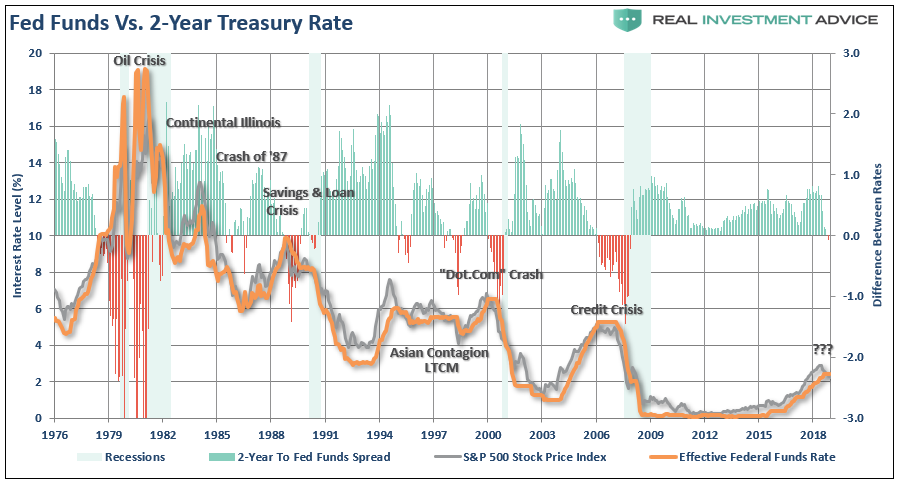
As noted by PNC this week:

"That would absolutely be a policy misstep. With industrial production data coming in ahead of expectations, retail sales ex-autos and gas beating up expectations, earnings season for Q1 beating and Q2 revisions moving in a positive direction, it just seems to me as if the backdrop doesn't warrant that swift of a policy reversal and that cuts really shouldn't be on the table." – Amanda Agati

Also, the 10-year yield is hovering at just 2% and seems the equity market is under appreciating the probability of a bad scenario which is being embedded into bond prices. Given the bond market is driven is a reflection of the "flight to safety" by investors, it suggests the "bulls" could be wading into a trap. 

(Note: it is NOT the inversion of yield curves which signal a recession, it is when those inversions reverse.)
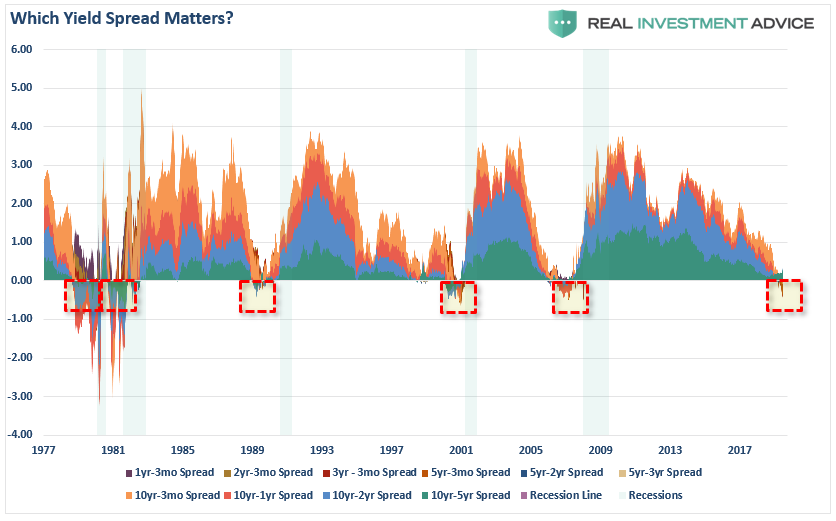
Lastly, the markets are already pricing in two events which haven't even occurred yet:

  1. Rate cuts

  2. Trade deal with China

There is a decent probability that neither happens soon, and could be a "sell the news" event when they do.

Let me reiterate something I wrote previously which I believe to be most important at this juncture:

"In 2008, when the Fed launched into their "accommodative policy" emergency strategy to bail out the financial markets, the Fed's balance sheet was only about $915 Billion. The Fed Funds rate was at 4.2%.
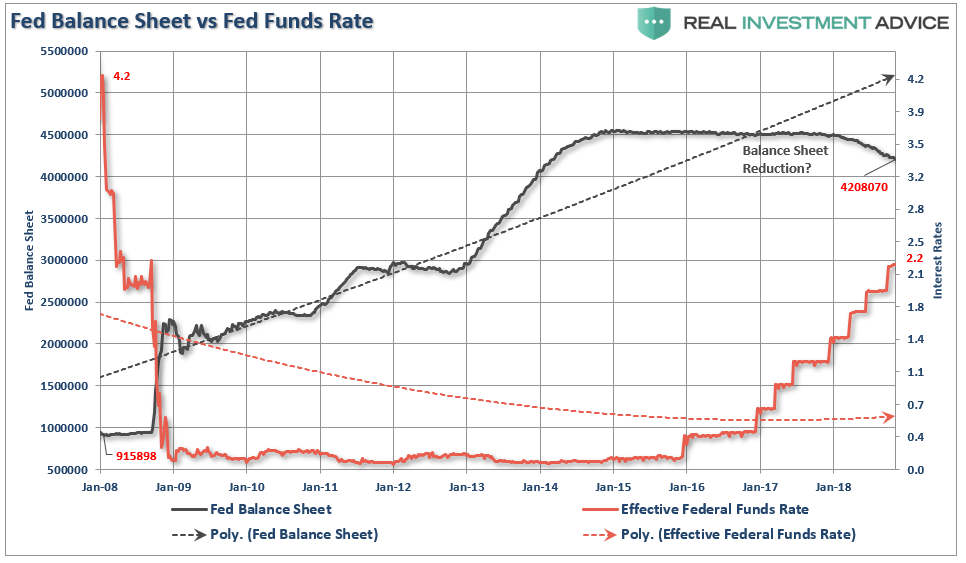
If the market fell into a recession tomorrow, the Fed would be starting with roughly a $4 Trillion balance sheet with interest rates 2% lower than they were in 2009. In other words, the ability of the Fed to 'bail out' the markets today, is much more limited than it was in 2008.
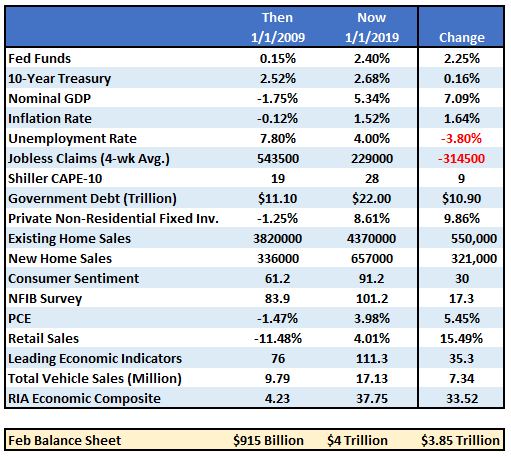
"The critical point here is that QE and rate reductions have the MOST effect when the economy, markets, and investors have been "blown out," deviations from the "norm" are negatively extended, confidence is hugely negative.

In other words, there is nowhere to go but up. Today, it is entirely reversed.

The extremely negative environment that existed in 2009, particularly in the asset markets, provided a fertile starting point for monetary interventions. Today, as shown in the table above, the economic and fundamental backdrop could not be more different."

Lowering interest rates and quantitative easing are "incentives." Incentives work when there is pent-up demand for a product, but are much less effective when everyone always has what you're offering.  

Bill Bonner had the best explanation:

"Investors' animal spirits were titillated brought last week by the Fed, which — in the wake of a deteriorating economy — seems ready to shift to Mistake No. 3 even before it has completed Mistake No. 2. 

You'll recall that Mistake No. 2 is raising interest rates to try to mitigate the damage done by Mistake No. 1 (leaving rates too low for too long). Mistake No. 3 is dropping them too sharply to try to undo the damage caused by Mistake No. 2."

What Happens Next

We recently suggested this "sellable rally" had room to go into the end of this month. That still seems to be the most likely case. However, July through September are going to become much more difficult from both an earnings and economic perspective. 
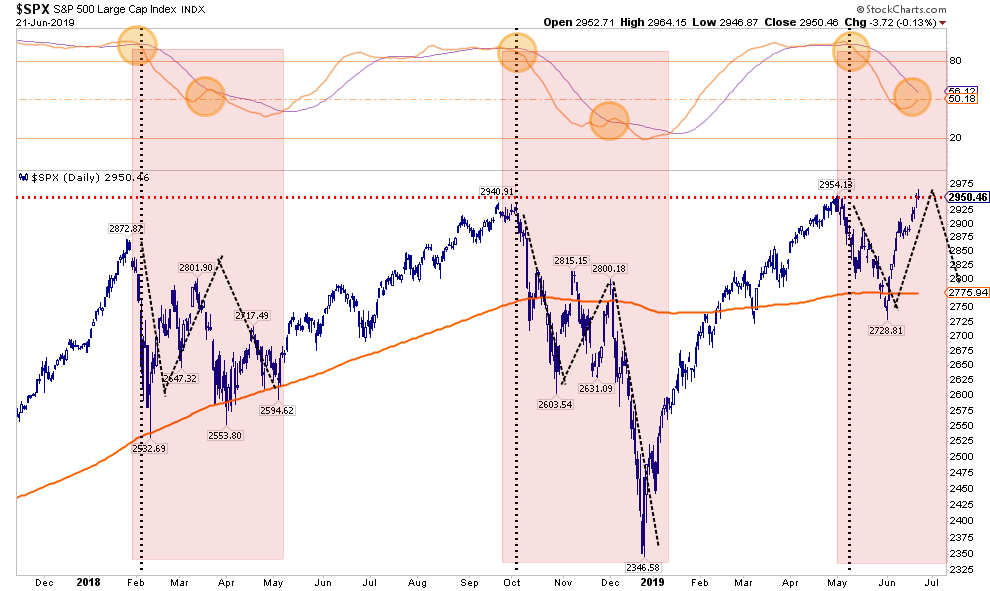
The red shaded bars denote the last two times that markets hit "all-time" highs coincident with an ongoing "sell signal" as denoted by the yellow circles. In both previous cases, the subsequent rally, while failing to hit new highs, almost reversed the sell signal before the markets turned lower again. While I am not suggesting that current market action will play out in the same fashion, it is worth considering before getting aggressively long-biased at this juncture.

More importantly, just about every other major index is NOT CONFIRMING the S&P 500's new highs. Small, Mid, International, and Emerging Markets are all suggesting that something isn't quite right, and even the "tech heavy" Nasdaq has failed to set new highs so far.
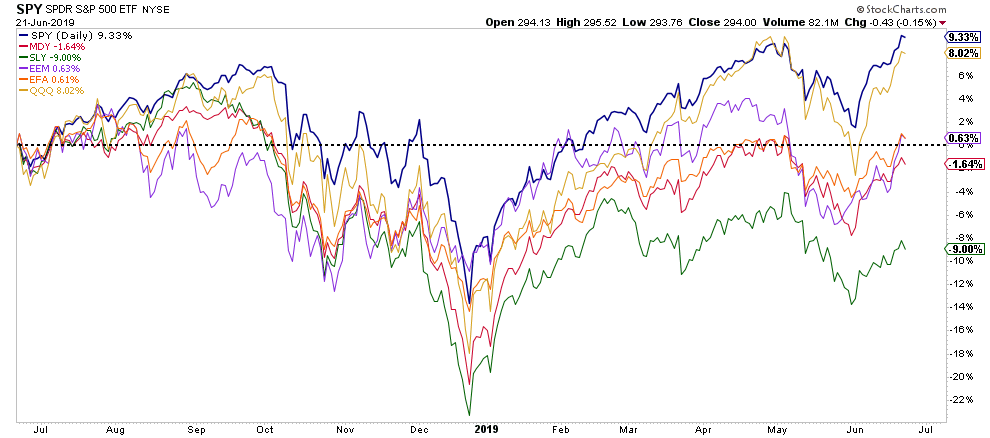
So, what is pushing the S&P 500 index to new heights. It has primarily been the rotation into "defensive positioning," which also suggests a "risk off" mood by investors. (This rotation is something we recommended to our clients in Mid-may.)
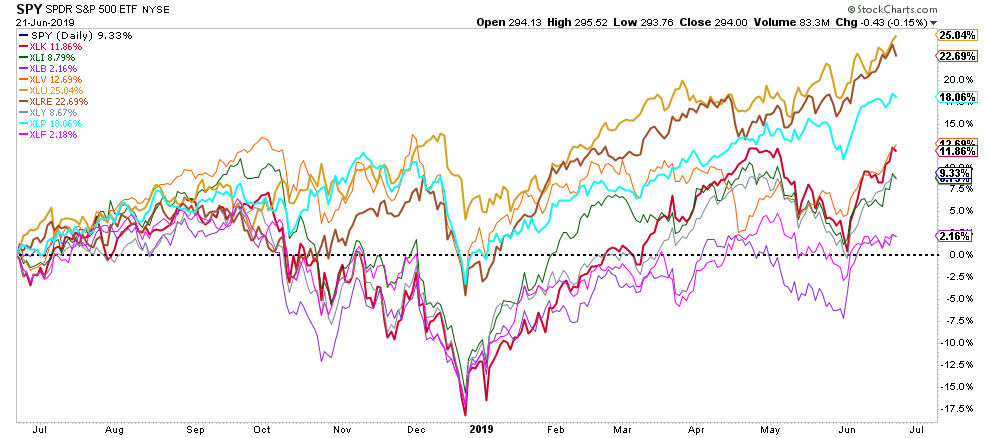
The risk is that the current breakout is another failed attempt in this 18-month long consolidation process. The chart below shows a more concerning backdrop. As noted above, it is when the 10-year less the 2-year yield spread starts to increase, combined with a monthly "sell signal," which as denoted major turning points in the market. 
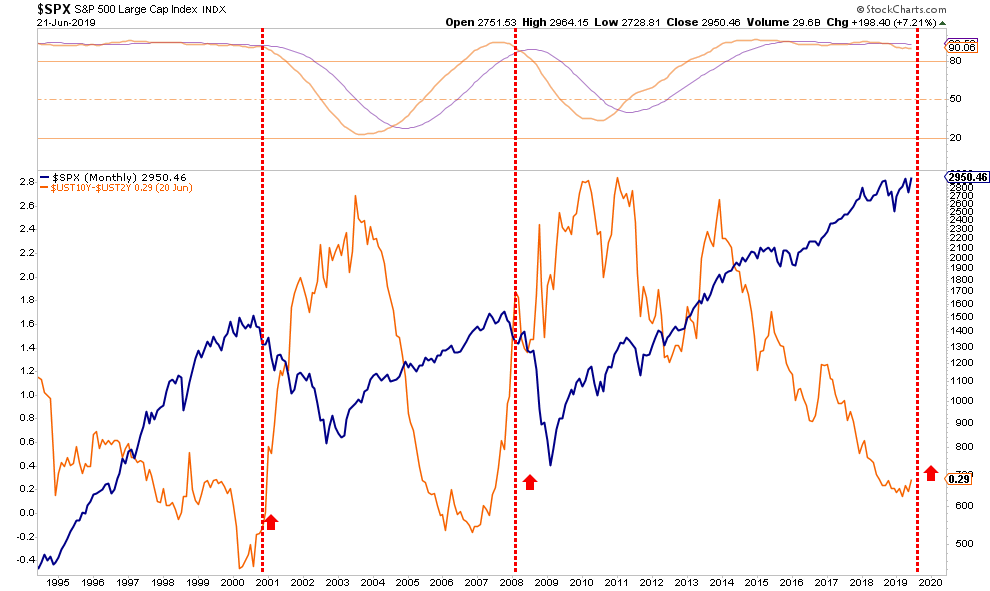
Therefore, we don't recommend buying the breakout just yet.

Why aren't we getting more bearish in our positioning? 

Simply because the market has done nothing wrong as of yet.

If the market can breakout, and confirm new highs, then a push towards 3100 is likely.

However, such a move would only likely be temporary and would only serve to further inflate current overvaluation and extensions of the market. Such will exacerbate the expected decline in late summer and early fall.

We suggest maintaining a long-equity base in portfolios, but continue to carry both higher levels of cash and hedges against a pickup in volatility. (We added Gold and Goldminers a couple of months ago for this very reason.)

Stay long for now, but I would not get too comfortable.

venerdì 21 giugno 2019

Existing Home Sales Tumble YoY For 15th Month - Worst Run Since Housing Crisis | Zero Hedge

Existing Home Sales Tumble YoY For 15th Month - Worst Run Since Housing Crisis | Zero Hedge

Existing Home Sales Tumble YoY For 15th Month - Worst Run Since Housing Crisis

After April's disappointing drop in all segments of the home-sales data, existing home sales were expected to rebound (again) in May and surprised modestly to the upside.

Existing home sales rose 2.5% MoM to 5.34mm in May (and saw a modest upward revision in April)

However, existing home sales have declined on a YoY basis for 15 straight months...

Home purchases advanced across all four regions, led by a 4.7% rise in the Northeast.

First time buyers accounted for 32% of sales nationally, unchanged from the prior month.

Finally, we note that the recent drop in existing home sales suggests a lagged response in mortgage purchase applications... even with rates collapsing...

As lower rates have apparently sparked a surge in prices as median home prices to a new record $277,700 - with a 4.8% YoY surge - the biggest spike since Aug 2018.

"The purchasing power to buy a home has been bolstered by falling mortgage rates, and buyers are responding," NAR Chief Economist Lawrence Yun said in a statement.

As Bloomberg notes, recent housing data have offered a mixed picture on the market, with housing starts falling from an April reading that was stronger than initially reported. Homebuilder sentiment deteriorated in June for the first time this year while permits gained, signaling a more robust pipeline of properties.


Inviato da iPad

domenica 30 settembre 2018

mercoledì 26 settembre 2018

The show in on!


Just after the FOMC statement (plus quarter point) market reacted slightly well, S&P500 was +0,22%.......

...... unfortunately the S&P500 future closed at -0,33%, touching few seconds before -0,39% (-0,32% just few minutes before closing) ...... got the problem ??


Considering hourly chart the situation is more evident ........ hanging the more market participants it's possible.... before "completing the chain"!! 😎😉

martedì 25 settembre 2018

Jamie Dimon: America Will Need 25 Years To Forgive Wall Street For The Crisis

JP Morgan CEO Jamie Dimon has never been one to shy away from the press. But barely two weeks after he boasted that he could defeat President Trump in a presidential race - inspiring speculation that the CEO of America's largest bank by assets is shadow-campaigning for the Democratic nomination - Dimon is once again making the media rounds, sitting for an interview with CNBC's Jim Cramer before delivering a widely reported address at the World Affairs Council in Philadelphia.

Dimon

It was at this latter event that Dimon offered what was probably the closest he's ever come to a mea culpa for Wall Street's recklessness in the run-up to the financial crisis. With the US economy finally booming again after a tepid, nearly decade-long recovery, Dimon predicted that the public will require 25 years to get over the financial crisis and finally forgive Wall Street.

Still, he believes the government "did the right thing" by casting moral hazard aside and immediately coming to the rescue of the struggling banks, leaving American consumers to shoulder most of the consequences for their reckless behavior.

Here's Bloomberg:

"It's going to be 25 years," Dimon, the CEO at JPMorgan Chase & Co., said Monday at a event sponsored by the World Affairs Council in Philadelphia.

Still, the government "did the right thing" to avoid a disaster, Dimon said, adding that the economy was facing the risk of another Great Depression.

Of course, as we have written extensively, not everyone agrees with Dimon's sanctimonious comments about how "right" the government was in bailing him out, and we suspect it will be a lot more than 25 years before he or the government is forgiven, as Michael Hudson recently noted:

Today's financial malaise for pension funds, state and local budgets and underemployment is largely a result of the 2008 bailout, not the crash. What was saved was not only the banks – or more to the point, as Sheila Bair pointed out, their bondholders – but the financial overhead that continues to burden today's economy.

Also saved was the idea that the economy needs to keep the financial sector solvent by an exponential growth of new debt – and, when that does not suffice, by government purchase of stocks and bonds to support the balance sheets of the wealthiest layer of society. The internal contradiction in this policy is that debt deflation has become so overbearing and dysfunctional that it prevents the economy from growing and carrying its debt burden.

Trying to save the financial overgrowth of debt service by borrowing one's way out of debt, or by monetary Quantitative Easing re-inflating real estate, stock and bond prices, enables the creditor One Percent to gain, not the indebted 99 Percent in the economy at large. Therefore, from the economy's vantage point, instead of asking how the banks are to be saved "next time," the question should be, how should we best let them go under – along with their stockholders, bondholders and uninsured depositors whose hubris imagined that their loans (other peoples' debts) could go on rising without impoverishing society and preventing creditors from collecting in any event – except from government by gaining control over it...

...

President Obama, Treasury Secretary Tim Geithner and their fellow financial lobbyists at the Federal Reserve and Justice Department are credited with saving "the economy," as if their donor class on Wall Street was a good proxy for the economy at large. "Saving the economy from a meltdown" has become the euphemism for saving bondholders and other members of the One Percent from taking losses on their bad loans. The "rescue" is Orwellian doublespeak for expropriating over nine million indebted Americans from their homes, while leaving surviving homeowners saddled with enormous bubble-mortgage payments to the FIRE sector's owners.

What has been put in place is not a restoration of traditional status quo, but a reversal of over a century of central bank policy. Failed banks have not been taken into the public domain. They have been enriched far beyond their former levels.

Additionally, in what appeared to be another gesture of deference to Trump, Dimon said he agrees with the president that the US needs proper border security and immigration reforms.

He added that Trump is right about trade issues he has been raising with China, but wrong in using tariffs to address the problem.

Just in case you got the wrong idea, Dimon clarified to CNBC that, though he has no plans to run, he believes a CEO could make a good president, adding that Trump "was a CEO."

"I would not say a CEO can not be a good president," Dimon said in an interview with CNBC's Jim Cramer on "Squawk Alley." President Donald Trump "was a CEO," he added.

"Jamie, you know what you sound like when you say these things, right? You sound like a politician," Jim Cramer said.

"I'm a patriot," Dimon said.


Found: The Driving Force Behind The Economy


Found: The Driving Force Behind The Economy

Fake news!

And this is how a meme is created. Complete shulbit will do it for you. Even the Weather Channel is faking it to get eyeballs.

And as if getting caught shulbitting folks would have caused one to stop and say, "Whoah there big boy, maybe we should just report, you know, what's actually happening." Nooo!

Doubling down:

And people wonder why the mainstream media is no longer trusted?

It's a One Way Street

President Donald Trump's national security adviser, John Bolton, says the ICC court is "illegitimate".

"For all intents and purposes, the ICC is already dead to us."

This is significant and to be expected.

We can expect the global cohesion that we enjoyed in the last crisis of 2008 to continue to be less cohesive going forward.

Criminal Probe

I've never tried one but I hear they're worse then civil.

Which makes this a pretty big deal.

As reported by Bloomberg:

Tesla is Facing U.S. Criminal Probe Over Elon Musk Statements.

"Federal prosecutors opened a fraud investigation after Musk tweeted last month that he was contemplating taking Tesla private and had "funding secured" for the deal, said the people, who were granted anonymity to discuss a confidential criminal probe."


And this response from Tesla:

"We have not received a subpoena, a request for testimony, or any other formal process. We respect the DOJ's desire to get information about this and believe that the matter should be quickly resolved as they review the information they have received."

And once this can of worms is opened, who knows what gets found in the entrails of Tesla's accounting department.

"Now that Musk's tweeting has attracted the Justice Department's attention, investigators there could extend their review to other public statements made by the CEO about the company's health, according to one of the people familiar with the matter. Authorities could also look into the circumstances surrounding the resignation of Tesla's Chief Accounting Officer, Dave Morton, after less than a month on the job, the person said."

Luckily for Elon, gullible, dumb investors in their naïveté don't mind too much. They're betting on iron man after all. Hero worship of the most extraordinary kind. The stock rallied $10 on the news.

On the other hand, the bonds are getting spanked like a transvestite in a leopard skin thong — down at a smidgen over 85. Oh and by the way, that's junk status if you're not familiar with such things.

And really, if I'm to be honest with you, I think that seals it. Why?

Well, Tesla can't do a capital raise while they're under criminal investigations and they sure as hell need to raise capital.

The other thing is they're outta time and bureaucracies aren't really known for their speed so we can reasonably except this investigation to take a good amount of time; time Tesla simply doesn't have.

For the time being though, the show must go on.

And speaking of a show....

Wowza!

I've grabbed a half dozen weed stocks at random for your gentle eyes. Take a look.

The funniest of the lot is, of course, Tilray (TLRY), which actually hit $300 a share a few days ago. That makes it worth more than some countries, and while I don't profess to know much about the stock, looking only at the basics I can tell you this: It isn't. Worth. $15billion.

Shorting is tough, and I'll be the first to admit I rarely short.

What I do know is this. Getting long cannabis stocks here and now impresses me as batshit crazy. These things are like the cryptos of 2017. Full of frauds, hype, hope, and happy investors. Not where you're likely to find asymmetry on the long side.

Talking of crazy...

How to Return to the Dark Ages

The PC crowd over in Sweden are hard at work ensuring "disadvantaged minority groups" aren't taken advantage of and attempting to mask the existence of facts. Let's not only pretend that things aren't what they evidently are but let's force everyone else to agree with our asinine opinions.


Hesslow cited empirical research which supports the idea that there are differences between men and women which are "biologically founded" and therefore genders cannot be regarded as "social constructs alone".

The university rector had ordered a "full investigation" into the case and said that there "have been discussions about trying to stop the lecture or get rid of me, or have someone else give the lecture or not give the lecture at all."

There is a reason that the period of enlightenment in the 18th century brought about the birth of what we today know as and recognise as Western civilization. It was a period of truth seeking, freedom of thought, expression, and action.

If we're to be honest, the reason these idiots have modern plumbing and a shop that makes their soy lattes is rooted in this. And now, day by day, they're actively tearing it down. This is NOT good.

The Driving Force of Economic Growth and Development

Queue the hate mail.

After Years Of Pain, Odey Is Suddenly The Year's Best Performing Hedge Fund

It had been a tough several years for LPs in Cripsin Odey's hedge fund, who has for years predicted a market crash which, well, has yet to happen, and suffered dramatic losses as his predictions failed to pan out with his flagship hedge fund plummeting in 2016 and 2017. That did not change his outlook, however, and in his latest newsletter sent earlier this month, he once again flagged his bearish views.

His funds are "positioned for more difficult times, invested in those companies that would be able to take advantage of a crisis, should it come along," he wrote. "Who knows when that happens? As Noah said to the doubters, 'How long can you tread water?'"

However, thanks to a correct bet on Italian bond volatility earlier in the year, The Odey European Inc. fund, which manages about $700 million, gained about 29% this year through Sep. 14, according to the latest HSBC weekly hedge fund tracker, making it the top performing hedge fund in 2018 ranked by HSBC.

And now, in a delightful irony, Odey is taking on even greater gains - on the long side of his book.

As Bloomberg rerorts, the London-based manager is one of the largest shareholders of both Sky Plc and Randgold Resources, the two-biggest gainers of the STOXX Europe 600 Index on Monday, amid a flurry of merger announcements. Randgold surged more than 6% after Canada's Barrick Gold agreed to buy the gold miner in a $18 billion deal, while Sky surged as much as 8.8% after Comcast won the auction for the U.K. broadcaster with a bid of 17.28 pounds a share, a premium of 9% to Sky's Friday closing price.

"I'm very pleased. It was a great price," Odey told Bloomberg of Sky the final Sky deal in a phone interview, adding that he added to his bets when the shares traded at 14.92 pounds. Odey had previously predicted that a deal could fetch as much as 18 pounds a share.

And so, if the world really does end tomorrow, all the pain his LPs took for so many years will finally have been worth it. The only question is how many of them are left.