MARKET FLASH:

"It seems the donkey is laughing, but he instead is braying (l'asino sembra ridere ma in realtà raglia)": si veda sotto "1927-1933: Pompous Prognosticators" per avere la conferma che la storia non si ripete ma fà la rima.


venerdì 20 luglio 2018

Central Banks Are Using The Trade War To Hide Their Direct Influence On Stocks

There has been a lot of confusion lately in the mainstream economic media as well as in independent media circles as to the behavior of stock markets in the wake of the recently initiated global trade war. In particular, stocks suffered one of the longest runs of negative days in their history in June, only to then spike just after Donald Trump "officially" began trade war tariffs in July. The expectation by many was that the headlines would cause an immediate and continued downturn in equities markets, but this was not the case. Many analysts have been left bewildered.

This is an issue I have touched on multiple times since the beginning of this year, and it is something I predicted long before Trump's election in 2016. But it is obvious that the schizophrenic nature of stocks needs to be addressed in a very concise, no-holds-barred fashion, because there are still far too many people who are looking at all the wrong causes and correlations.

First, let's be clear: stock markets are NOT tracking the news headlines. The past month should have proved this if there was any previous doubt.

It is hard for investors and some analysts to grasp this fact, primarily because for at least the past few years it appeared as though stock markets were utterly dictated by headlines out of Bloomberg, Reuters and other mainstream media outlets. Once investors and analysts became used to this narrative it was difficult for them to adapt when the dynamic changed. They are still living in the past based on an assumption that was never quite correct to begin with.

In reality, headlines never actually dictated stock prices; it was always the Federal Reserve among other central banks.

As I and others have noted consistently, stock market valuations for the past several years have tracked almost perfectly with the Fed's balance sheet. That is to say, every time the Fed purchased more assets and increased the balance sheet, stocks went up.

After years of the notorious "Fed Put," we now have an entire generation of investors and market writers that have never experienced a stock environment in which equities actually fall according to the health of their corresponding companies or the economy at large. The past year has been a bit of a shock for them, and it's only going to get worse.

The Fed's large scale interventions in stocks are now essentially over, which is exactly why stocks are no longer hitting new historic highs every month as they used to. The massive bull market rally of the post credit crash world of 2008 has stalled, and here are the reasons why.

Central Banks Tapering QE

The Federal Reserve was only the first to begin tapering its purchases of treasury bonds. Japan is now in the midst of what many are referring to as a "stealth taper" of its own bond purchases. TheEuropean Central Bank has announced it will likely end its QE program by the end of this year. Bond purchases helped first to support the ever growing debt burden of the governments and nations in question, but along with artificially low interest rates, it made bond investment less desirable in terms of profits. This pushed the majority of investors into stocks, where profits were essentially guaranteed by the central banks.

Now that QE is ending around the world and rates are rising along with yields, bonds are becoming a competing asset, luring investors away from stocks once more.

Central Banks Raising Interest Rates

The Federal Reserve has been raising rates consistently since the end of 2016, exactly as I predicted they would before the U.S. election.  Interest rates are a direct influencing factor in stocks — low interest rates and cheap overnight loans to corporations by the Fed allowed these companies to continually buy back their own stocks, thereby decreasing the number of stock offerings available on the market and artificially boosting the value of the stocks that were left circulating.

Corporation have taken on a historic level of debt not seen since 2007 in order to keep their stocks prices high. Now that interest rates are rising, the party is almost over. The only source of capital left to fuel the stock buyback bonanza has been the Trump corporate tax cut.  Instead of using this cut as a means to increase employment, innovation and to bring manufacturing back to the U.S., companies have instead squandered it on boosting the stock market yet again. However, as we have seen this year so far, without the aid of cheap money from the central bank the effects of stock buybacks are diminishing.

How long will it take for corporations to completely exhaust this last revenue stream? I predict stock buybacks will die off by the end of this year. And with rising interest rates, all that debt they took on in order to keep stocks elevated will now become rather expensive to hold onto. Once stock buybacks diminish, markets will crash.

It's important to note that the Fed is not the only central bank that is raising interest rates. The Bank of Canada and the Bank of England among others are beginning to push higher rates as well.

Federal Reserve Cutting Balance Sheet (And Hiding The Effects)

The Fed has been the single most important trigger for stock markets. Period. As noted above, it was the Fed that created the historic bull market rally after the derivatives collapse. Jerome Powell, the current chairman of the Fed, stated back in 2012 that this was the case, and also made statements on what would happen if the Fed ever raised interest rates and cut asset purchases, ending the central bank's "short volatility position."

What did Powell predict in 2012? Essentially, a stock market crash. And, yet, as the new Fed chair he is implementing the exact measures he warned about back in 2012.

With every new balance sheet cut and rate hike, the Dow Jones in particular tends to lose 1,000 points or more. The damages have been mitigated by continued stock buybacks from corporations as well as smaller asset purchases by the Fed after the fact, but as already mentioned, the buyback stop gap will be ending shortly.

I should also note that the St. Louis Fed recently ended its reporting of data on cuts from week-to-week (known as FRED data). There are other sources for this data, but they mainly show how much was cut per month, not WHEN in the month those cuts were made. The St. Louis data was originally reported on a weekly basis, which means we can more closely compare Fed asset cuts to stock market movements.

If we look at a 2018 year-to-date chart of the performance of the Dow Jones side by side with the St. Louis FRED chart of balance sheet cuts before the Fed discontinued it, we can see for example that on January 24th the Fed made a dramatic cut in their balance sheet, and two days later on the 26th the Dow began to drop precipitously.  On February 7th the Fed increased asset purchases slightly, and only two days later stocks began to recover.  On February 21st the Fed cut dramatically once again, and once again stocks plunged.  On March 2nd the Fed added a smaller level of assets and stocks recovered.  I would also note that when the Fed does not cut, but simply keeps assets mostly static as in May, stock rise.  Like clockwork, only when the Fed dumps its balance sheet do stock markets fall.

I believe the Fed is not attempting to hide the size of its asset dumps when it discontinued FRED data, but it is attempting to hide the exact TIMING of when the cuts occurred.  In this way, they hope to distance themselves from any blame by making it more difficult to connect Fed cuts to specific weekly plunges in stock markets.

As a side note, the argument that market plunges and rallies are somehow due to algorithmic computers and not the Fed is misguided.  FRED data was normally released long after stock movements had already begun.  Meaning, any influence algorithms might have had came AFTER the fact, not before or during the Fed's balance sheet actions.  Algos are not magic despite predominant and odd misconceptions; they DO NOT predict the timing of Fed asset cuts or purchases.  They do nothing more than lag behind the already direct influence of the Fed on equities.

The Fed is also suddenly attempting to change the way it reports on Yield Curve data, which has in the past been a very accurate indicator of when a recession will take place.  Why?  Most likely because the Fed has been pushing the claim that the economy is in swift recovery when their own data shows that it is actually in swift decline.  The Fed needs a rationale for their rate hikes and balance sheet cuts - actions which they KNOW will cause the next financial crash.  The central bankers are hiding FRED data and Yield Curve data because they are deliberately sabotaging what remains of the US economy, and they are seeking to do this without taking any responsibility.

Trade War Distraction

The trade war continues as the most effective possible distraction from central bank activities. In every instance of a stock market decline, which takes place after every instance of a Federal Reserve cut in the balance sheet or an interest rate hike, Donald Trump also seems to make yet another trade war announcement.  During Jerome Powell's most recent congressional hearing, discussion strayed far from any examination of the Fed's culpability for economic weakness.  Instead, the majority of questions revolved around the "threats" presented by Trump's tariffs and their negative affects on markets.

The only outlier has been the "official launch" of the trade war with China, which saw stock markets suddenly rise.  I have witnessed numerous analysts and commentators frantic over the fact that stocks did not fall on the headlines. Some have even suggested that the investment world "loves the trade war."

What these commentators do not understand is that the headlines are meaningless and the trade war has little to do with the behavior in equities. It is the Federal Reserve and to some extent other central banks that are controlling stock market prices, along with corporate stock buybacks which are facilitated by the Federal Reserve's low interest rates.

I've said it before and I'll say it again — what we are witnessing is a controlled demolition of the U.S. economy, and stock markets are merely an extension of this process. They are a lagging indicator, not a leading indicator. Stocks fall when the Fed dumps more assets, and these cuts are growing larger and larger as 2018 drags on. Stocks rise when the Fed slows asset cuts in a particular week, or when companies initiate more stock buybacks. That's it. That is all there is. There is nothing else to look at when predicting what stocks will do at any given time.

The facade will end when balance sheet cuts expand to a point at which buybacks cannot keep up and the slack in markets grows too fast.  Or when stock buyback cash runs out (probably by the end of this year). The trade war can and will cause various problems within the global economy, but the greater cause of fiscal distress will always be central banks. They are to blame for any future crisis.

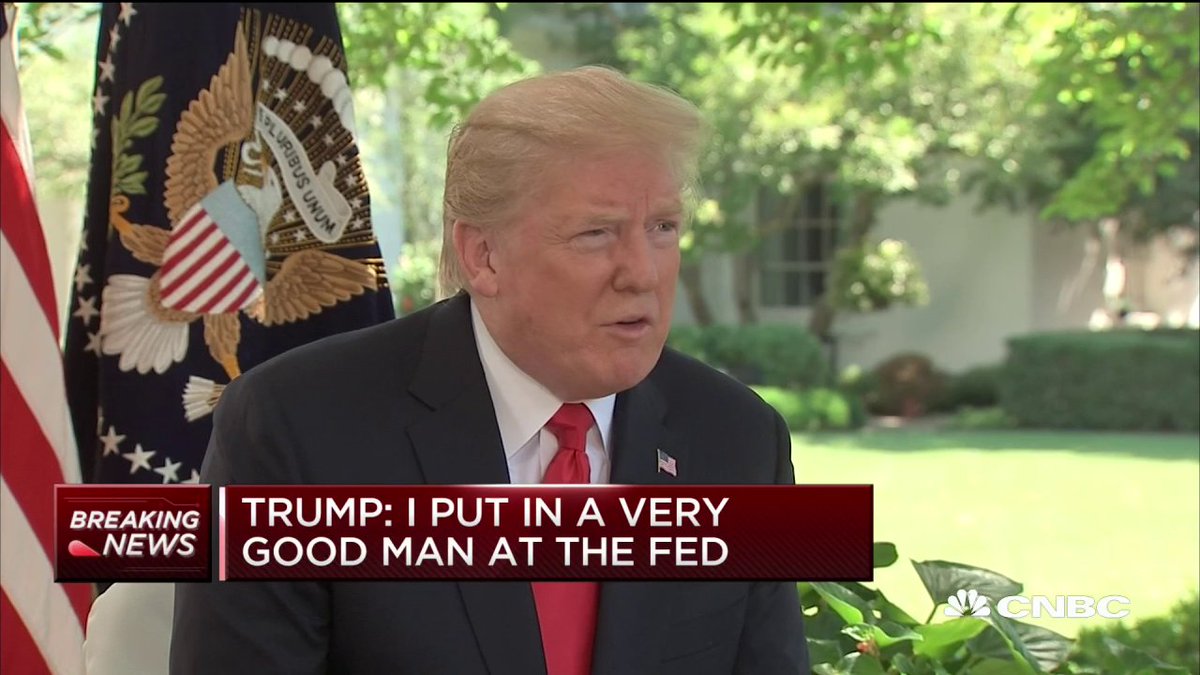
Trump Blasts Fed: "Not Thrilled" About Rising Rates, Says Strong Dollar "Disadvantageous"

Update: and as has been the case recently, the White House had to immediately clarify what Trump meant:

  • WHITE HOUSE SAYS TRUMP `RESPECTS THE INDEPENDENCE' OF FED
  • WHITE HOUSE SAYS TRUMP ISN'T INTERFERFERING WITH FED DECISIONS

In response, the USD staged a feeble bounce which is already being faded.

* * *

It should perhaps come as no surprise that the president who once called himself a "low interest rate guy", has finally laid into the Fed, and during an interview with CNBC's Joe Kernan, criticized the US central bank saying that he is "not thrilled" about rising rates, and would prefer a weaker dollar to offset the Chinese Yuan which is "dropping like a rock."

"I'm not thrilled," he told Joe Kernen.

"Because we go up and every time you go up they want to raise rates again.

I don't really...

I am not happy about it. But at the same time I'm letting them do what they feel is best."

"But I don't like all of this work that goes into doing what we're doing."

Trump also said he's concerned that the timing of the Fed's rate hikes may be poor and the resulting strong dollar will put the U.S. at a "disadvantage" while the Fed's counterparts like the European Central Bank and the Bank of Japan maintain loose monetary policy.

The statements, which could have comes from Turkey's Erdogan on any given day, and which will immediately be seen as threatening the Fed's independence, is sure to spark another meltdown, this time in the business media.

The president acknowledged that his comments are unusual but said he doesn't care.

"Now I'm just saying the same thing that I would have said as a private citizen," he said.

"So somebody would say, 'Oh, maybe you shouldn't say that as president. I couldn't care less what they say, because my views haven't changed."

"I don't like all of this work that we're putting into the economy and then I see rates going up," he said.

Finally, hinting that trade war is about to become a full-blown currency war, Trump confirmed that he is well aware of what is going on China where the Yuan has been crashing relentlessly for the past month, and said that the Chinese currency is "dropping like a rock"... which it is:

Full interview below:

Gold spiked:

And stocks hiccuped...

And while Trump's unorthodox comments are sure to set off a firestorm of criticism and complaints that Trump is seeking to eliminate the Fed's independence, which of course it isn't, because as Ben Bernanke's former advisor once admitted, "A lot of people would be stunned to know the extent to which the Federal Reserve is privately owned", here is an excerpt from the NYT, showing how previously US presidents handled Fed "independence":

However, since it is all about preserving the "narrative", the blowback was immeidate with Former Dallas Fed President Richard Fisher telling CNBC that Trump is out of line.

"One of the hallmarks of our great American economy is preserving the independence of the Federal Reserve. No president should interfere with the workings of the Fed," Fisher said. "Were I Chairman Powell, I would ignore the President and do my job and I am confident he will do just that."

As China Suffers Its Biggest Bankruptcy Of 2018, The PBOC Finally Panics

One month ago, when discussing the recent surge in Chinese corporate bankruptcies, we asked "Is It Time To Start Worrying About China's Debt Default Avalanche." Just a few weeks later, the answer appears to have been yes, and not only because of the new quasi-QE policy unveiled by a suddenly concerned PBOC last night, which "encourages" Chinese banks to buy AA- rated, i.e. stressed corporate bonds, those which have seen their spreads blow out in recent months on fears of growing defaults...

... but because just one month later, one of China's biggest corporate-debt defaults hit, with the collapse of a coal mining giant that had taken advantage of China's wave of cheap and easily accessible credit until Beijing once again changed the game with their aggressive deleveraging campaign, which sent shadow credit creation crashing to record lows just last month.

But before we go into the details, a reminder what we wrote in October 2015, when we showed that when credit was easily available, more than half of China's commodity companies were unable to pay the interest on their debt as their EBIT/Interest ratio was <1.

As we noted at the time, all it would take is another down cycle in commodity prices for mass defaults to become a staple in China's massively overleveraged economy.

And for investors in China's Wintime Energy, that time is now.

To be sure, for a long time, it was smooth sailing for the coal miner: as Bloomberg reports, the company from northern grew and grew and grew, but mostly thanks to an unprecedented increase in its debt, which quadrupled in less than five years, ending up with a debt tab of 72.2 billion yuan ($10.8 billion).

The surge in Wintime debt came amid a near-doubling in size of China's domestic bond market, now roughly $12 trillion and the world's third largest. The government had encouraged companies to use bonds for financing as they embraced financial innovation to make the economy less dependent on state-owned banks.

Alas, the debt-fueled party is now over, and the company had no choice but to default after it was unable to rollover its debt, an event which to Bloomberg "illustrates why this year will be China's worst yet for corporate defaults."

Initially, Wintime's strategy made sense: borrow to fund acquisitions and expand into areas including finance and logistics. And as long as  borrowing costs were low, funding was easy to get and the miner took full advantage of creditors' largesse.

However, things changed in 2016, when President Xi Jinping relaunched an aggressive deleveraging campaign, and put emphasis on reining in financial risks, after China's first great attempt to reduce debt crashed and burned in the summer of 2013 when overnight funding costs exploded and nearly took down the country's financial system.

Fast forward to July when Wintime became the largest bankruptcy in China (so far) in 2018, when it defaulted on 11.4 billion yuan of debt after it failed to pay a local bond this month.

That said, it will hardly be the last because as we showed recently, through the end of May, there had already been no less than 20 corporate defaults, involving more than 17 billion yuan, a shockingly high number for a country which until recently had never seen a single corporate bankruptcy, and a number which prompted not only Chinese banks to pull back from lending to other firms that use the funds to buy bonds, but also last night's PBOC easing response.

But how did no alarm bells go off anywhere as Wintime's debt exploded without a commensurate increase in the company's cash flow? Simple: as Bloomberg admits, the trouble was that local buyers had little experience in doing credit research, and the local debt-rating agencies lacked the kind of differentiation among borrowers found overseas. And the punchline:

"There was little need for due diligence until China began allowing defaults in 2014."

Which is a problem because as Qin Han, chief fixed income analyst at Guotai Junan Securities, wrote, "China's economic growth was largely driven by debt and its corporate debt looks like a Ponzi scheme."

Qin also predicted that absent a government intervention, an avalanche of defaults is coming as "more firms may give up on repaying debt if they encounter financing difficulties."

Which they are: because with authorities taking measures to curb leverage by clamping down on shadow financing, boosting money-market borrowing rates and tightening regulations on the asset management industry, companies are increasingly running into those - and more - difficulties.

Nowhere is it easier to see the changing nature of China's "Ponzi" corporate debt history than in the financing efforts of Wintime itself, which after issuing more than 10 billion yuan of bonds in 2016 and again in 2017, was only able to find buyers for 3.6 billion yuan so far this year, according to Bloomberg data show. Why? Surging interest rates of course: Wintime's borrowing cost for one-year bonds soared to 7% in 2018 from 4.5% in 2016.

The party officially ended on July 5 when the company admitted it would not be able to meet its obligations and Wintime defaulted on a 1.5 billion yuan note, triggering cross-defaults on 13 of its other bonds totaling 9.9 billion yuan. Of course, angry stockholders have been left in the void, with shares suspended from trading from July 5.

But wait's there more.

Recall that just last week we warned that China was threatened by a "vicious circle of panic selling" from marketwide margin calls, as a result of the massive amount of stocks pledged as loan collateral, which according to some estimates is as high as $1 trillion and represents an aggressive means of obtaining funding - one that is constantly under threat of margin calls - and as a result is increasingly under scrutiny in China. .

As it turns out, Wintime was also a poster child for its involvement in share pledging: Wintime Energy's parent as of the end of March had pledged almost all its shares in the subsidiary as collateral for loans, according to public filings.

And now that the shares are not only worthless, but also halted, those counterparties who expected to be repaid in full, or even in part, are out of luck.

Of course, the scrambling parent has made some progress in obtaining credit lines to repay its stock-pledged by signing a strategic cooperation agreement with five banks including China Development Bank and China CITIC Bank. But all that would do is kick the can: after all at this point the company is using debt to repay another piece of debt, one which is for all intents and purposes worthless. Furthermore, the new credit line may have little impact on the ability to repay debt, if lenders impose strict covenants and seek assets for collateral.

* * *

With Wintime down, bond investors want to know where the default wave will strike next. Unfortunately, there are plenty of of targets: the average debt-to-common equity ratio at listed companies in China climbed to 100% at the end of 2017, the highest in more than a decade, according to Bloomberg. The problem is three-fold: i) as a result of the recent emerging market swoon and commodity bear market, indebted companies are suddenly generated far less cash which puts them at far higher risk of default, ii) Chinese coprorate debt is up against a shrinking financing universe: the shadow-banking sector contracted by 691.7 billion yuan in June, the biggest net monthly drop on record, and iii) rates for deeply indebted companies have been rising sharply.

That explains why the PBOC on Wednesday announced it would use its Medium-Term Facility, or MLF, which currently has 4.4 trillion yuan outstanding...


...to support the local bond market and banks, especially those that have invested in bonds rated AA+ and below.

In other words, the central bank confirms that China's debt mountain is indeed a Ponzi Scheme as the Guotai Junan analyst explained, however instead of this particular bubble to burst - something it can not afford to do as it would risk widespread public dissent and anger - the PBOC decided to do the only thing it could: kick the can, again.

We give the last words to Gary Zhou, director of fixed-income at China Securities International, who said that "financial institutions were too generous in lending to firms a few years ago but not anymore. Lower investor demand is now met with huge maturity wall. Investors should watch out for default risks and how restructurings are done."

They should, unless the PBOC disintermediates banks entirely, and proceeds to buy near-insolvent corporate debt directly on its account, in line with what both the BOJ and ECB are doing. Last night's news confirms that this is precisely what the central bank is doing.


The Fonzie-Ponzi Theory Of Government Debt

This post is excerpted from my book Economics for Independent Thinkers, although with some updating. It seems relevant after the CBO's latest long-term budget outlook, which in its optimistic"baseline scenario" called for America's net federal debt to double over the next 30 years, rising from 76% of GDP in 2017 to 152% in 2048.

Before reaching this chapter or even picking up this book, I imagine many of you were already loosely divided into the two major camps of the public debt debate.

The first camp is already concerned and doesn't need my research to form an opinion. These people stress the math involved in borrowing - the idea that you get do extra stuff today, but you have to somehow pay for it in the future.

Meanwhile, those in the other camp ask, "So what?" They might argue that America will make good on its debt because "it always does." Or they'll point confidently to America's unique advantages as a military superpower, paragon of political stability, and steward of the world's predominant reserve currency. Confronted with the lessons of history, they'll say, "This time is different."

But what exactly is it that may or may not be different? It's important to draw a distinction between two concepts of debt limits:

  • The Fonzie–Ponzi transition. At what point does it become virtually certain that a debt problem won't be resolved without a credit event?

  • The Keynesian endgame. At what point does the ability to bear more debt break down completely and actually trigger the credit event or hyperinflationary money printing?

I'll explain Fonzie–Ponzi first. Charles Ponzi was the perpetrator of a pyramid scheme, soon to be called Ponzi scheme, that the Boston Post exposed in 1920. It's fair to say that Ponzi, who lived extravagantly while his scheme was underway, knew how to manipulate people. He shared that particular skill with Fonzie, although he was a scoundrel, whereas Fonzie was a well-liked sitcom character. If you watched enough Happy Days back in the day, you know that "The Fonz" had a keen understanding of human nature. You also know that impressing friends and foes with his unbounded confidence was a huge part of his alpha-male badassness. I still remember watching the "Richie Fights Back" episode and puzzling over the revelation that Fonzie's tough-guy image was a confidence trick. Fonzie asks Richie, "In the entire time you've known me, have you ever seen me in a fight?" Richie's answer: "Well no, but that's just because the other guy always backs down first." In other words, it was no George Foreman–like string of knockouts that made Fonzie fearsome. It was attitude, reputation, and a commanding voice, along with a self-described "majestic bearing."

Fonzie soon became my word association for other confidence tricks. For example, paper currencies are Fonzies because their value rests entirely on confidence in the governments that back them. And where do Ponzi schemes fit in? Well, Ponzi schemes have characteristics that don't quite fit The Fonz. Namely, they need an endless supply of participants to sustain confidence and stay alive. Once the participant pool depletes as it eventually must, Ponzi schemes are revealed as scams. Whereas Fonzies can persist indefinitely (at least in theory), Ponzis must eventually collapse.

Ideally, public debt would always cruise along in Fonzie mode. Governments would rely on the confidence of their creditors, but without taking too many liberties with those creditors. But in reality, finances sometimes deteriorate and push public debt into Ponzi territory. The precise point where this transition occurs depends on the amount of austerity that's needed to put public debt ratios on a clear downward path, as well as the likely effects of that austerity. Instead of using numerical measures (for now), I'll say that restoring discipline at the Ponzi point would cause the economy to break down for an unusually long period, failing to create jobs or growth. The downturn may or may not meet the textbook definition of a depression, but it would lead to depression-like joblessness. Think of current circumstances in Greece, for example.

The Ponzi characteristics of the no growth, no jobs scenario are based on politics. Politicians are sure to second-guess austerity in a depression or depression-like economy. If they didn't, they'd be pilloried and voted out of office, replaced by populists and demagogues. Demagoguery thrives in difficult times—by whipping up a hurricane of discontent. And warnings of fiscal ruin at an indeterminate time in the future? They carry all the force of a gentle breeze. Political realities ensure that short-term thinking carries the day, whereas the Cassandras who insist on fiscal responsibility fade away.

With austerity becoming a bad word in such challenging circumstances, debt resumes its climb toward a higher threshold, one that brings a more destructive outcome. That ultimate threshold - mainstreamers call it debt tolerance, whereas I'm joining the heterodox thinkers who call it the Keynesian endgame - is when investors refuse to lend more money, forcing default or hyperinflationary money printing. It then becomes obvious that the government's borrowing was a Ponzi scheme. It needed an endless supply of participants to stay alive, but the appetite for debt isn't endless.

The difference between the Ponzi point and the Keynesian endgame is crucial. At the Ponzi point, the game isn't over just yet, but it's a foregone (if not widely recognized) conclusion that you're on a path in that direction. The path is firmly established because measures to curb deficits would wreak havoc on the economy and change the political calculus about austerity. Also, investors remain in the game at the Ponzi point, happy to hold government debt, in the same way that successful Ponzi schemers are able to find willing participants right up to the end. Large, developed nations, such as the United States and Japan, can sail right past their Ponzi points with nary a flutter in the financial markets. As I'll argue in a moment, Japan has already passed its Ponzi point.

Think of it this way:

You're swimming in the ocean on a perfect, sunny day, unaware of a riptide that's pulling you far beyond a swimmable distance from shore. Once you realize what's happened, you'll struggle against the current and may pay for your mistake with your life if there's no help at hand. But the mistake was made earlier when you ignored the water conditions and drifted past your ability to swim back safely. Let's say it was halfway between the shoreline and where the rescue helicopter pulled you out that you unknowingly let yourself drift too far. That halfway spot was your Ponzi point.

In the swimming scenario, you should have turned around well before reaching the Ponzi point, even as there were no obvious signs of danger. By the same logic, governments should take action well before public debt rises to Ponzi levels, even though they, too, won't get a clear warning of the eventual catastrophe.

Now for my thoughts on the Ponzi point for today's large, developed countries. Smaller and emerging countries are different, because they often lose their creditors' confidence before the Ponzi point comes into play. Here's my theory for the big countries:

Thresholds are notoriously inexact in economics, which is why I use big, round numbers. It's also why I've chosen a wide range for the transition from Fonzie to Ponzi. At some point between 100% and 150% debt-to-GDP, I think the sovereign debt of today's large, developed countries fundamentally changes. Bondholders who were merely perpetuating a confidence trick become participants in a Ponzi scheme.

My estimates are based on the research summarized earlier in this chapter, which I'll tie into the Fonzie–Ponzi theory in just a moment. I'll first add a few more qualifiers and then some data. Here are the qualifiers:

  • Assumptions behind my transition range. I don't recommend a range of 100% to 150% for all times and places. It seems sensible, though, for countries with spending commitments extending far into the future without proper funding behind them or even honest accounting. That happens to be many of today's developed countries. My transition range is also more likely to apply to countries with heavy private sector borrowing. The amount of private borrowing is important because it determines the capacity for new bank credit and, therefore, the likely effects of fiscal policy changes. If private debt capacity is high, banks can cushion fiscal restraint by expanding credit to the private sector. Conversely, low private debt capacity means fiscal restraint can more easily swing bank money creation into reverse (see this article), leading to the stagnant or negative growth that invariably coincides with a broad-based deleveraging.

  • Austerity versus anti-austerity. I'm not making blanket recommendations for austerity policies—which may or may not be helpful, depending on the circumstances—nor is this a policy-oriented book in the first place. That said, I'll offer three brief policy conclusions. First, economic risks are lowest when governments stay well clear of their Ponzi points. Second, even though sovereign defaults are highly disruptive, debt restructuring is often the best option once the Ponzi point is breached. (If you're headed for default anyway, there may be a case to act quickly and restore public debt capacity to healthy levels.) Third, after a restructuring occurs, it's imperative to put public finances back on a sustainable path, one that remains below the Ponzi point. Of course, politicians often reach very different conclusions.

  • Fonzie–Ponzi versus Minsky. The Fonzie–Ponzi theory is more lenient than Hyman Minsky's financial instability hypothesis. Minsky proposed a "Ponzi finance" threshold for private debt, but we can just as easily apply it to the public sector. He said that borrowing qualifies as Ponzi finance whenever fresh issuance is needed to fund interest on existing debt. According to the common assumption that America would miss interest payments without regular increases in the statutory debt limit, we long ago triggered Minsky's threshold.

Now here's the data:

The chart shows the IMF's projected 2018 public debt ratios for the ten largest advanced economies, ordered from highest to lowest GDP. It shows three economies in the transition range and one full Ponzi, and these include the two largest economies and three of the largest six. Meanwhile, private debt has grown nearly as fast as public debt on a global basis. The Bank for International Settlements compiled data showing global borrowing by households and corporations jumping from 126% of global GDP in 1999 to 151% in 2008 and 159% at the end of 2017. That growth in the private debt burden—33% of GDP so far this millennium—has to eventually stall or reverse. Soaring private debt makes it even more important to heed the Ponzi point for public debt.