MARKET FLASH:

"It seems the donkey is laughing, but he instead is braying (l'asino sembra ridere ma in realtà raglia)": si veda sotto "1927-1933: Pompous Prognosticators" per avere la conferma che la storia non si ripete ma fà la rima.


lunedì 26 marzo 2018

Rickards Warns: PREPARE IMMEDIATELY For Fallout From Massive Escalation In The Trade Wars

Jim Rickards says the trade wars are about to get much more intense as nuclear options will be used. Here's the details…

What we have seen so far are just the opening shots of the coming trade war. Think of it as the Battles of Lexington and Concord that opened the Revolutionary War. Much larger tariffs and penalties are waiting in the wings.

Trump will soon receive a report under Section 301 of the Trade Act of 1974. That report has been almost a year in preparation and will reveal that China has stolen over $1 trillion in U.S. intellectual property.

Section 301 of the Trade Act of 1974 is the "nuclear option" when it comes to trade wars.

I don't want to get too deeply in the weeds here, but Section 301 gives the president broad authority to impose sanctions and penalties. The president will have a completely free hand to impose billions of dollars of damages if not more on China.

Trump could receive this report within days or weeks. Regardless, it is coming soon.

Once the president receives it, the law gives him 90 days to react. But he will likely act within days or weeks upon receiving it.

Importantly, Trump does not require Congressional approval to act. Again, the law gives the president enormous flexibility. So he doesn't need Congressional backing as he did for, say, the tax cuts.

Initial reports indicated that these penalties will be about $60 billion. In fact, Trump used that figure in today's press conference on tariffs. But that's just for starters.

Trump will wait to see if China is willing to make concessions in other areas. If not, he can easily double or triple that $60 billion figure.

The penalties Trump seeks to impose are not limited to specific sectors but may apply across a wide range of goods and services from China that benefitted in any way from the theft of intellectual property (IP).

IP is a very tricky subject with a lot of gray area.

Trade restrictions on steel, for example, are much easier to implement. Steel is tangible. You can weigh it, track it, etc.

Intellectual property, on the other hand, is much more vague, much more amorphous. It exists inside human brains, or on the internet or a computer thumb drive. It can be everywhere at once in a sense.

So it's much more difficult to identify, quantify, and throw tariffs on than traded products like steel, autos, solar panels or washing machines. Yet intellectual property is more important than ever.

We live in a world of technology, a world of the internet, of smart devices, and even cryptocurrencies for that matter. These are all forms of intellectual property.

Now, China has been stealing U.S. intellectual property for decades in various ways. Sometimes it happens when a Chinese scientist comes to the United States and takes what he learns back to China.

But a lot of the theft has been done through malicious hacking of U.S. technology companies. These could be big defense contractors like Lockheed Martin or Northrop Grumman. But they could also be small firms with one great innovation or idea. These smaller firms may actually be more vulnerable because they don't have the defenses against hacking or cyber warfare that the big guys do.

With this stolen intellectual property, China has been able to build up companies like Huawei, a large technology and telecommunications firm. And its defense industry has made enormous strides because of stolen intellectual property.

Because intellectual property is so amorphous, the president could look at a wide variety of Chinese industries and say:

"You know those electronic products you're assembling, like smart phones? They wouldn't be so smart if you hadn't stolen some of our intellectual properties. So we're going to throw a tariff on them."

These penalties will have a much broader and deeper impact than the steel and aluminum tariffs, or those on washing machines or solar panels.

China has issued a pro forma denunciation of the fines and tariffs, but have not announced any specific retaliatory measures in the immediate aftermath of Trump's actions.

China will retaliate for U.S. sanctions not with their own tariffs, but with asymmetric financial warfare including diversifying reserves away from U.S. Treasuries into gold and European bonds, and with restrictions on U.S. direct foreign investment in China.

Both sides can continue the trade war in cyberspace with ongoing reciprocal theft of intellectual property and intrusions into critical infrastructure.

I want to mention one other trade weapon the president has at his disposal, something called CFIUS. CFIUS stands for the Committee of Foreign Investment in the United States.

It does not have to do with trade specifically, but with what's called direct foreign investment. That's when a foreign entity from China or Europe or anywhere else buys a U.S. company.

Generally, the U.S. has been very open to direct foreign investment in the same way we've been open to trade.

But there's always one big exemption, which is national security. And the 1974 trade act, which I mentioned earlier, does provide a national security provision to limit direct foreign investment in the U.S.

CFIUS is designed to protect U.S. companies from foreign takeovers where national security could be compromised.

Nobody cares if a company from a friendly country like Canada wants to buy a nonstrategic asset like an ice cream company in the United States. No one thinks that involves national security.

But if the Russians or the Chinese wanted to buy AT&T, that's a completely different story. That would not be allowed because that's a critical part of the infrastructure of the United States.

That's a simple example of how CFIUS can be used for national security reasons to protect against foreign acquisitions of U.S. companies.

The president has already announced that he's going to be very aggressive in preventing Chinese acquisitions of U.S. companies. So that's another arrow in Trump's trade war quiver. He's using them more aggressively than at any time going back to the 1980s — maybe even the 19th century.

What are the practical implications of tariffs, IP penalties, and all these trade war developments?

First, Chinese companies that export to the U.S. will be hit with tariffs. But U.S. companies like Boeing that import materials from China will be affected also. Further, U.S. companies that export to China will get hit with retaliation. And U.S. companies looking to expand in China will be denied permission.

Likewise, many Chinese companies looking to expand to the U.S. will be denied permission under CFIUS. And U.S. companies that are hoping for a Chinese buyout offer may not be able to sell to a Chinese company.

But it goes beyond China. You can take those examples and just substitute South Korea or the Eurozone. Will a South Korean company be able to buy a U.S. company if there's a trade war going on? Maybe not.

So the trade war is going to ratchet up and get much more intense. Wall Street has its head in the sand. This trade war is not going away anytime soon. It will last for years, likely intensify and be a major headwind for stock prices.

Investors need to prepare immediately for the fallout from this massive escalation in the trade wars.

It’s All Starting To Make Sense: The MOST SOUND Currency In The World RIGHT NOW Is?

Hint: They're evil people who meddle in everything and cause myriad ruckus around the world, but talking finances, they're king of the hill, and it will matter…

So it's all starting to make sense now.


We keep hearing the terms "global reset", 'monetary reset", and "financial reset", but resetting what to what, and how would that look?

First, why would there be a reset?

Resets happen quite regularly for reasons such as hyperinflation, default on debt, break-down of the system, and loss of confidence, etc.

The last reset was in 1971 when Nixon closed the gold window.

Prior to that, it was the Bretton Woods Agreement that came out of WWII.

And now, we're close to the point of the next reset.

The way that a nation conducts a reset, traditionally, which has always been the case and will be the case again, is that gold is revalued to a price that gets it equal to the outstanding debt or outstanding money supply of the nation.

Let's use the example of money supply and look at where things stand right now.

In our example, let's take 'M0', which is a type of money supply.

M0 is the most liquid type of money there is.

M0 is a measure of the money supply which counts all the cash floating around in the system as well as the liquid assets held in checking and savings accounts. Think of M0 as something that can be converted into cash on a whim.

So in our example, we will be resetting the price of gold to M0.

One question that comes up is, how much of the currency should be backed by gold?

We often hear analysts, such as Jim Rickards, throw out numbers of 20% gold backing or 40% gold backing.

I'm not goin' down that road, however.

You see, Article 1 Section 8 of the US Constitution says that congress is to coin money and fix the standard of weights and measures.

Then, Article 1 Section 10 takes it one step further and requires that only gold and silver be our money.

This means the dollar (and units of the dollar, and multiples of the dollar) is supposed to be a specific weight and purity of gold & silver.

So I'm going to go with a 100% gold backing because that's the only money we're constitutionally allowed to have.

Santiago Capital has done all the grunt work for us:

So looking at the chart above, we can get back to the original question in the title of this article: Who has the soundest currency?

First, what does that mean?

That means that for the amount of gold backing their M0 monetary supply by 100%, this country needs the lowest U.S. dollar price for gold to fully back their currency.

In other words, their currency is more sound than those who need a very high U.S. dollar price for gold to 100% fully back their currencies.

Said differently, if a nation has a crap-ton of currency (M0) out there, and not a lot of gold, they need a sky high gold price.

Look at Japan, for example.

Now, the nation that has the best ratio of gold compared to the money supply outstanding?

Yup. Russia.

You see, Russia only needs a $2,368 (USD) gold price to fully back their money supply.

Compare that to the United States, where we need nearly a $15,000 gold price to back our money supply.

It is all starting to make sense now, isn't it? This is exactly why China and Russia have been so busy stacking the yellow metal.

Speaking of China, if we cast aside the World Gold Council "official reserves" for China and use a number of tons more in line with what many analysts believe, then China has an even more sound money supply than Russia.

Again, the math has been done for us, on the working assumption that China really has 20,000 tons of gold and not the paltry stack the WGC says they have.

Here's the number's crunched by James Anderson:

Looky there: China needs an even lower USD gold price than Russia.

"Unofficially" of course.

What can we conclude about all of this?

China and Russia are in way better shape than the United States, and China and Russia are in way better shape, financially, than most countries for that matter.

Most countries need between a $10,000 and $20,000 gold price to cover their M0 money supply.

Granted, this is a country by country reset in our example. A global reset would look much different because we would be talking about total global M0 divided by total global gold reserves.

But we're not going there for now. For now, we're looking at financial soundness of individual nations.

Wrapping it all up, what can we conclude?

This is more evidence of the ongoing shift of power from West to East.

With the exception of Japan, the East is in much sounder shape than the West, and as they say, "he who owns the gold makes the rules", all things considered, China and Russia are near the point if not at the point of being able to make the rules.

Furthermore, China and Russia are still very busy stacking the shiny phyzz, and as just shown, their finances are much sounder than ours – no complicated math or sophisticated models needed.

Again, all you have to do is take the nation's M0 money supply and divide by the ounces of gold, and your answer is the dollar price you need for the M0 to be fully backed by gold.

In the case of Russia, the math looks like this: $141,237,200,000 / 59,651,090 oz = $2367.72 per oz.

Side note: Here's some more hi-res pics inside Russia's gold vault for anybody wanting some eye candy of a fat stack.

Bottom line: Sooner or later the world is going to eat their losses on U.S. Treasuries and ditch the dollar.

The dollar is on the life support of U.S. Military Backing.

Think about this: If the "economic recovery" is long in the tooth, with the U.S. military actively engaging around the world in armed conflict since basically September 11th, 2001, the U.S. military is surely over-extended and therefore the U.S. military support of the dollar is also long in the tooth.

In conclusion: China and Russia are busy stacking gold (and silver) because they have the opportunity to stack at bargain basement prices, and there is people dumb enough to sell it to them at bargain basement prices all to keep the dying dollar alive just a little while longer.

The end is near.

So is the “Trade War” Crushing Stocks?

Bull markets climb a wall of worry. What the heck happened?

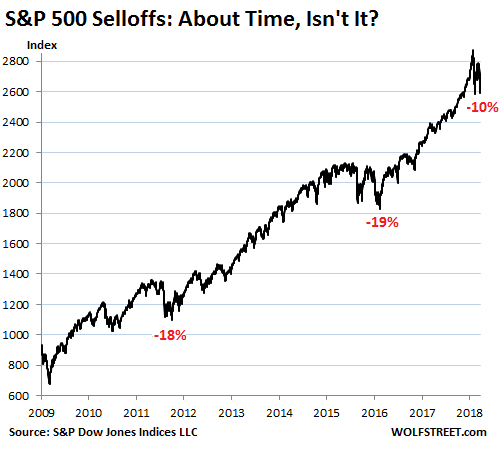
OK, it was an ugly week. Facebook (FB) dropped 14% and lost $75 billion in market cap. It's down 10% year-to-date. It's currently trying to dig itself deeper into its self-inflicted debacle. It wasn't just Facebook. Alphabet (GOOG) dropped 10% in the week and is down 2.4% year-to-date. This was a broad selloff.

The S&P 500 index dropped nearly 6% for the week and 9.9% from the peak on January 26. It's down 3.2% year-to-date. At 2,588, it's just 7 points above the low point on February 8, which is begging to be taken out on Monday. This drop is big enough to show up on a long-term chart, but given the nine-year 320% rally, why would anyone be surprised?


The Dow dropped 5.7% for the week. It's down 11.6% from the peak on January 26, and down nearly 5% year-to-date. It carved out a new low in this down-cycle.

The Nasdaq dropped 6.5% for the week, and 7.8% from its peak on March 12, but is still up 1.3% for the year.

When stocks soared no matter what, it was because they were "climbing a wall of worry," which is, as it was ceaselessly pointed out, what bull markets do. Bad news was good news. It didn't matter what happened. The worse the news was, the more stocks would climb. Falling earnings and revenues no problem. Geopolitical nightmare scenarios no problem. Trump's promises during the campaign and after the election to fix the trade imbalances in the US were just as well communicated as his promises to cut taxes. From the day Trump was elected until its peak on January 26, the S&P 500 soared 30%.

And yet, suddenly, according to Wall Street analysts and the media, the universally declared culprit for the sell-off this week was the decision by the White House to do what Trump had been promising to do since the campaign.

"A Horror Week for the Dow Has Investors Begging for Trump Respite," Bloomberg said. Of course, these investors are always whining when their investment theories fall on their nose, no matter what the perceived cause. Perma-bulls on Wall Street always beg for "respite." Usually, their begging is directed at the Fed, but now it's directed at Trump.

"Wall Street nosedives as investors flee on trade war fears," Reuters reported.

"Trade Fears Jolt Global Asset Prices," The Wall Street Journal said. "Looming trade conflict between U.S. and China is weighing on stocks, currencies and commodities."

Though everyone saw the tax cuts coming and priced them into stocks, thus driving up the S&P 500 30% since Trump's election, no one saw the trade policies coming? I mean, come on!

Everyone knew Trump would crack down on the trade imbalances. The NAFTA renegotiation has been going on for months. China's gigantic trade imbalance with the US has been on Trump's verbal target list since 2016.

But the fact is simple: during a bull market, this type of "bad news" would have caused stocks to jump 6% at a minimum in the week. A bull market climbs a wall of worry, analysts would have said. Nothing would have mattered.

When markets head south, the media and analysts are trying to find a reason,other than reality. This time, the excuse du jour was the risk of a "trade war." Next time, it's some other excuse du jour.

Reality is a little harder to stomach for these folks. The stock market is horribly overpriced, with many individual stocks at absolutely ludicrous levels. This is a flaming stock market bubble. Every indicator has been pointing it out for years. At some point, bubbles reach their maximum and begin to deflate.

In addition, the Fed has been tightening, and the markets have been fighting the Fed. This always ends the same way. Eventually, the markets will back off from fighting the Fed, and this leads to a long series of downward adjustments in the markets. The Fed has been pointing at the stock market as one of the asset classes where values are "elevated." It's worried about financial stability and doesn't want asset prices to inflate to such an extent that they'll take down the financial system when they implode. So this selloff has the Fed on its side.

The Fed has also been unwinding QE. This started in October with baby steps that are now accelerating. Just as ZIRP and QE caused the biggest bout of asset-price inflation the world has ever seen, rate hikes and the QE-Unwind will reverse some of this. It's not a secret. What are people thinking?

Investors around the globe had it historically good for nine years, with all asset classes experiencing sometimes hilariously sharp price surges that lasted year after year after year. The real reason for the selloff now is that enough players see that this cannot go on forever, and they're trying to unwind some leverage and take some risk off the table, and other players are losing their enthusiasm. These players could be algo-driven or human. Either way, at these rarefied levels of asset prices, any decline in blind enthusiasm causes prices to swoon. No trade war required. Just the reality of pandemic asset bubbles having reached their limits.

In an interview about the trade sanctions President Trump is throwing at China and at Corporate America, Ambassador Cui Tiankai trotted out all kinds of vague threats, including the possibility that China might cut back on its purchases of US Treasuries

Competition Eats the Profits of Big Shaky Banks in Euroland: So Consolidate

The plan: Take out mid-sized banks to create a "bipolar" industry of large and small banks, and a lot less competition.

Barely nine months have passed since Spain's sole officially too-big-to-fail bank, Banco Santander, took over its collapsed rival, Banco Popular, in a shotgun marriage hastily endorsed by panicked Spanish and EU authorities. Santander still hasn't even fully digested Popular's assets, yet it already has its sights set on new takeover targets.

In a speech to shareholders the bank's president, Patricia Ana Botín, stressed the lender's capacity for "organic growth" but she also refused to rule out the possibility of fresh acquisitions. "We have the obligation to analyze the opportunities for external growth that arise in our markets and that could strengthen our business," she said.

The speech comes at a time that Goldman Sachs is predicting a new round of consolidation in Spain's financial sector. After the acquisitions of Popular (by Santander) and BMN (by Bankia) last year, the first cycle of the consolidation process of Spanish banking is almost complete, Goldman said in a recent note to investors. Now, a second cycle, designed to capture new efficiency gains, can begin.

In the report the New York-based investment bank identified the most attractive acquisition targets for alpha-banks like Santander, BBVA and Caixa Bank, based on factors such as the target bank's valuation, size, shareholding structure and potential cost savings for the buyer. The bank that came out on top is Unicaja, "a relatively small and clean bank," with significant potential for generating efficiencies "if its branch network is reduced."

Banco de Sabadell, Spain's fifth largest lender, placed second on the list, although given its size, Sabadell is just as likely to acquire another bank as be acquired by one. Also on the list of takeover targets are smaller lenders like Kutxa, Ibercaja, Cajamar, Abanca and Liberbank, which almost collapsed in the wake of Popular's demise last summer.

Spain's banking industry is already heavily concentrated, with the five biggest lenders — Banco Santander, BBVA, CaixaBank, Bankia and Sabadell —controlling 72% of the retail banking space. Before the crisis the country was home to 45 savings banks and a dozen commercial banks. Now there are barely more than ten large or mid-size lenders left. And the latter are right at the top of the former's menu.

"The essential problem is for mid-sized lenders whose collapse [like Popular's] could trigger adverse effects on the system," said Fernando Restoy, former Bank of Spain governor and current president of the Financial Stability Institute (FSI) of the Bank for International Settlements (BIS). "These entities could come under heavy pressure in the future."

Once they do, the job of monetary authorities will be to "help facilitate" corporate operations that would favor an "orderly transition towards the industry's new bipolar structure" (i.e. of small and big banks), he said. It goes without saying that in this new "bipolar" world the emphasis will be on creating ever bigger banks rather than, say, breaking up big banks into ever smaller banks.

Senior ECB representatives have repeatedly underscored the need to weed out smaller banks in order to cut competition for bigger lenders. In September 2017 Daniele Nouy, Chair of the ECB's Supervisory Board, and thus in charge of the Single Supervisory Mechanism, which regulates the largest 130 European banks, blamed fierce competition from smaller banks. Rather than lots of competition between banks, what Europe needs, Nouy said, are "brave banks" that are willing to conquer new territory.

It's not just senior central bankers who are calling for a new round of consolidation for Europe's banking industry. So, too, are executives at the helm of the big banks that stand to benefit the most from the industry's restructuring. They include John Cyran, the CEO of Deutsche Bank, which last week reported yet another round of annual losses while dishing out bonuses that had somehow quadrupled in size on the previous year's bonus pot.

In a panel discussion at last year's Frankfurt European Banking Congress, Cyran argued that Europe would benefit from having "a handful of institutions" powerful enough to compete on a global stage with larger US and Chinese rivals. "There are too many institutions in Europe, especially in this country (Germany)," he said. "China and the United States have very large banks which have the heft to invest globally and which can withstand relatively long eras of low returns."

Deutsche, which has already acquired domestic peers Postbank and Sal. Oppenheim over the last decade with no noticeable improvement in its financial health, held talks with its biggest rival Commerzbank over a potential merger in 2016. In the end the talks fell through but every few now and then fresh rumours reemerge that a tie-up between Germany's two biggest, serially troubled banks is in the works.

Both lenders are in such dire straits that the German newspaper recently Welt just asked if they can still be saved. Perhaps the only way is to meld them together into the world's scariest semi-publicly owned Frankenbank, as Reuters' Breaking Views just suggested. The alternative would be for bigger, healthier European alpha banks to swoop in and take over Germany's two most important lenders, a solution that is unlikely to satisfy German policymakers and business leaders.

Meanwhile, Banco Santander, another global systemically important lender, has acquired a taste for taking over struggling mid-sized banks. And it knows that in this endeavor it can count on Europe's monetary, political and regulatory authorities for a helping hand whenever needed.

After the largest British outsourcer collapsed, two other large British outsourcers are also on the verge of collapse, and the vultures are circling.

Morgan Stanley: "We Can Already See The Writing On The Wall"

Last Sunday, just before the Facebook plunge opened the selling floodgates for tech stocks (as also previewed here last weekend in "FANG + Apple Now Account For A Quarter Of The Nasdaq, And Some Are Getting Worried") and the broader market, Morgan Stanley warned that "something was different this year", specifically pointing out that as a result of escalating trade tensions and a global economy that is rolling over, the market may be priced beyond perfection, and that "2018 earnings expectations may be too high", which however was good news for vol-starved hedge funds (which just suffered their worst month since January 2016).

When considering what that means for markets, it feels less like 'morning in America' than 'happy hour in America'. In that sense, we're pushing back on the notion that US policy actions have meaningfully extended the market cycle, instead arguing that markets have already largely reflected, and are currently pricing in, the benefits they delivered. Hence, we see more volatility to navigate as we work through the other side of the policy agenda. In US equities, for example, tax benefits are clear in their scale, but their use is murky. The nearly 8% move in 2018e EPS following the passage of tax reform aligns with our US equity colleagues' estimate for full potential earnings benefit for the S&P from tax reform (~7.6%), leading us to believe that estimates are baking in a full flow-through of tax reform.

Morgan Stanley doubled down on the bearishness the very next day, when on Monday its chief US equity strategist Mike Wilson said that it is likely that the highs for the year are now in, that "when we look at our internal data combined with industry flows and sentiment, we think there is a strong case that January was the melt-up, or at least the culmination of it", that "peak sentiment/positioning is behind us" ...

... even as profits - the primary driver behind the recent market rally - peak: "earnings expectations might need to come down if we start to see some evidence of lower margins since consensus forecasts assume no operating margin degradation. That is another reason why we think the S&P 500 makes its highs for the year."

What does Morgan Stanley think now? Below we present the latest take from Michael Wilson, who released the following Sunday Start report ahead of this week's trading, which appears set for more volatility if only on purely statistical grounds - as some have noted, since 1990 when the S&P has lost more than 1.5% on a Friday, Monday saw a lower low 97% of the time, or on 90 out of 93 occasions.

From Morgan Stanley's Michael Wilson:

* * *

Cruel to Be Kind

Just two short weeks ago, investors were celebrating the remarkably strong US jobs data with few signs of inflation. It was, in fact, the ideal combination for risk markets with many proclaiming "Goldilocks is alive and well!" Indeed, on the day of the release, the S&P 500 was up 1.74%--the biggest single day increase since the day after the US Presidential election in November 2016. Global markets celebrated too with every regional equity market rallying sharply that Friday or the following Monday for those that were closed when the data were released.

But, that excitement was quickly met with disappointing price action over the following days.There was no follow through—a classic sign that the good news had exhausted rather than uncovered new buyers. It also coincided with the top end our 2650-2800 trading range in which we have been suggesting the S&P 500 would be stuck until the next positive catalyst could arrive—1Q corporate earnings.

We also pointed out in our Weekly Warm-up on March 12th that the market wasn't properly focused on two very visible risks over the coming weeks—The Fed's March meeting and the potential escalation of trade tensions initiated with the US administration's steel and aluminum tariffs. Fast forward to today, and the good news is that the market is now fixated on both—especially the higher risk for a potential escalation of trade tensions—and we have quickly fallen all the way back to the low end of our trading range.

Our nearly 30 years of experience often makes us wonder if markets are really designed to play with our emotions. At the same time, we can't help but think that our firm's 2018 outlook for a "Tricky Handoff" is playing out to a T. To recall, this was very different from our much more bullish view in 2017 and out of consensus at the time of publication. The reality is that many of the things we expected this year are happening—higher volatility across rates, FX and equity markets, tighter financial conditions, risk adjusted underperformance of credit relative to equities, contracting equity valuations in the US, narrower breadth, and a peak in economic leading indicators and data surprises.

We have yet to see some of the more inauspicious things we expect later this year—including a peak in operating margins and y/y EPS growth in the US and perhaps other regions as well.However, we can already see the writing on the wall and are highly confident this becomes obvious to the masses by the end of 3Q, or 4Q at the latest. This suggests more tough times for equity investors, but we doubt it will be that easy as market tops tend to be particularly exhausting.

In the near term, we think global equity markets will eventually settle down about the Fed's slightly more hawkish path of tightening they signaled last week and the elevated risks of a broader trade dispute. Specifically, the dot plot is slightly steeper but not enough to upset the apple cart in the next few months/quarters. Our fixed income strategists have been highlighting rising funding costs—led by LIBOR—as a near term risk, but they also expect reduced supply in April and a subsequent fall in these rates. This should provide another positive catalyst along with corporate earnings.

As for the risk of a broader trade dispute, we think the odds here remain low as well. We note that so far, the size of the tariffs announced—25% on up to $50-60B—amounts to just $12-5-15B in actual tariffs. More importantly, Europe has been exempted much like the President exempted Canada and Mexico from the steel and aluminum tariffs a few weeks ago. This all suggests these shots across the bow are being used more as negotiating tactics. China's response, so far, is tepid with tariffs affecting just $3B of traded goods with the US.

While I acknowledge most disputes are typically started unintentionally, I also believe the tail event will be over discounted in the near term relative to the actual near term impact on earnings and growth. In addition, these kinds of events do tend to ebb and flow and right now it's ebbing sharply which means it's getting priced; and just like markets top on good news, they bottom on bad. There is also significant valuation support at current prices so we stick to our guns that higher price highs for the year are still likely in 2Q/3Q for US equity markets as forward earnings move higher; but it should continue to narrow, we expect leadership to get more defensive and the S&P 500 should likely end the year not far from current levels as earnings growth expectations decelerate from the evolution of the business cycle, tougher comparisons and tighter financial conditions. In the meantime, enjoy your Sunday!

PetroYuan Futures Open - Over 10 BillIon Notional Trades In First Hour

After all the preparation, all the expectation, cheerleading and doomsaying, China's Yuan-denominated crude oil futures contract began trading tonight and appears to be off a good start with well over 10 billion yuan notional traded within the first hour.

So far it has tracked WTI futures well, trading at around a $2 premium to WTI (when translated from yuan to USD)...

Additionally, well over 23,000 contracts have traded within the first hour for a notional trading volume of over 10 billion yuan - more than $1.5 billion notional... signaling significant demand.

Offshore Yuan is moving in sync with 'Petroyuan' futures - as WTI tends to track the USD.

As we most recently noted, after numerous "false starts" over the last decade,  the "petroyuan" is now real and China will set out to challenge the "petrodollar" for dominance. Adam Levinson, managing partner and chief investment officer at hedge fund manager Graticule Asset Management Asia (GAMA), already warned last year that China launching a yuan-denominated oil futures contract will shock those investors who have not been paying attention.

This could be a death blow for an already weakening U.S. dollar, and the rise of the yuan as the dominant world currency.

But this isn't just some slow, news day "fad" that will fizzle in a few days.

A Warning for Investors Since 2015

Back in 2015, the first of a number of strikes against the petrodollar was dealt by China.Gazprom Neft, the third-largest oil producer in Russia, decided to move away from the dollar and towards the yuan and other Asian currencies.

Iran followed suit the same year, using the yuan with a host of other foreign currencies in trade, including Iranian oil.

During the same year China also developed its Silk Road, while the yuan was beginning to establish more dominance in the European markets.

But the U.S. petrodollar still had a fighting chance in 2015 because China's oil imports were all over the place. Back then, Nick Cunningham of OilPrice.com wrote

Despite accounting for much of the world's growth in demand in the 21st Century, China's oil imports have been all over the map in recent months. In April, China imported 7.4 million barrels per day, a record high and enough to make it the world's largest oil importer. But a month later, imports plummeted to just 5.5 million barrels per day.

That problem has since gone away, signaling China's rise to oil dominance…

The Slippery Slope to the Petroyuan Begins Here

The petrodollar is backed by Treasuries, so it can help fuel U.S. deficit spending. Take that away, and the U.S. is in trouble.

It looks like that time has come…

A death blow that began in 2015 hit again in 2017 when China became the world's largest consumer of imported crude

Now that China is the world's leading consumer of oil, Beijing can exert some real leverage over Saudi Arabia to pay for crude in yuan. It's suspected that this is what's motivating Chinese officials to make a full-fledged effort to renegotiate their trade deal.

So fast-forward to now, and the final blow to the petrodollar could happen starting today. We hinted at this possibility back in September 2017

With major oil exporters finally having a viable way to circumvent the petrodollar system, the U.S. economy could soon encounter severely troubled waters.

First of all, the dollar's value depends massively on its use as an oil trade vehicle. When that goes away, we will likely see a strong and steady decline in the dollar's value.

Once the oil markets are upended, the yuan has an opportunity to become the dominant world currency overall. This will further weaken the dollar.

The Petrodollar's Downfall Could be a Lift for Gold

Amongst all the trouble ahead for the dollar, there are some good news too. The U.S. might have ditched the gold standard in the 1970's, but with gold making a return to world headlines… we could see a resurgence.

For the first time since our nation abandoned the gold standard decades ago, physical gold is being reintroduced to the global monetary system in a major way. That alone is incredibly good news for gold owners.

A reintroduction of gold to the global economy could result in a notable rise in gold prices. It's safe to assume exporters are more likely to choose a gold-backed financial instrument over one created out of thin air any day of the week.

Soon after, we could see more and more nations jump on the bandwagon, resulting in a substantial rise in gold prices.

Hedge Fund CIO: "The Market Generals Are Dead"

"Every market has its generals," said the CIO, atop the hill, surveying the battlefield. "Bull markets march onward, upward until their leaders die," he said, lowering his binoculars, smoke rising from the valley floor.


Banks led the last great bull market. Fueled by reckless lending and leverage, loose regulation, moral hazard, and the wondrous illusion of boundless riches that accompany all reflexive markets, these generals charged ever upward, looting, pillaging. Leading the troops. Until they didn't.

The S&P 500 peaked in October 2007, then fell 58%. When it bottomed seventeen months later in March 2009, Citigroup stock lay in the dust, trampled, mangled, mutilated beyond all recognition.

Citi's stock price had collapsed 98.3% from its 2007 highs. It never really recovered. Bank of America plunged 95%. Morgan Stanley fell 91%. Goldman 82%. JP Morgan 72%.

"I suspected that regulation would be the death of the current market's technology generals," he said, turning to his table, unrolling a map. "I was right."

From the 2009 lows through the recent highs, the S&P 500 advanced 331%. In that drive, Facebook rallied 413% (from its 2013 IPO), Amazon surged 2102%, Apple 1123%, Netflix 5349%, and Google 586%.

"The generals are dead." From recent highs, Facebook has stumbled 18%, Amazon 8%, Apple 10%, Netflix 10%, Google 14%.


"Trading market tops is difficult," he explained, "That's where we are now." With his finger, he traced the advances and retreats of the S&P 500 since WWII. Nearly every top was a volatile series of skirmishes lasting 6-18mths, before the real decline. The notable exception being 1987.

"The generals are dead, but the economy remains strong." Employment, wages, profits too. "The bull case is all backward looking. It describes why it makes sense to stay invested. But it's intellectually bankrupt," he said, repositioning his troops on the map. "You get paid for the future, not the past."