MARKET FLASH:

"It seems the donkey is laughing, but he instead is braying (l'asino sembra ridere ma in realtà raglia)": si veda sotto "1927-1933: Pompous Prognosticators" per avere la conferma che la storia non si ripete ma fà la rima.


mercoledì 21 marzo 2018

Two Days To Trade Wars: Can Stupidity Be Avoided?

US steel and aluminum tariffs start Friday.

Germany's economy minister is in D.C. But Trump has stringent demands.

No one wins trade wars. The notion is ludicrous.

I have more on the "meaning of win" in a moment. But first let's consider the Eurointelligenceview.

This is not a trade war the EU can ever win, as Wolfgang Munchau points out in his FT column. If the EU were to put up a big fight over this, with a long list of sanctions on Friday, the US would immediately respond with a tariff on car imports. It would be the equivalent of the Fool's Mate in chess, Munchau argues. Donald Trump is right in his assertion that trade wars are easy to win - if your opponent is sufficiently desperate and addicted to the export of manufactured goods, like Germany is. When we said that a current account surplus of 8% (or probably higher) is not sustainable, it was not meant as a statement of right or wrong. Unsustainable means that it will end at some point - through either adjustment or force.

Spiegel magazine had a story over the weekend that there is a glimmer of hope. It was one of those short Spiegel news stories, something they picked up from a single source, but not quite worthy of a full-length article. The story says the US will make three specific demands as a pre-condition for exempting the EU from the steel and aluminium tariffs. The first is that the EU caps steel output at 2017 levels. The story did not reveal the metric, whether in volume or value. The second is that the EU take anti-dumping measures against China, and agrees to cooperate with the US in questions of international trade policy. And, to top it all, the Europeans will have to deliver proof that they are on the way to meeting their Nato commitments on defence spending. The latter is an impossible demand to meet since no such proof can exist. The German grand coalition, for example, is making no efforts to increase defence spending. The priority of the new finance minister, Olaf Scholz, is to maintain the fiscal surplus.

OK, Where's the Win?

Eurointelligence never explained how this magical "win" occurs.

Instead, Eurointelligence linked to a report by Brad Setser: Forming an Alliance With U.S. Allies Against Bad Chinese Trade Practices Won't Be Enough to Bring the Trade Deficit Down.

There are growing calls for a global coalition of U.S. allies to pressure China to change some of its most egregious commercial practices.

That makes some sense [Mish - actually it makes zero sense - explained later], even if it is much easier said than done. It is relatively simply to get agreement that China should change many of its policies. But China doesn't typically respond to peer pressure alone. It is relatively hard to get agreement on what to do if China doesn't change voluntarily.

After a useless diversion into complaints about China, Setser admits this interesting tidbit:

China's current account surplus is well below that of the Eurozone. Or that of Japan. [Mish - It's simply high with the US].

Even at 2.5 percent of China's GDP, it is smaller, relative to China's GDP than the current account surpluses of the United States' security allies. ​

U.S. allies generally have much tighter fiscal policies than China. That's a big reason why they run larger current account surpluses than China. [Mish - Not really - the reason is that Nixon closed the gold window and this is the logical result.]

Korea and Taiwan (and neutral Switzerland) also put their finger on the foreign exchange market when needed to keep their currencies weak (Korea rather egregiously in January).

As a result, the combined current account surplus of U.S. allies in Europe and Asia is close to $800 billion—well over China's roughly $200 billion. That sum would be a bit bigger if you added in the surplus of democratic but formally non-aligned European countries like Sweden and Switzerland.

A China that behaved better commercially would no doubt help many companies. And if China lowered barriers to actual imports, overall trade with China might expand. But better commercial practices on their own aren't enough to assure a smaller Chinese trade surplus. [Mish - On that I strongly agree with Setser]

So long as Asia and Europe's aggregate surplus remains high, someone in the world will still need to run a large external deficit, and odds are that will still be the United States. [Mish - Once again this is a mathematical necessity!]

In Dollar Terms

See the Problem?

The US has its biggest trade deficit with China, but globally the imbalance is with Germany and Japan.

Placing tariffs in Chinese steel will so nothing but make the US more uncompetitive on exports.

Averting a Trade War

To stave off the trade war, assuming Trump sticks to his guns, the EU needs to do these three things.

  • EU caps steel output at 2017 levels.

  • EU takes anti-dumping measures against China, and agrees to cooperate with the US in questions of international trade policy.

  • EU must deliver proof that they are on the way to meeting their Nato commitments on defence spending.

If not, we have a trade war.

Easy to Win

Wolfgang Munchau say In a Trade War Germany is the Weakest Link and "If your target is Germany, then yes, a trade war is easy to win."

Munchau bases his opinion on the idea that the EU, Germany in particular, is very dependent on exporting cars at a time when Germany's diesel technology is on the verge of being worthless.

Brexit poses an additional threat as Germany is a huge net exporter to the UK.

Here's Munchau' conclusion: "This trade war is indeed easy to win. It is going to be the equivalent of the fool's mate in chess: the game could all be over in two moves."

Meaning of Win

What does it mean to "win" a trade war?

Donald Boudreaux at the Cafe Hayek explains in his post: An Oxymoron to Beat All Oxymorons.

No two human activities are as opposite one another as are trade and war. Trade is voluntary; war is coercive. Trade is peaceful; war is violent. Trade enriches; war impoverishes.

Trade is a mutually advantageous exchange of property rights; war is a bilateral destruction and confiscation of property rights – destruction and confiscation that never are mutually advantageous and that too often, in the end, are advantageous to no one.

When trading, each party improves his welfare only by attending to, and enhancing, the welfare of others; when warring, each party improves his welfare only by attacking, and diminishing, the welfare of others. Those who trade with each other have an interest in each other's well-being; those who war against each other have an interest in each other's annihilation. Trade enhances life; war ends life.

What are called "trade wars" are indeed wars, but they involve only war and no trade. Every so-called "trade war" is each government making war on its own citizens, coercing them not to trade as they would otherwise peacefully trade.

The term "trade war" makes no more sense than do the terms "good evil" or "peaceful violence." We should stop using it. We must find a better term to describe governments' waging war upon those of their own citizens who dare to trade with others.

Curious Way to Win

As Munchau, Trump, and Peter Navarro (Trump's trade guru) see things, it is remarkably easy for Trump to win.

In reality, the only way to win is to not play the game at all.

Please reflect on this: Shall we play a game?

The Markets Are Now Globally in “Risk Off” Mode (the US is Next)

Sentiment is now completely disconnected from reality.

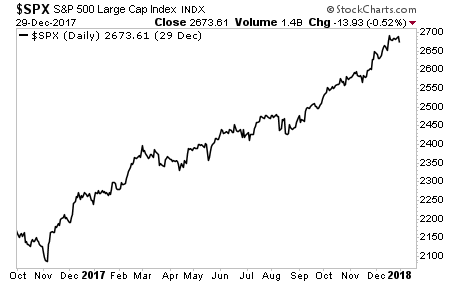
Currently, sentiment suggests that stocks are in a raging bull market and will never fall. This sentiment is based on the fact that much of last year (2017) the US stock markets rose virtually non-stop.

GPC32018

However, that era is now OVER. And globally the markets are moving into "risk-off" mode.

Don't believe me?

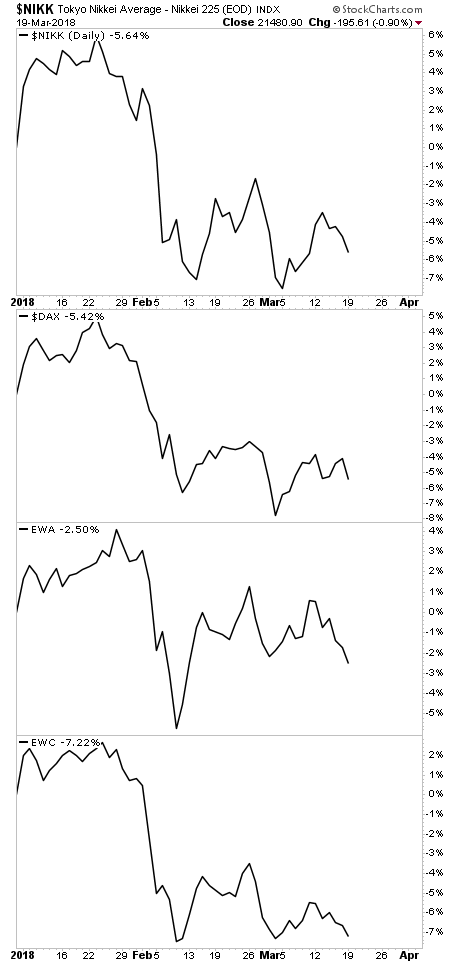
Consider that most global markets are in fact now DOWN for 2018.

That is not a typo.

Japan's Nikkei, Germany's DAX, Australia's stock market, Canada's stock market… ALL of them are in the red thus far in 2018.

GPC320182

The reason?

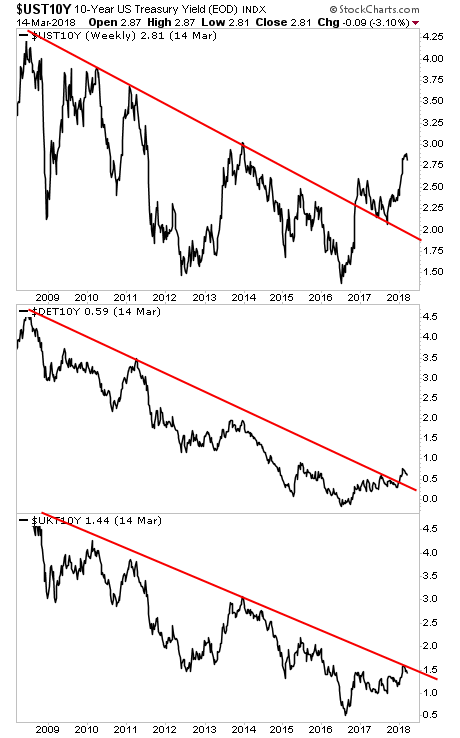
Globally the bond market is forcing ALL risk assets to be repriced.

As noted in the recent past and again, following 2008, Central Banks created a bubble in sovereign bonds. And because these bonds are the bedrock for the current financial system, when they did this they created a bubble in everything (the "Everything Bubble").

However, this bubble, is now beginning to burst. Bond yields are rising around the globe.

GPC315182

martedì 20 marzo 2018

What’s Going on in the Treasury Market?

Will we see a "monetary shock?"


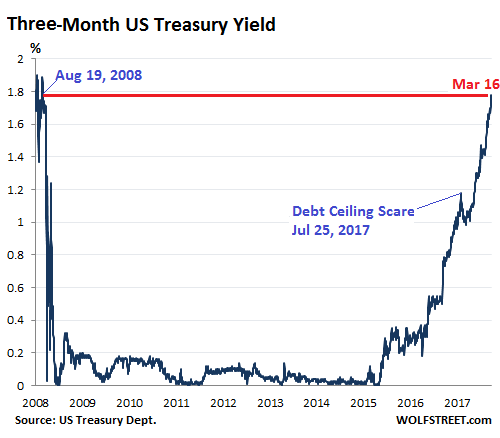
Back in October 2015, the three-month Treasury yield was 0%. Many on Wall Street said that the Fed could never raise interest rates, that the zero-interest-rate policy had become a permanent fixture, like in Japan, and that the Fed could never unload the securities it had acquired during QE. How things have changed!

On Friday, the three-month Treasury yield closed at 1.78%, the highest since August 19, 2008. When yields rise, by definition bond prices fall:


The Fed's target range for the federal funds rate has been 1.25% to 1.50% since its last rate hike at the December FOMC meeting. In other words, the three-month yield is already above the upper limit of the Fed's target rangeafter the next rate hike. So the market has fully priced in a rate hike at the FOMC meeting ending March 21. And it's also starting to price in another rate hike in June.
No "monetary shock" now, but maybe later

In this rate-hike cycle, the Fed has engaged in policy action only at meetings that are followed by a press conference. There are four of these press-conference meetings per year. The next two are this week and June.

If, in this cycle, the Fed hike rates at an FOMC meeting that is not followed by a press conference – there are also four of them this year – it would be considered a "monetary shock" that the Fed decided to administer to the markets. It would be like a rate hike of 50 basis points instead of the expected 25 basis points. There would be a hue and cry in the markets around the world. But I think the Fed isn't ready to spring that on the markets just yet. Maybe later.

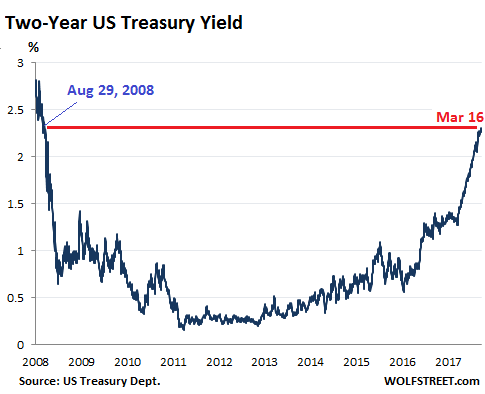
The two-year yield rose to 2.31% on Friday, the highest since August 29, 2008


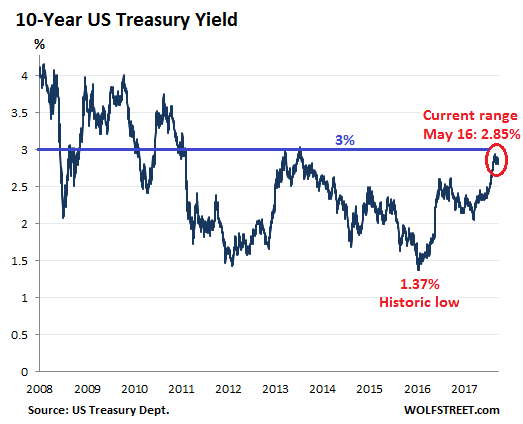
In past rate hike cycles, the two-year yield reacted faster to rate-hike expectations than the 10-year yield. This is happening now as well. The 10-year yield has its own dynamics that are not in lockstep with the Fed's rate-hike scenario. On Friday, the 10-year yield closed at 2.85%, within the same range where it had been since late February, tantalizingly close to 3%:

Bearish bets against Treasuries leave skid marks

Back on February 13, as the 10-year Treasury yield was surging and threatened to take out the 3% level, I postulated that it would have a hard time doing so over the near term, for two reasons:

One, in the 3%-range – given current asset prices, dividend yields, etc. – the 10-year Treasury is appealing to more buyers, and this will keep bond prices from falling further, thus putting a lid on the yield.

Two, speculators were heavily betting against the 10-year Treasury. By mid-February, bearish bets had risen to about 960,000 contracts, an all-time record. On February 21, the 10-year yield reached 2.95%. Everyone was on the same side of the boat. And there would have to be a sharp snap-back rallythat could turn into a short-squeeze.

So we have seen some of both, and the 10-year yield remains stuck until further notice.

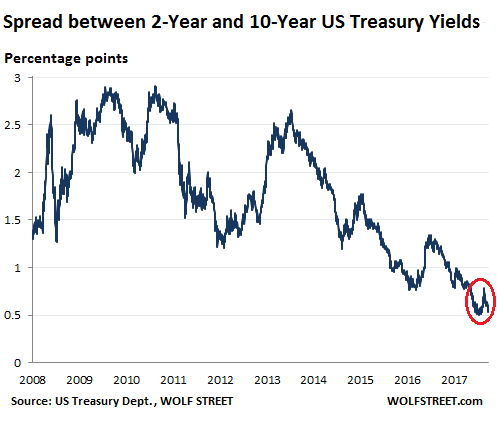
After the surge of the two-year yield, the difference between the two-year and the 10-year yield – the "two-10 spread" – has narrowed again. On Friday, it was at 54 basis points. In the chart below, note the narrowing at the end of last year to 50 basis points, then the mini-spike, as the 10-year yield surged faster than the two-year yield, and the recent fallback:

Where does this leave the yield curve?

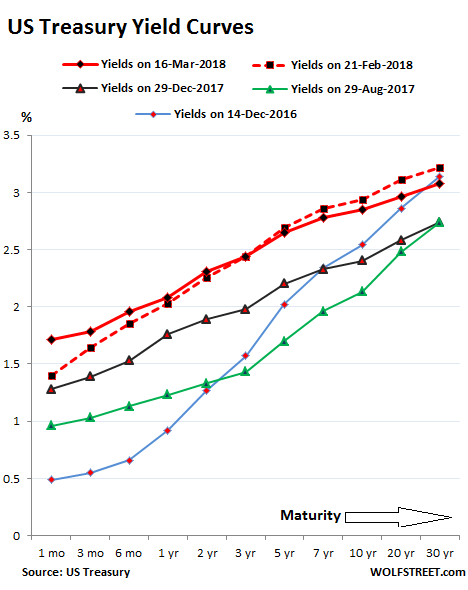
The chart below shows the "yield curves" as the yields across the maturity spectrum occurred on these five key dates:
On Friday, March 16 (solid red line)
On February 21 (dotted red line) when the 10-year yield closed at 2.95%.
On December 29, 2017 (black line), before the 10-year yield started surging.
On August 29, 2017 (green line) two weeks before the QE unwind was detailed.
On December 14, 2016 (blue line) when the Fed stopped flip-flopping and started raising rates like clockwork.


Note how the spread widened toward the long-dated end (right side of chart) between the black line (December 29, 2017) and the dotted red line (February 21), with the 30-year yield surging 48 basis points over those seven weeks, and how the slope of the dotted red line steepened compared to the black line.

These yields at the long end have since reversed slightly, but short-term yields have surged, leaving the yield curve on Friday (solid red line) somewhat flatter than it had been on February 21.

But I do not think that the yield curve will "invert" – a phenomenon when short-term yields are higher than long-term yields, which has been closely associated with recessions or worse. The last such inverted yield curve occurred before the Financial Crisis.

This time, the Fed has a tool that it didn't have before: During QE, it acquired $1.7 trillion in Treasuries and $1.8 trillion in mortgage-backed securities that it has now started to unload. It can start jawboning the markets by telling them that it will unload the securities more quickly, and it could then actually unload them more quickly. This would be a "monetary shock." It would put a lot of pressure on long-term Treasuries, and yields would jump at the long end of the curve, thus steepening the yield curve and causing all kinds of turbulence.

It may already be in the works. The first Fed Governor came out and said that the QE Unwind isn't fast enough. And because it's so slow it may actually contribute to, rather than lower, "financial imbalances."

The Federal Reserve Has Forgotten Why They Raise Rates

Why does the Federal Reserve raise rates?  Seems like a basic question.  And I think most will agree they do it to limit an economic expansion from progressing too quickly that it spurs inflation.  Inflation, largely a psychological phenomenon, is hard to reverse once it gets ingrained in society.  Or so they say, whoever they are.

Inflation has a large psychological component to it.  Therefore, raising rates must largely be done for psychological purposes too.  If the public believes prices for goods and services are going up, they jump on the band wagon and also hike prices.  Sounds reasonable.  But then why would raising rates limit or reverse this behavior?  Could the Fed have forgotten why they raise rates?

The Federal Reserve has done their own past studies that show when the public knows what the Federal Reserve is going to do, they plan ahead leaving the impact of Fed policy impotent.  Simply put, if it is known that interest costs will increase, the public will proactively take action to limit their negative impact and try to make it a positive one.

Prior to 2000, when the Fed raised rates with much of the public clueless to Federal Reserve policy, the public would mostly be caught off guard.  The public would psychologically reduce risk or output until their future costs and revenues became clearer.  Economists and traders had to master the art of reading the tea leaves from every Federal Reserve members speeches to decide whether to take or limit risk.  Not knowing for sure what the Federal Reserve would do had a tangible impact on the pace of growth and, therefore, inflation.  It is this uncertainty that regulated the economy and markets from overheating.  Yes, the Fed knew this at one time and now seems blissfully ignorant to why they raise rates.  So, what does the Fed accomplish when they raise rates in a highly transparent fashion?

Raising rates and telegraphing these moves, a failed policy pursued to keep the party of 2004, 2005, 2006 and 2007 going, has a detrimental effect on the perceived goal of keeping inflation in check.  When the public prepares ahead of time for Fed rate increases, they know their interest costs and interest income will be increasing.  Planning for increased interest income is easy.  Simply spend more – you can afford it!  For those that have higher interest costs, knowing these costs are increasing can be managed by raising prices. Sound inflationary?  It is! 

The US government is the world's largest borrower.  When interest rates go up, they have less to spend on political projects.  Looking for other revenue sources, either taxes go up, costs to the public go up with less government support, deficits go up, or a combination of these outcomes.  None of these slow the economy and limit inflation.   No, these are all inflationary forces that keep output on a similar or increasing trajectory accompanied with higher prices for goods, services and employment. 

If the Federal Reserve raises rates too far too fast, costs do increase faster than prices can increase thus leading to spending slowdowns from companies and individuals.  And that's why past Federal Reserve monetary policy would have more frequent but much shallower recessions.  Raising rates with public uncertainty leads to a lack of confidence and slower growth.  It was always a guess if the Fed would raise rates AND by how much.  25 basis point, 50 basis points, 75 basis points… who knew and why stand in front of the Fed and take this risk.  Prior Fed policy with uncertainty certainly had potency.

But the new and improved Fed of the modern age, ignoring advice on rate increases from past Feds, pursues steady, slow, well publicized policies.  This type of rate rise cycle from the Fed leads to greater risk taking, faster growth, more interest income and higher levels of inflation.  The end result will look an awful like 2008 where risks grow uncontrolled trying to make up for, or exploit, transparent Fed policy.  

Are we better off with shallow recessions every two to three years and opaque Fed policy, or a doozy (doozy is a technical term taught in most economic courses) of a recession or depression once every 10 years but have full transparency during the joy ride?  The crisis of 2008 should still be too fresh for everyone and this should be an easy answer.  Fed policy should not bring the financial system to the verge of collapse.  The Fed needs to do some historic soul searching and modify failed monetary policy before we all live through a 2008 monetary policy induced redux. 

Morgan Stanley: "That Was It For The Market For This Year"

We first got a glimpse that not all is optimistic at Morgan Stanley on Sunday afternoon, when we reported that Michael Zezas, the bank's chief US public policy strategist warned that unlike 2017, when the bank was bullish and cheerful, "something was different this year."

That something was that much of the upside from Trump's tax reform is already priced in, and that, as Zezas said, "it feels less like 'morning in America' than 'happy hour in America'. In that sense, we're pushing back on the notion that US policy actions have meaningfully extended the market cycle, instead arguing that markets have already largely reflected, and are currently pricing in, the benefits they delivered."

Worse, Morgan Stanley warned that "it is possible that spending on capex and wage growth will prevent a full pass-through, meaning 2018 earnings expectations may be too high."

Translation: the market is priced beyond perfection.

But if that was the preview, we got the main event this morning when Morgan Stanley's chief US equity strategist Michael Wilson, who was already downcast  on the market for 2018, predicted that not only is the stock market meltup over, but worseJanuary may have marked the market top for the year.

"Back in January when stocks were rising sharply, we heard numerous calls for a "meltup" being made by prognosticators and investors. Of course, that's how tops are made and we think January marked the top for sentiment, if not prices, for the year" said Wilson whoechoed JPMorgan in pointing out that while retail may have made tentative steps to return to the market via record ETF inflows, "with volatility moving higher we think it will be difficult for institutional clients to gross up to or beyond the January peaks."

So for those bulls who missed the furious buying scramble of late January, is there still a chance for a repeat performance? Not according to Wilson, who notes that "when we look at our internal data combined with industry flows and sentiment, we think there is a strong case that January was the melt-up, or at least the culmination of it."

Furthermore, the brief blow off top which stunned everyone, including Jeremy Grantham who predicted a near-term meltup was imminent, wasn't even that according to the bank. Wilson says that he had "several clients tell us they think it was too brief a period to qualify as a proper melt up scenario; but we suggested January's move was perhaps just a punctuation mark on a 59% rally in the S&P 500 from the February 2016 lows (26.6% annualized). In other words, by the time people are calling for a melt-up, it is basically over. Tax cuts were the event to capture investors' imagination, but the reality is that the market had been pricing tax legislation in for months, if not quarters."

Wilson uses two metrics to justify his call that "peak sentiment/positioning is behind us are" and that it's all downhill from here.

First, he shows gross leverage by the bank's hedge fund clients, which he believes is a good measure of investor willingness to assume risk. In January, this chart showed all time highs on a beta and delta adjusted basis. He also notes that "that this high was two years in the making aligning with our conclusion above that the melt up was almost done by the time it was being widely called for."

The January top was also right before the February 5 volatility shock which is what forced clients to reduce the total risk they are holding to a more tolerable level, as shown below. And with volatility moving higher from the cycle low in January, "it will be very difficult for gross leverage to approach the old highs anytime soon."

Second, Morgan Stanley also looks at the simplest measure of retail sentiment - the American Association of Individual Investors % Bulls - which Wilson likes "because there is a long history of data and the major peaks and troughs coincide with important market turning points." As we showed previously, retail sentiment reached its most bullish - or rather euphoric - reading since 2010 in late January, and while it had not been a major turning point, it "did mark a pause in the velocity of the stock market recovery from the great recession."

Of course, since no analyst leaves themselves without a loophole in case Bullard tomorrow screams "QE4" Wilson caveats that he doesn't view this setup "as a smoking gun for a market top in price" but he does admit that it will mark a top in sentiment for quite awhile, "meaning it is unlikely retail will reach higher heights of excitement this year" concluding rhetorically "after all, what's on the horizon that would get them more excited than a tax cut?"

In light of today's market action which saw the market-leading tech sector finally crack, Wilson may be 2 out of 2, first calling the 2017 surge correctly, and now the drop.

Wilson wasn't any more optimistic when looking at corporate earnings. Echoing Zezas' Sunday comments, Wilson said that "if we just roll forward the current bottom-up estimates, the forward earnings per share would be $166 and $170 by June 30 and September 30, respectively. That is approximately 3% and 5% higher than today's $161. Not exciting, but not very bad either."

The risk here is the sooner or later, the sellside crew starts slashing earnings expectations: "those numbers might need to come down if we start to see some evidence of lower margins since consensus forecasts assume no operating margin degradation. That is another reason why we think the S&P 500 makes its highs for the year.... It's also a wild card that has big idiosyncratic risk at the stock level in our view."

In other words, with the S&P closing just above 2,710, and below Morgan Stanley's base case of 2,750, it is safe to say that in the next few weeks, the bank will shift its outlook to the bear case which sees the S&P sliding back down to 2,300.

Paul Craig Roberts: War Is On The Horizon

Have Washington and its British vassal set a stage for testing whether Russia has the stomach for war?

How else do we interpret the announcement by General Sergey Rudskoy, chief of the Operational Directorate of the Russian General Staff,  that

"we have reliable information at our disposal that US instructors have trained a number of militant groups in the vicinity of the town of At-Tanf, to stage provocations involving chemical warfare agents in southern Syria. They are preparing a series of chemical munitions explosions. This fact will be used to blame the government forces. The components to produce chemical munitions have been already delivered to the southern de-escalation zone under the guise of humanitarian convoys of a number of NGOs.

The provocations will be used as a pretext by the United States and its allies to launch strikes on military and government infrastructure in Syria."

Don't expect to hear anything about this in the totally discredited Western presstitute media, which is a propaganda ministry for war.

The Russian government must be kicking itself that it again failed to finish the job in Syria and instead permitted Washington to expand its Syrian presence, arm and train its mercenaries, provide chemical weapons, and assemble its fleet to attack Syrian forces in order to prevent their reconquest of Syrian territory.

The question before us is:

If the information that General Rudskoy cited is correct, what will Russia do?

Will Russia use its missile defences and air superiority to shoot down the US missiles and aircraft, or will Russia accept the attack and again denounce the illegality of Washington's action and protest to the UN?

If Russia accepts the attack, Washington will push harder. Sooner or later Russia will be unable to accept another push, and war will break out.

If war breaks out, will it be a limited conventional war or will Washington use the excuse to launch nuclear ICBMs against Russia? These questions must be going through the minds of Russia's leadership. Russia faces the grave danger that Washington's Fifth Column inside Russia, the Atlanticist Integrationists, those Russians in the political and business leadership who believe Russia must be, at all costs, integrated into the Western world, will lock the government in indecision and expose Russia to a nuclear first strike.

So far Russia has continued to defeat itself by playing according to the rules of diplomacy and international law despite the obvious fact that Washington has no respect for either. During the past week, Washington's British vassal, a country of no military or political significance, demonstrated total contempt for Russia and its president, Vladimir Putin. In other words, the insult to Russia came from a mere vassal state of Washington's empire. An alleged poisoning by an alleged Russian nerve gas, the very existence of which is doubted by US and UK experts, of an inconsequential former spy and his daughter has been blamed, without a shred of evidence, on Russia by the British prime minister, defense minister, and foreign minister.

The British prime minister violated law and agreements to which Britain is partner by giving Russia 24 hours to respond to an accusation for which no evidence was provided. Law and the agreements require that the country making an accusation share the evidence with the accused country, which has 10 days to assess the evidence and reply. The British government refused to abide by the agreement to which it is partner. Moreover, the British foreign minister Boris Johnson personally accused Russia's President Putin of ordering the attempted murder of the inconsequential spy. For more information on the former spy and his lack of consequence and the absurdity of the orchestrated event, see recent postings on my website.

Not content with the unprecedented insult to Russia and its President, the British defense minister of a country that has no capability whatsoever of defending itself against Russia, even with its liege lord's help, said in response to Russia's rejection of the unsupported-by-any-evidence charge that "Russia should shut up and go away."

This was too much for the Russian Ministry of Defense. General Igor Konashenkov replied:

"The rhetoric of an uncouth shrew demonstrated by the Head of the British Ministry of Defense makes his utter intellectual impotence perfectly evident. All this confirms not only the nullity of all accusations towards Russia we have been hearing from London for the last several years but also that the 'accusers' themselves are nonentities.

"The 'Great' Britain has long turned not only into a cozy nest for defectors from all over the world but also into a hub for all sorts of fake news-producing agencies: from the British 'Syrian Observatory for Human Rights' to the created by a British intelligence officer pseudo-Syrian 'White Helmets'.

"As to boorish words of the British Defense Minister regarding Russia, it seems that in the absence of the real results of professional activity, rudeness is the only weapon remaining in the arsenal of the Her Majesty's Military." 

Note the total dismissal of 'Great' Britain by the Russian Ministry of Defence as a military and political power. From the Russian military's standpoint Washington's British vassal state is a total nonentity. This suggests that the Russian military is focused on Washington and is unlikely to tolerate Washington's agents in Russian government and business circles if they attempt to leave Russia exposed by indecision.

Perhaps the Russians will decide it is past time for them to demonstrate their superior military capabilities, and they will take out not only the US missiles and airplanes but also the fleets from which the attack is launched while putting their nuclear forces on high alert. What then would Washington do? Can a government composed of bullies drunk on hubris come to a sensible decision, or would people so arrogant as to think themselves "exceptional" and "indispensable" condemn the world, including the plants, animals, birds, and all creatures who have no idea of the murderous lunatics that rule the Western world, to death?

There is no greater threat to life on earth than Washington. Constraining Washington's determination to destroy life on earth is the greatest challenge humanity has faced. If we fail, we all die, every one of us and all creatures.

Despite Russia's military superiority, the humanity of the Russian government places it at a disadvantage as there is no concern for humanity in Washington.