MARKET FLASH:

"It seems the donkey is laughing, but he instead is braying (l'asino sembra ridere ma in realtà raglia)": si veda sotto "1927-1933: Pompous Prognosticators" per avere la conferma che la storia non si ripete ma fà la rima.


domenica 21 gennaio 2018

Mitch McConnell: "This Shutdown Is About To Get A Lot Worse"

Despite assurances from the House that an even shorter-term spending bill that would give lawmakers more wiggle room to negotiate would be a non-starter, Susan Collins and a group of moderate senators told reporters they are taking ideas about a short-term fix to the Republican senate leadership...

Both the House and Senate have reconvened for another rare weekend session.

Meanwhile, House Speaker Paul Ryan took to the Sunday shows to heap blame for the shutdown on Democrats.

"You can't blame Donald Trump for Senate Democrats shutting down the government. They shut down the government with no endgame in sight," House Speaker Paul Ryan said on CBS News' "Face The Nation."

Democrats, meanwhile, have dubbed the stalled negotiations the "Trump shutdown," and say the GOP's control of both the White House and Congress puts the blame squarely on their shoulders, per NBC News.

McConnell has scheduled a procedural vote on a three-week extension bill for 1 am Monday morning. If passed, that bill would need to clear the House. Ryan has said he would support the bill, which would keep the government open until Feb. 8. The original four-week plan offered to keep the government open until Feb. 16.

"This shutdown is going to get a lot worse tomorrow," Senate Majority Leader Mitch McConnell said in a speech opening the Senate floor. "Today would be a good day to end it."

Senate Minority Leader Chuck Schumer called on President Trump to return to the bargaining table. "I'm willing to seal the deal, to sit and work right now, with the president or anyone he designates. Let's get it done."

"This is the Trump shutdown, only President Trump can end it." Schumer said. "We Democrats are at the table, ready to negotiate. The president needs to pull up a chair and end this shutdown."

As NBC News explained, Democrats maintain that the weeks-long spending bill being considered in the Senate is just a stalling tactic that will not lead to a serious legislative debate about immigration reform. Democrats have vowed not to vote for a spending package until a deal to enshrine DACA protections for 690,000 undocumented immigrants is in place.

* * *

Update: Amid reports that Trump hasn't spoken with Chuck Schumer since Friday, Sen. Dick Durban refused to offer a prediction about when the shutdown might end.

"I'm not going to make that prediction," Durbin said on NBC's "Meet the Press."

"We're going to look every minute of every day," Durbin said on Sunday, adding that he wanted President Trump to get involved in the negotiation process.

Durbin added he feels there are "positive conversations" happening amid the negotiations (even if the president and the minority leader aren't participants in those conversations).

The shutdown is set to impact workers on Monday, many of which will be furloughed if they are deemed non-essential by the government.

* * *

While Congressional leaders and the White House have assured the public that the federal government shutdown that technically began at 12:01 am ET Saturday morning could be over within 24 hours, Mick Mulvaney, the director of the Office of Management and Budget and a key player in the White House's negotiations, told Fox News Sunday what many - including us - expect will be the case: The government shutdown could persist for weeks...

Mulvaney said Democrats want to keep the government shut for Trump's Jan. 30 State of the Union address. The beginning of the shutdown also coincided with the anniversary of Trump's swearing-in.

As we've pointed out, both of the two most recent shutdowns lasted for two weeks or longer, per Axios.


Shutdown

Mulvaney argued that the present shutdown differed from the 2013 Obama-era shutdown in that the Democrats want to support the Republicans' stopgap.

Global Market Momentum Just Hit Extreme Levels; Profit-Taking Imminent

According to the latest fund flow data, anecdotal speculation of a marketwide melt-up was indeed the case. As a reminder, market optimism among both professional and retail investors had hit the highest level since just before the crash of 1987...


... with a recent E-Trade survey disclosed that 8 out of 10 retail investors - the highest on record - were certain that stocks would continue to rise in Q1. Then, BofA calculated that the 4-week inflows into equities was not only "thundering", it was the largest ever. This is the result of a massive $23.9bn weekly inflow into equities which brings the 4-week inflow to stocks to the biggest ever, $58bn as shown in the below...


and there was even some good news for active managers: the 4-week inflows to active equity funds was at a 4-year high, although the relentless market share theft by ETFs is unlikely to change any time soon, and certainly not if the market keeps levitating with virtually no volatility.

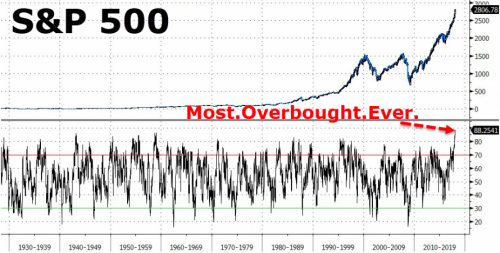
Also on Friday the S&P's Relative Strength Indicator rose to a new all time high, suggesting that as of this moment, the US stock market is the most overbought ever.


Now it's JPMorgan's turn to opine on recent market euphoria, which - in the aptly named weekly "Flows and Liquidity" report, arguably JPM's most interesting publication - it says that as of Friday, "momentum signals have reached extreme levels for the S&P" which to JPM's Nikolaos Panigirtzoglou suggests that "equities are vulnerable to near-term profit taking."

Why? JPM observes that after revisiting the bank's momentum-based indicators, shown in Tables A5 and A7 below which it uses to infer how CTAs and other momentum-based investors are positioned across various commodities as well as equity indices, US sectors, bond futures and currency pairs....


... JPM noted that "momentum was approaching extreme levels in the S&P 500, along with the Nikkei as well as crude oil futures."


The tables reveal, that in the just passed week, the continued strong momentum in risky asset prices saw the z-score of JPM's S&P signal triggering the mean reversion overlay on Thursday after pointing to longs for around a year and a half.

This means that at long last, the market "could be at levels where momentum-based investors would begin to take profit on their positions."

Additionally, the continued sell-off in bond markets has seen z-scores for US Treasury futures shift further into negative territory, "but they remain some way away from extreme levels." Finally, for oil, momentum retraced some of the recent strong gains after Brent oil prices declined from a peak of just over $70 per barrel, though as Chart A39 in the Appendix shows speculative.

To recap: CTAs and other momentum-factor based investors are now at and beyond levels where they traditionally take profits. This could start happening as soon as next week, especially should the market be spooked by the uncertainty surrounding the government shutdown, which as Goldman said yesterday "could last a few weeks", and near the date of the US debt ceiling D-date, some time in early March, by which point stocks will really sell off if there still is no funding deal.

Draghi’s Membership in Murky G30 Financial Group Under Fire


A private club for central bankers, regulators, and bankers.

On Wednesday, ECB President Mario Draghi suffered the rare ignominy of being criticized in public by the EU's Ombudsman, Emily O'Reilly, whose job it is to arbitrate public complaints about EU institutions. The complaint against Draghi was that he had compromised his public role by regularly attending the Group of 30, a secretive club of corporate and central bankers.

In her response to the complaint, O'Reilly recommended that Draghi should suspend his membership of the group for the remaining duration of his term.

"The implied closeness of the relationship through membership – particularly between a supervising bank and those it supervises – is not compatible with the independence obligation of an institution such as the ECB," O'Reilly said.

Previously called the Consultative Group on International Economic and Monetary Affairs, the Group of 30 (or G30) is a Washington DC-based private group whose members consist of central bank governors, private sector bankers and academics. Membership is by invitation only.

Its current membership list reads like a Who's Who of global finance. It includes current and former central bankers, many of whom now work or worked in the past for major financial corporations, such as:

  • Mario Draghi (ECB, Bank of Italy, Goldman Sachs)
  • Ben Bernanke (former Chairman of the Federal Reserve)
  • William Dudley (New York Fed, Goldman Sachs)
  • Timothy Geithner (Warburg Pincus, former US Treasury Secretary, New York Fed)
  • Mark Carney (Bank of England, Bank of Canada, Goldman Sachs)
  • Axel Weber (UBS, ECB, Bundesbank)
  • Haruhiko Kuroda (Bank of Japan)
  • Christian Noyer (Bank for International Settlements, Bank of France)
  • Jaime Caruana (Bank for International Settlements)
  • Agustín Carstens (Bank for International Settlements, former Chairman of Bank of Mexico)

It also includes senior representatives of financial corporations with subsidiaries supervised by the ECB, including:

  • Gail Kelly (UBS)
  • Tidjane Thiam (Crédit Suisse)
  • E. Gerald Corrigan (Goldman Sachs)
  • Jacob Frenkel (JP Morgan Chase, Bank of Israel)
  • Philipp Hildebrand (BlackRock, Former Chairman of the Governing Board, SNB)

And it includes economists such as Lawrence Summers, Paul Krugman, and Kenneth Rogoff.

While the group prides itself on being a well-intentioned forum for "deepen(ing) understanding of international economic and financial issues," its abject lack of transparency makes it an ideal setting for the trading of insider information or favors.

"The transparency standards of the G30 fall below the standards applied by the ECB in the context of other fora, or even the transparency standards applied by the G30 at the time of the Ombudsman's first G30 case in 2012," notes the Ombudsman's report. Of the G30's board of trustees only the identity of its chair, Jacob A Frenkel, the chairman of JPMorgan Chase International, has been made public.

At a G30 meeting last year, Draghi apparently met with representatives of Credit Suisse, Deutsche Bank, BridgeWater Associates, BlackRock, Morgan Stanley, Munich Re, and AXA. If they were given indicators of future ECB policy or actions, they would have huge risk-free opportunities to enrich themselves as well as huge advantages over all other market participants, including their biggest rivals. This is what prompted the Brussels-based NGO Corporate Europe Observatory (CEO) to lodge a complaint with the EU Ombudsman against Draghi's membership of the Group of Thirty.

While O'Reilly said there was no evidence of sensitive information being shared at the G-30, there could still be "a perception that, through the participation of members of the ECB's decision-making bodies, the ECB could be open to influence in the shaping of new regulatory practices." And it's not as if the ECB hasn't already got into hot water over sharing sensitive information with market players in other settings, such as when hedge funds at a London conference were warned that the ECB would be ramping up its QE program hours before the rest of the market.

For the ombudsman, the mere perception of impropriety is cause enough for concern. "Any lack of transparency could create a public impression of secrecy, which would reflect negatively on the image and reputation of the EU's decision-making bodies, including the ECB," O'Reilly said.

In light of this risk, O'Reilly not only requests that Draghi immediately end his membership of the G-30; she also calls for a complete ban on all future presidents of the ECB taking up membership of the club. The mere fact that the ECB has allowed its membership of the G-30 to taint its perceivedinstitutional independence is tantamount to maladministration, she said:

"The ECB takes decisions that directly affect the lives of millions of citizens. In the aftermath of the financial crisis, and in consideration of the additional powers given to the ECB in recent years to supervise member state banks in the public interest, it is important to demonstrate to that public that there is a clear separation between the ECB as supervisor and the finance industry which is affected by its decisions."

While the EU Ombudsman's recommendations are non-binding, they do carry a certain amount of weight. The fact that someone with some degree of influence in Brussels' corridors of power has cast a spotlight on the potentially pernicious influence of fora like the Group of 30 on the workings of supposedly independent central banks like the ECB is at least a tentative step in the right direction

venerdì 19 gennaio 2018

The "World's Most Bearish Hedge Fund" Has A "Stunning" Theory What Happens Next To The Dollar

After a rollercoaster year, the clients of Horseman Global, which in 2016 Was dubbed the world's most bearish hedge fund when its net exposure hit over -100%...


... finally got some good news when in his December letter, CIO Russell Clark announced that after returning 5.54% for December, the month emerged back in the green for the full year, up a modest 2.27%.


However, what caught our attention was not the fund's performance, which after a -24% 2016 barely closed in the green in 2017 (and suffered a dramatic plunge in AUM as a result), but Russell Clark's comments on the plunging USD, a topic which seemingly everyone has an opinion on.

Specifically, we found his comments notable because if he is right, the dollar slide will only accelerate, and will have profound consequences not only for assets, but for the US and global economy in the not too distant future.

Here is Clark's "fascinating" - as he puts it - theory about the source of dollar weakness, and more troubling, why what is about to happen next will make the recent collapse in the USD seem like a walk in the park.

Since the financial crisis, I have tried to apply the Japanese Quantitative Easing ('QE') model to the world as more and more central banks moved to zero or negative interest rates and asset purchase programs. In Japan the practical effect of QE has been for Japan to export capital, and this creates credit bubbles in the recipient countries. The country receiving the capital then has to deal with the credit bubble by devaluing and exporting deflation back to Japan. In my view, Japanese QE was the cause of the Asian Financial Crisis, and played a role in the Global Financial Crisis and the Eurocrisis. In Japan QE has meant my strategy has been to always be bullish JGBs, and short Japanese equities whenever they attempt to exit QE, and short the currencies of countries that had accepted QE capital flows. From 2013 to 2016, shorting various emerging markets, and being long developed market bonds was a winning strategy for the Fund.

However, in 2016 Chinese policy changes seemed able to reverse this trend, mainly through government mandated capacity cuts. I have seen many fund managers and economists hold on to investment and economic ideas long after they have been proven wrong, so given this break in the model, I thought it wise to question many of my investment ideas, particularly on bonds.

It is very easy to get bearish on bonds. With Chinese growth improving, and commodity prices rising, inflationary pressure is building. Furthermore, Chinese bonds currently offer 4%, substantially higher than developed market bonds. In addition, in a break with the Japanese experience of QE, the Federal Reserve has managed 5 interest rate increases, rather than only the one or two that Japan has been able to achieve since the bursting of the bubble. The refrain that I have heard these days is that QE works, and the US will be able to easily exit QE policies, followed by the ECB and the BOJ, and that bonds are a sell.

* * *

December tends to be quiet, so I have had time to reflect on market views on QE. Looking at how the US dollar has traded, and the performance of bonds, I am beginning to think that the model is not broken, but needs to be adjusted for the fact that QE is now undertaken by various central banks simultaneously, rather than just by Japan. The big increase in QE from the ECB and the BOJ that we saw in 2016, has seen capital move from Japan and Europe to the US. This has meant that even as the US has raised rates, credit conditions have remained very favourable. This combined with a recovery in China has created an extremely favourable market for all assets in 2017. But what does it mean for 2018?

Well, if the QE model still holds, then the capital flows from Europe and Japan to the US are beginning to slow and even reverse. The implications of this is that the strategy is to be bearish US dollars and bearish on US corporate credit. It also implies being bearish on European and Japanese banks, and buying of bunds and JGBs, however this remains to be seen.

Intriguingly, all these assets are already beginning to move this way. The full implications of thinking this way are fascinating.

And here is the conclusion, where - if Clark is right - better hold on to your hats, because it's about to get very volatile:

The worst-case scenario would be profound dollar weakness forcing the Federal Reserve to increase interest rates much more quickly than expected. Dollar weakness would cause Japanese and European exporters to suffer, forcing money into JGBs and bunds. This would be like the capital flight market in the US we saw in the late '70s. For reference, Swiss bonds yielded only 2% in the late 1970s, even as US rates went to near 20%.

Naturally, it would be poetic justice if the payback for the world's biggest (and really only) globally coordinated episode of QE which injected some $15 trillion in QE in capital markets, was a just as rapid, and accelerating episode of rising interest rates, starting with the US, in the process crushing US stock first and then spreading like a tsunami around the globe.

Maybe mean reversion is not dead after all, maybe it's just waiting for the right reversal to remind the economist PhDs in the Marriner Eccles building that there is no such thing as a free lunch... or free all time highs in the stock market.

And incidentally, for those who are wondering, Horseman "remains long emerging markets, short developed markets."

giovedì 18 gennaio 2018

Why The Globalists Need A War, And Soon


It is difficult to gauge and understand geopolitical and economic events without first comprehending the fact that much of what happens in the world is engineered to happen and with a specific encompassing goal in mind. If you subscribe to the theory that all is random "chaos" and outcomes are circumstantial or coincidental, then you will be lost in the dark on most things. If you think a globalist "conspiracy" would require "too much control" or foresight, I would point out that organized conspiracy by people in power is a matter of history, not of theory. If such cabals were prevalent in the past, it is rather foolish to dismiss the reality that they are prevalent today.


There is considerable evidence supporting the following conclusion: International financiers and political puppets in Western AND Eastern countries share a deep rooted ideology called "globalism" or the "new world order." This ideology demands total centralization of economy and government resulting in a single global fiscal authority, a single global monetary system and a one world ruling structure. Obviously, such a pursuit would take extensive time and planning. It is a long term project, with moments of accelerated change.


The globalists refer to the process of their intended change as the "global economic reset." A reset of the world's economic processes is not so far fetched as skeptics like to argue. When an organized group of ideologues maintains control over the currency production and interest rates of most nations on the planet, it would hardly be difficult to manipulate politicians, manipulate legislation or even scientifically conjure financial bubbles and collapses. By extension, it would also be simple to trigger international conflicts if needed.


But why would war be a necessary ingredient to globalization?


War is the ultimate distraction, the ultimate divider and, perhaps ironically, the ultimate consolidator. In the past century, war always seems to follow or coincide with economic crisis events that are later exposed as products of the banking elites and their aggressive monetary policies. And, in the aftermath of these wars, supranational institutions are often founded (like the League of Nations, the United Nations, the Bank for International Settlements and the International Monetary Fund) as "solutions" to preventing mass tragedies from ever happening again. War is a social steroid promoting mutation, usually in an unhealthy way.


In recent years the concept of "world war" has given way to a more insidious trend of constant and sporadic regional wars. In most cases these regional wars have helped to contribute to the steady downfall of the U.S. through accumulating national debts as well as international distrust or hatred. In fact, one might conclude that if we were to look at the macro-picture of the vast array of regional wars being perpetrated by the globalists we would see that all of them combined are amounting to a kind of world war in a different form.


That said, the globalists will need a new and far larger catalyst for their reset, and soon. Why? Because a sizable distraction is essential to the next phase of the ongoing collapse. A pervasive scapegoat is needed; one that can be blamed for almost any negative scenario. This draws public attention away from the globalists themselves as the culprits behind fiscal crisis, maybe so much so that it will take decades before the mainstream ever questions what actually happened, if they ever question anything at all.


The fear generated through an uncertain war also acts as a form of psychological alchemy, transmuting the collective public mindset to accept centralization they never would have accepted otherwise.


Here is the issue at hand — central banks are seeking a monetary reset more than anything else. A monetary reset demands massive debt, followed by massive stimulus, followed by fiscal tightening, then massive inflation, followed by currency implosion that opens the door to a replacement structure (most likely in the form of blockchain technology and cyrptocurrency). The credit crisis of 2008 conveniently provided at least two of these elements so far, vast debt and stimulus measures. Today, we are beginning to witness the fiscal tightening phase of this process.


As I have been warning since before the Fed taper of QE, the central bank trend will lead to aremoval of stimulus support, facilitating a crushing blow to bonds and equities markets. Now, interestingly enough, the Bank for International Settlements is warning of the same thing as 2017 comes to a close. It should be noted that this is not the first time the BIS warned of an impending crash; they also predicted with keen timing the derivatives and credit crash back in 2007. This was, of course, too little too late for the masses to react in any positive way, though.


Their latest warning arrives on the heels of the December Federal Reserve meeting at which it is widely expected that the central bank will raise interest rates yet again while taking the next step towards reducing their balance sheet. Many mainstream and alternative economists doubted the taper of QE and doubted the hiking of interest rates. They were wrong. Just as the doubts over the Fed balance sheet reductions are wrong. The pullback in these measures will invariably strike bonds and equities in a negative way. Time is running out.


But, the banking elites have taken steps. For example, they have in place a perfect distraction in the form of the Trump Administration. With Trump loudly and proudly taking credit for the stock market bull run over the course of the past year, who do you think the public will blame when those same markets go south as the central bank pulls the rug out? Probably not the Fed or the establishment banks.


Trump has also in an odd way created the perfect rationale for the Fed as they increase interest rates and end the cheap money that has been feeding stocks for so long. With the passage of Trump's tax "reform" plan, the fed can now argue that interest rates MUST be raised in order to create incentives for treasury investment and to pay for Trump's intended public works programs and military expansion goals. Meaning, the fed can claim it is not culpable for any negative effects from removing cheap capital from the table because Trump's actions demanded it.


I would also point out that in most cases in history the Fed has lowered interest rates immediately following tax cuts and reforms. They did this after Reagan's tax reforms in 1981 and in 1986, as well as after George W. Bush's tax reforms in 2001. Juxtapose that with 2018, as the Fed intends to continue RAISING interest rates in the wake of Trump's tax reforms. Meaning, they are taking the opposite action from what they have often done in the past. Something to think about...


Trump's tax plan itself is primarily a distraction from the real problem. First, when comparing tax brackets from this past year to the intended tax brackets for next year under the Trump reforms, there is almost no change whatsoever for the average American. The only major reductions in taxes are, no surprise, in the form of corporate tax cuts; reducing the corporate tax ceiling from 35 percent to 20 percent. This is trickle-down economics at best, and not a solution to a single problem facing the public and the country in terms of the flailing economy.


Second, why are we talking about income tax "reform" when we should be talking about abolishing the income tax and the Federal Reserve altogether? Whatever happened to that dialogue? It has disappeared down the memory hole.


Trump's tax plan will do nothing to slow or undo the current economic crisis because the crisis stems directly from central banking monetary policies and interest rate manipulations. Tax reform is far too little far too late, and stands as nothing more than meager bone thrown to conservatives to keep them quiet for a while. This is what Trump's tax reform does do very well, though — it rallies conservatives around Trump, regardless of whether it actually helps them or not. Much like Obama's universal health care bill, which has proven to be a continued disaster in practice, but was rather successful at the time of its passage in rallying the liberal base. Trump is certainly going to need a base of public support if he is going to initiate a major war campaign.


North Korea continues to be the most likely powder keg for the next distraction event. Two months of quiet led people with short attention spans to dismiss the notion, and perhaps some of them will double down and continue their denials, but it is growing more difficult to ignore by the day. I would argue that North Korea is the most viable option simply because almost no one expects a war with the isolated nation to happen. The level of complacency despite all the signals to the contrary is palpable.


The U.S. has staged three aircraft carrier groups in the region for the first time in a decade. Major combat exercises are underway, designated Vigilant Ace 18, specifically designed to simulate an invasion of North Korea with over 230 aircraft and 12,000 American troops participating. North Korea has warned of "nuclear war" as a consequence.


North Korea may have the ability to follow through, at least on a limited scale, as they have recently test launched what appears to be a huge leap in missile technology — an ICBM capable of carrying multiple warheads and striking the Eastern seaboard of the U.S. How the North Koreans came to possess this technology so quickly is a question everyone should be asking.


In response, the war rhetoric has been amplified. White House National Security Adviser H.R. McMaster has stated that North Korea is the greatest immediate threat to the U.S., saying that the potential for war "is increasing every day." Warmonger and enemy of the Constitution, Lindsay Graham, has stated that the families of U.S. military personnel should be moved out of South Korea for their own safety, and that "We're getting close to military conflict."


So how close is close? I maintain that war with North Korea is likely by the second quarter of 2018. I also maintain the globalists will continue the strategy of multiple regional conflicts and global economic warfare rather than a one-off global nuclear mess that would wipe out trillions of dollars and decades of effort put into infrastructure and surveillance grids.


This would be advantageous to the globalists if they plan to continue interest rate hikes and stimulus removal by central banks around the world. It would help hide the effects of balance sheet reductions on stocks and it could expedite the fall of the dollar as the world reserve as Eastern and European nations apply alternatives like the IMF's SDR basket system in response to the massive debt brought on by a military quagmire for the U.S. In other words, catastrophic fiscal developments that were already going to happen anyway due to central bank sabotage will be entirely blamed on geopolitical crisis rather than the true culprits.


Finally, will the East step in militarily to prevent a conflict in North Korea? No. China has already stated that if North Korea attacks first, then they will not obstruct regime change by the U.S.


This flies in the face of those that believe in the false east/west paradigm. China has left the door wide open to potential conflict. If the globalists want a war in North Korea, they will create a war in North Korea, and the Chinese have publicly admitted they will step out of the way to let it happen. A false flag is probable. More provocations leading to a violent response by North Korea would also be rather easy to produce. So far, North Korea remains the best existing shock and awe event to hide a globally disintegrating economic situation. Would the globalists pass up an opportunity like this? There is no reason for them to do so.

The Strange Case Of The Falling Dollar – And What It Means For Gold


Trillions of dollars in uncontrolled central bank stimulus and years of artificially low interest rates have poisoned every aspect of our financial system. Nothing functions as it used to. In fact, many markets actually move in the exact opposite manner as they did before the debt crisis began in 2008. The most obvious example has been stocks, which have enjoyed the most historic bull market ever despite all fundamental data being contrary to a healthy economy.

With a so far endless supply of cheap fiat from the Federal Reserve (among other central banks), as well as near zero interest overnight loans, everyone in the economic world was wondering where all the cash was flowing to. It certainly wasn't going into the pockets of the average citizen. Instead, we find that the real benefactors of central bank support has been the already mega-rich as the wealth gap widens beyond all reason. Furthermore, it is clear that central bank stimulus is the primary culprit behind the magical equities rally that SEEMS to be invincible.

To illustrate this correlation, one can compare the rise of the Fed's balance sheet to the rise of the S&P 500 and see they match up almost exactly. Coincidence? I think not…


Another strangely behaving market factor that has gone mostly unnoticed has been the Dollar index (DXY). Beginning after the global financial crisis in 2008, the dollar's value in reference to other foreign currencies initially moved in a rather predictable manner; collapsing in the face of unprecedented bailout and stimulus programs by the Fed, which required unlimited fiat creation from thin air. Naturally, commodities responded to fill the void in wealth protection and exploded in price. Oil markets in particular, which are priced only in the US dollar (something that is quickly changing today), nearly quadrupled. Gold witnessed a historic run, edging toward $2,000.

In the past few years, central banks have initiated a coordinated tightening policy, first by tapering QE, then raising interest rates, and now by decreasing their balance sheets. I would note that while oil and many other commodities plummeted in relative value to the dollar after tightening measures, gold has actually maintained a strong market presence, and has remained one of the best performing investments in recent years.

Something rather odd, however, has been happening with the dollar…

Normally, Fed tightening policies should cause an ever-increasing boost to the dollar index. Instead, the dollar is facing a swift plunge not seen since 2003.

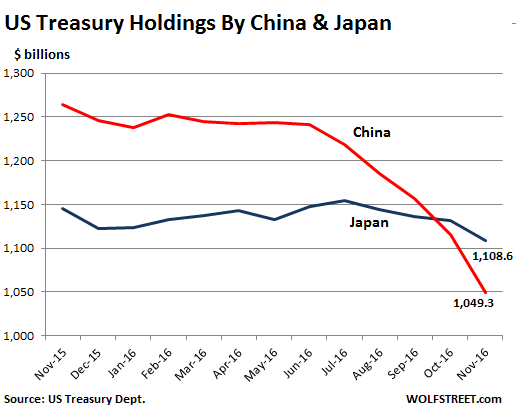
What is going on here? Well, there are a number of factors at play. First, we have a growing international sentiment against US treasury bonds (debt), which may be affecting overall demand for the dollar, and in turn, dollar value. For example, one can see a relatively steady decline in US treasury holdings by Japan and China over the course of 2016, with China being the most aggressive in its move away from US debt:


We also have a subtle, yet increasing, international appetite for an alternative world reserve currency. The dollar has enjoyed decades of protection from the effects of fiat printing as the world reserve, but numerous countries including Russia, China, and Saudi Arabia are moving to bilateral trade agreements which cut out the US dollar as a mechanism. This will eventually trigger an avalanche of dollars flooding into the US from overseas, as they are no longer needed to execute cross-border trade. And, in turn the dollar will continue to fall in relative value to other currencies.

There is also the issue of coordinated fiscal tightening by central banks around the world, with the ECB and even Japan moving to cut off stimulus measures and QE. What this means is, other currencies will now be appreciating in terms of Forex market value against the dollar, and in turn, the dollar index will decline further. Unless the Federal Reserve acts more aggressively in its interest rate hikes, the dollar's decline will be brutal.

Finally, we also have the issue of nearly a decade of Fed stimulus that has gone without audit (except for the limited TARP audit, which shows tens of trillions in money/debt creation). We truly have no idea how much fiat was actually created by the Fed – but we can guess that it was a massive sum according to the seemingly endless rise in equities from a point of near total breakdown, funded by quantitative easing and stock buybacks. You cannot conjure a market rebound merely with debt. Eventually, that currency creation and the consequences will have to set a foot down somewhere, and it is possible that we are witnessing the results first in the dollar, as well as the Treasury yield curve, which is now flattening faster than it did just before the stock market crash in 2008.

A flat yield curve is generally a portent of economic recession.

I believe that this is just the beginning of troubles for the dollar and for US bonds. Which raises the question, how will the Fed react to a dollar market that is so far completely ignoring their tightening policies?

Here is where things get interesting. Throughout 2017, I warned that the Fed would continue to raise interest rates (despite many people arguing to the contrary) and would eventually find an excuse to increase rates much faster than previously stated in their dot plots. I based this prediction on the fact that the Fed is clearly moving to pop the enormous fiscal bubble it has engineered since 2008, and that they plan do this while Donald Trump is in office (whether or not Trump is aware of this plan is hard to say). Trump has already taken credit on several occasions for the epic stock rally, and thus, when the plug is pulled on equities life support, who do you think will get the blame? Definitely not the banking elites who inflated the bubble in the first place.

Even the mainstream financial media has admitted at times that Trump will "regret" his campaign demands that the Fed hike rates and stop pumping up stock markets, as he will be inheriting a fiscal punch in the gut.

The Fed, as well as the mainstream, have also planted the notion that the Fed "will be forced" to raise interest rates faster if the Trump Administration pursues its plans for Hoover-style infrastructure development.

But, on top of this, the "problem" of the falling dollar also introduces a whole new rationale for speedy interest rate hikes. I believe that soon after Janet Yellen leaves as Fed chair and Jerome Powell transitions in, the Fed will begin an exponential increase in rates and will speed up their balance sheet reductions. And, they will blame the unusual decline in the dollar index as well as falling Treasury demand as the cause for more extreme action.

Powell has already backed "gradual rate hikes" in 2018, and, a few members of the Fed expressed a need for "faster hikes" in the minutes of the last meeting in December. I predict this sentiment will expand under Powell.

A small number of Wall Street economists are also warning of more rate hikes in 2018, and that this could cause considerable shock to the virtual stock rally in play right now.

That might be the Fed's plan. The central bankers need a scapegoat for the eventual bursting of the market bubble that they have produced. Why not simply allow that bubble to finally implode in the near term, blaming the Trump administration and, by extension, all the conservatives that supported him? To do this, the Fed needs an excuse to hike rates swiftly; and they now have that excuse with the dollar dropping like a stone (among other reasons).

But how will this affect gold?

So far, gold has actually spiked along with Fed rate increases, which might seem counter intuitive, but so is the dollar falling along with rate increases. I do think that there will be an initial and marginal drop in gold prices if the Fed increases the frequency of rate hakes. That said, eventually reality will set into stock markets that the party is over, the punch bowl is being taken away, and Trump's tax reform will not be enough to offset the loss of access to trillions in cheap fiat dollars from the central bank.

Once stocks begin to collapse in the wake of Fed hikes and balance sheet reductions (and they will), and uncertainty in the fate of the dollar swells, gold will bounce back stronger than ever. In the meantime, I would treat any drop in precious metals as a major buying opportunity. Gold is one of the few assets that always does well during times of crisis.

The American System Is Not Capitalism


One of the great myths of our time is that America is a capitalistic country. It is not, and has not been close to capitalistic for more than 150 years.

Capitalism is a social system in which an individual's rights, including his rights to own property, are recognized and all property is privately owned. In a capitalistic society, governments acknowledge that individuals and companies can and should compete for their own economic gain, and the prices of goods and services are determined by the free market. The role of government in capitalistic societies is to ensure that markets function without interference and to protect individuals from fraud and/or the use of physical force by others.

Capitalism is not about greed. Capitalism is about human freedom, or as we term it, personal liberty. As Adam Smith posited in Wealth of Nations, when individuals are permitted to pursue their self-interest through markets, they are amazingly good at finding ways of bettering not only themselves but society as well.

In Capitalism: The Unknown Ideal, Ayn Rand writes:

The recognition of individual rights entails the banishment of physical force from human relationships: basically, rights can be violated only by means of force. In a capitalist society, no man or group may initiate the use of physical force against others. The only function of the government, in such a society, is the task of protecting man's rights, i.e., the task of protecting him from physical force; the government acts as the agent of man's right of self-defense, and may use force only in retaliation and only against those who initiate its use; thus the government is the means of placing the retaliatory use of force under objective control... In a capitalist society, all human relationships are voluntary. Men are free to cooperate or not, to deal with one another or not, as their own individual judgments, convictions, and interests dictate. They can deal with one another only in terms of and by means of reason, i.e., by means of discussion, persuasion, and contractual agreement, by voluntary choice to mutual benefit. The right to agree with others is not a problem in any society; it is the right to disagree that is crucial. It is the institution of private property that protects and implements the right to disagree — and thus keeps the road open to man's most valuable attribute (valuable personally, socially, and objectively): the creative mind.


Americans no longer have property rights. Think you do? Try going a year or two without paying tribute to the king (via property taxes) and you'll see who owns your property. The local sheriff will evict you; the state or local government will seize your property and sell it to the highest bidder or its favorite crony.


Try building a structure on your property... or even remodeling your home. If you don't obtain the proper permissions (approval for your design, building permits and inspections), you will be fined and forced to tear your structure down. Failure to do so will result in armed agents of the government invading your property, assaulting and incarcerating you until you comply with the government's demands.


Try damming a creek, tampering with the watershed or capturing water for a pond on your property. You will get a visit from federal agents representing the Environmental Protection Agency and the result will be fines, expensive court costs and possible visits by armed federal agents who will forcibly escort you off your property and into a prison cell.


Try growing livestock or certain plants on your property. Unless you live in an area zoned for agriculture, you will likely get a visit from a local or federal "inspector" who will order you to dispose of your animals and/or uproot your plants in favor of others approved by the local authorities.


Try selling a product you grew or made. You will be forced to comply with regulations regarding harvesting, production, packaging and distribution. You will be forced to act as agent of government and collect government tribute (taxes) which you must then pass along to government — regardless of the time and effort required to comply. Failure to do so will result in fines and/or imprisonment.


Want to inform people about and sell a protocol that experience and use has shown to be beneficial to good health? You must first obtain permission from local and federal agencies, provide proof that your protocol has been tested, tested and retested, regardless of the expense or inconvenience to you. You must then comply with any and all regulations regarding marketing, production, packaging and distribution. Failure to do so will result in seizure of assets, fines and/or imprisonment.


Want to not sell your product for a reason — or no reason at all — not approved by the establishment? That is not allowed and you will find your business shuttered and you will be subject to fines and revocation of your previously-acquired permission to conduct business.


The establishment will tell you that once enter into business you have surrendered your individual rights to the collective, and all your activities must be geared toward the collective good. This is the very definition of force — government force, which is anathema to voluntary exchange and individual liberty.


The federal government works overtime to ensure we are not a capitalist system by passing legislation and enabling federal alphabet soup regulatory agencies to create rules favorable to certain businesses and unfavorable to others. Congressweasels pass tax laws to encourage and discourage behaviors.


The federal government subsidizes certain products, driving up prices and encouraging unsound business practices that skew the market. There are still price controls on food products that were put in place during the Great Depression.


The Federal Reserve, which is not a federal agency but a privately-owned bank, prints money to infinity, which encourages mal-investment and skews the market. It is depreciating your currency.


Here is what has happened to the American people: The money creators, the Federal Reserve and the U.S. Treasury as symbiotic partners, are creating non-substance (fiat money) and "buying" (stealing) substance with it.


Has anyone wondered why "federal money" never gives out? As admitted in congressional testimony and in Federal Reserve publications, the federal money creators can create any amount of "money." Of course this money is non-substance fiat. It is imaginary numbers that appear either on green pieces of paper called dollars or as computer symbols.


The key word to describe fiat non-substance is infinity. This imaginary money system can be created to infinity and indeed is on its way. The American people (and the world) believe that this non-substance is real money. This is an exercise in an unbelievable and unimaginable delusion that is accepted by the mind as real.


This is socialism at its most perfect creation and it is doing exactly socialism's work of transferring the wealth and savings of the American people to the state without payment.


Every writer, commentator politician in America refers to the U.S. as a democracy of free enterprise capitalism with individual privacy and property rights. We live in a fiction of freedom perpetuated with semantic corruption that has evolved us into economic fascism. Language and words that support a free society have been turned inside out.


The American economic system, and in fact the world's economic system is failing, and that failure is being attributed by many on the left (and some on the right) as a failure of capitalism. This is a big laugh to any sober person.


All governments are fronts for monopoly capitalism, and monopoly capitalism has many names: fascism, socialism, communism and democracy. Big business has and will promote every ideology and philosophy known to man to disguise its madness for profits. But one equals the other. They are all immoral systems that use the power of government to exist and to suppress human freedom.


Capitalism is the only moral system. It was American free market capitalism that fueled the growth of the U.S. economic engine beginning in the 1800s and raised the standard of living around the globe, before monopoly capitalism began to exert greater and greater control over the U.S. economic system beginning in the mid-1800s and accelerated after the creation of the Federal Reserve in 1913.


The extraordinary level of material prosperity achieved by the capitalist system over the course of the last 200 years is a matter of historical record. But very few people are willing to defend capitalism as morally uplifting.


Sadly, it's not just the progressive left and ignorant millennials that oppose free market capitalism. In any discussion forum where true or laissez-faire capitalism is discussed, "conservatives" are quick to make the disclaimer that "we must have some regulation" or, "we can't have unfettered capitalism." In truth, most so-called conservatives are really closet socialists. This is a testament to the powerful propaganda we are subjected to.


Throughout history there have been two basic forms of social organization: collectivism and individualism. In the 20th century, collectivism has taken many forms: socialism, fascism, Nazism, welfare-statism and communism are its more notable variations. The only social system commensurate with individualism is laissez-faire capitalism.


The return of capitalism will not happen until there is a moral revolution in this country. We must rediscover and then teach our young the virtues associated with being free and independent citizens. Then and only then, will there be social justice in America.

Olympic Games In South Korea - Perfect Opportunity For A False Flag Attack?


The war rhetoric surrounding North Korea on both sides of the Pacific has never been more aggressive than it has been the past year (at least not since the Korean War). There are some people that see the entire affair as a "distraction," a distraction that will never amount to actual conflict. I disagree with this sentiment for a number of reasons.


North Korea is indeed a distraction, but still a distraction in the making. That is to say, the chest beating and saber rattling are merely a prelude to the much more effective distraction of live combat and invasion in the name of regime change and "national security.". The extensive staging of military assets to the region that has not been seen in over a decade, the extremely swift advancement of North Korean missile technology to include ICBMs capable of reaching the mainland U.S., the strange and unprecedented language by China indicating that they will not intercede against an invasion of North Korea by the U.S. "if Pyongyang attacks first...." All of this and more shows a clear movement of chess pieces into place for a sudden action.


According to these factors, I am led to believe that a false flag event blamed on North Korea, or a prodding of North Korea into taking an attack posture, is likely. The purposes behind such a war would be many-fold. Primarily, the final implosion of the vast financial bubbles created by central bank stimulus measures could be undertaken while the banks themselves escape public blame or prosecution.


A geopolitical crisis large enough would provide a perfect scapegoat for an economic crisis that was going to develop eventually anyway. And, if this geopolitical crisis were initiated by a "rogue state," along with the poor decisions of a conservative "populist" president (Trump), then the historical narrative would be complete. Future generations would talk about the "great blunder" of sovereign states and nationalists and how hubris and greed and ego led to a global fiscal disaster and unnecessary destruction. The rationale for a one world governmental authority would be planted in the minds of the populace.


Will a war in North Korea be the trigger event for this narrative? It's hard to say, as there are so many potential geopolitical powder kegs around the world. However, ample assets to initiate this kind of event are present around North Korea. And, unlike hot spots like Syria and Iran, North Korea offers the most immediate and tangible threat in the minds of many people with its nuclear arsenal.


The pure panic and mindless reactionary thinking that can be provoked in the unprepared when the danger of nukes is present is quite powerful. This could not have been made more clear than this past week when an "accidental" warning of a live ICBM launch occurred in Hawaii.


The Hawaii Emergency Management Agency now claims that this false alarm was started by a single employee, who has not been named. How? They somehow "pushed the wrong button" ...twice!


I find this explanation absurd. I can only find one example of a false alarm similar to the one in Hawaii, and this took place way back in 1971 with a mix-up of tapes leading to a broadcast warning of imminent attack on the U.S. After this event, the alert system was subject to streamlining and stopgaps designed to prevent it from ever happening again. During the false alarm of 1971, over six attempts were made for cancellation broadcasts, the first one within about ten minutes of the initial false alarm. In Hawaii, no cancellation was attempted for nearly 40 minutes.


To add to the overall strangeness, there was yet another false missile alarm in Japan within the same week! Yet again, this alert was immediately attributed to North Korea, but at least this time the alert was corrected 5 minutes later instead of 40.


To me, this smells of a psyop; a test to gauge public reactions to a threat, as well as planting preconceived notions of a particular bogeyman. The public did not disappoint.


Eye witnesses described people "running and crying in the streets," completely bewildered as to what to do. An associate of mine (who is also experienced in preparedness) was in Hawaii at the time of the event. She related to me that her family decided to shelter in place because there were no indications that fallout shelters were available anyway. Other people tried to lower their children into the sewers in an effort to escape a nuclear blast. Here is a video showing the false missile alert causing hysteria in Hawaii:


(As a side note, sheltering in a sewer during an actual nuclear event is the height of stupidity. Nuclear blasts send irradiated particulates into the air. These particulates then settle in the streets or are washed out of the air by rainfall. This water becomes a highly concentrated dose of irradiated particulates which are then drained down into the sewers. You might survive the initial blast, you might not, but you are certain to die from radiation if waiting out the attack in a sewer. Shelter in a dry basement instead with as much matter density between you and the outside as possible. Keep in mind that whatever place you choose to shelter is where you will likely have to stay for at least two weeks, or until the nuclear half life of the particulates has run its course.)


Obviously the average American is completely unprepared for a real attack of a minor magnitude, let alone the magnitude of a nuclear blast. Perhaps this reaction in Hawaii was so prevalent because Hawaii tends to be left leaning to the extreme, and leftists are generally poorly prepared for anything beyond a cancellation by their manicurists. That said, the fact that this "mistake" happened to take place in Hawaii and Japan which are already under stress due to the ballistic missile tests of North Korea is an interesting coincidence indeed.


Seeing what the reaction in Hawaii was like, a real attack presents an alluring opportunity for the establishment. The pure terror involved in just the potential of a nuclear attack is palpable, and this fear makes the masses easy to manipulate. Should a real attack take place, either by North Korea or by other agencies through false flag, when is the most advantageous time?


The history of Korean conflict suggests a surprise attack is a probable strategy. North Korea is a nation trapped in time, and North Korean authorities remember the success of the surprise attacks they used to launch the first Korean war in June 1950. These attacks allowed North Korea communists to overrun South Korean forces within days.


In terms of a false flag event, these seem to occur in the midst of other "training exercises" or distracting events. I can't think of anything more distracting for South Korea than the Winter Olympics, set to take place February 9-25 in Pyeongchang.


I would note the sudden friendly demeanor between North Korea and South Korea just before the Olympics, including the offer by North Korea to participate in a joint women's hockey team during the games (something that has never happened before). Would it not be a shame if this ember of goodwill was snuffed out by a North Korean missile test or attack of some kind? The "betrayal" would be excellent war fuel, like a new Pearl Harbor.


As Secretary of State Rex Tillerson stated recently, the threat of war with North Korea is "growing" despite the recent "thaw" in relations due to the Olympic Games. The thaw is partially predicated on the North Korean demand that all South Korean and US military exercises be cancelled during negotiations.


The typical response by skeptics will be that any attack by North Korea would be met with massive nuclear response. I would point out that a full-scale nuclear response is unlikely in the region. First, a nuclear onslaught on North Korea also puts its neighbors (our allies) at risk of considerable radiation exposure. The argument may be made that only a conventional assault would be safe for the surrounding countries, not to mention the Pacific U.S., which could see radiation exposure as well.


Second, a nuke attack is not necessarily going to prevent the need for a ground invasion. North Korea has more than 8,000 underground facilities that we know of and has been preparing for bombardment for over 60 years. Its mountainous terrain also presents serious doubts as to the effectiveness of bombardment. This is not just my assessment but the assessment of the Department of Defense. The idea that one big nuke button is going to solve the problem is childish delusion by people who watch too many movies.


Hopefully, the Olympics will conclude without incident and the skeptics are proven correct on North Korean tensions being nothing more than a sideshow amounting to a lot of bluster. But for now the level of conflict staging over the past year should be taken seriously, and the panic that could develop if a war does erupt should be concerning to us all. In times of crisis, people act stupidly and they beg for help from anyone offering, even if it is someone with malicious intent. Fearful individuals will give up almost anything to escape uncertainty, including their freedom and their common sense. And nothing causes fear quite so much as thoughts of war and mushroom clouds.

mercoledì 17 gennaio 2018

According To These 3 Measures The Stock Market Is Now Literally Off The Charts

Three aspects of the stock market that I follow closely are fundamentals, sentiment and technicals. According the measures below, all three now show the stock market has entered uncharted territory.


The first chart comes from my friend, John H., and shows his margin-adjusted version of the cyclically-adjusted price-to-earnings ratio. This improved version of the CAPE ratio (improved because it has a greater negative correlation with future 12-year returns) shows equity valuations have now surpassed both the dotcom mania peak in 2000 and the 1929 mania peak.


This next chart shows that investors today are employing more leverage than ever before. Even when you adjust margin debt for the overall size of the economy it's at a new record high and, to my knowledge, this doesn't include the asset-backed loans at major financial firms which have become so popular in recent years.


Finally, from a technical standpoint, the monthly RSI reading of the Dow Jones Industrial Average shows the stock market is now more overbought than at any other time during the entire history of this index which was created way back in 1896 (chart via Nasdaq.com).


Thus it is fair to say that this is now the most overvalued, overbullish and overbought stock market of all time.