MARKET FLASH:

"It seems the donkey is laughing, but he instead is braying (l'asino sembra ridere ma in realtà raglia)": si veda sotto "1927-1933: Pompous Prognosticators" per avere la conferma che la storia non si ripete ma fà la rima.


sabato 25 novembre 2017

China Deleveraging Hits Corporate Bonds As Cascade Effect Begins


Following the market lockdown during October's Party Congress, many commentators were disturbed by the continued rise in Chinese government bond yields as we returned to "business as usual", with the 10-year rising to 4%. People noted a useful insight from the Wall Street Journal.
An important anomaly to note about the bond rout: as government bonds sold off, yields on less-liquid, unsecured Chinese corporate bonds barely moved.
 That is atypical in an environment of rising rates – usually, bond investors shed their less-liquid holdings and hold on to assets that are more easily tradable, like government debt.
The question was…why had corporate bond yields barely moved? The answer, according to the WSJ, was that China's deleveraging policy led to redemptions in the shadow banking sector, e.g. in the notorious $4 trillion Wealth Management Products (WMP) sector. Faced with redemptions, shadow banks had to sell something…quickly…and highly liquid government bonds were the "easiest option". Furthermore…and this is potentially significant…the WSJ noted.
Meanwhile, the nonbanks have held on to their higher-yielding corporate bonds, which at least have the benefit of helping them to maintain high returns.
Not any more (see below).
We agreed with the WSJ's explanation at the time, but noted that the government bond sell-off was actually a sign of the unravelling of the WMP Ponzi scheme. The Chinese authorities are wise to the Ponzi which is why they announced the overhaul of shadow banking and WMPs last Friday (see "A 'New Era' In Chinese Regulation Means Turmoil For $15 Trillion In China's 'Shadows"). However, the new regulations don't kick in until mid-2019, a sign to us that when they looked "under the bonnet", they didn't like what they saw.  
We doubt that China can achieve an orderly restructuring of its shadow banking sector, never mind its much larger credit bubble. A sign that we have taken another step towards China's "Minsky moment" is that the bond sell-off has spread to the corporate bond market. The chart shows how spreads versus sovereign bonds have blown out during the last few weeks.
Bloomberg noted how the 10-year yield on China Development Bank notes, a quasi-sovereign issue, closed above 5% for the first time since 2014 today while, in another report, it put the corporate bond sell-off in a wider context.
China's deleveraging campaign is finally starting to bite in the nation's corporate-bond market, a shift that will make 2018 a clearer test of policy makers' appetites to let struggling companies fail. Yields on five-year top-rated local corporate notes have jumped about 33 basis points since the month began, to a three-year high of 5.3 percent, according to data compiled by clearing house ChinaBond. Government bonds, which have far greater liquidity, had already moved last month as the central bank warned further deleveraging was needed.
With more than $1 trillion of local bonds maturing in 2018-19, it will become increasingly expensive for Chinese companies to roll over financing — and all the tougher for those in industries like coal that the nation's leadership wants to shrink. Two companies based in Inner Mongolia, a northern province that's suffered from a debt-and-construction binge, missed bond payments on Tuesday, in a demonstration of the kind of pain that may come.
Bloomberg tries to put a positive spin on the corporate bond sell-off, defaults are healthy in terms of differentiating good and credits.
In the long haul, that all may be good for China. Allowing more defaults could see its bond market become more like its overseas counterparts, with a greater differentiation in price. And that could mean it channels funds more productively. "The deleveraging campaign and the new rules on the asset management industry will further differentiate good and bad quality credits, and make the onshore credit market more efficient," said Raymond Gui, senior portfolio manager at Income Partners Asset Management (HK) Ltd. "Weaker companies will find it harder to roll over their debts because funding costs will stay high." Gui predicts yields will keep climbing. The average for top-rated corporate bonds is already 2.2 percentage points above what investors demanded to hold them in October last year.
The rise comes as authorities show greater determination to shift the economy onto a more sustainable footing, with less debt. The latest move was a plan to discipline the asset-management industry, including banning guaranteed rates of return. People's Bank of China Governor Zhou Xiaochuan graphically depicted the risk of excess leverage, by evoking a "Minsky moment," or sudden collapse of asset values. Key to that endeavor will be scaling back some of the implicit credit guarantees that have backed a broad swathe of Chinese borrowers. The country only started allowing corporate defaults in 2014. Last year there was a record, coming in at at least 29. It's unclear yet whether that total will be met in 2017.
Bloomberg spoke to an analyst who also believes the recent sell-off in Chinese bonds is more to do with separating the "wheat from the chaff", rather than anything more profound.
"We expect the divergence of performance between different bond categories (Chinese government bonds, policy bank bonds and credits) to become more prominent into 2018," Albert Leung and Prashant Pande, rates strategists at Nomura Holdings Inc., wrote in a note Wednesday.
We disagree. From our perspective, it looks like early signs of cascading sell-offs within Chinese financial markets, which have long been abused by excessive leverage and Ponzi characteristics. Talking of which, the Shanghai Composite Index suffered its biggest one-day drop since June 2016.
What caused the sell-off? According to some commentators it was fear that the local bond rout was getting out of control…hence "cascade". We noted that traders had been stunned by the official warning from Beijing that some stocks – in this case Kweichow Moutai – had risen "too far, too fast". Zhengyang Shen, a Shanghai-based analyst at Northeast Securites commented.
"The decline in Moutai has triggered selloffs in some of this year's best performing stocks."
Which sounds an awful lot like another example of cascading selling…

giovedì 23 novembre 2017

11 Charts Exposing The Madness Of The Stock Market Crowd

Summary

  • There's more to stock market valuations than the current level of interest rates.
  • In this article, 11 charts are presented which expose the extraordinary level to which stock prices have dislocated from a range of economic aggregates.
  • The height of these charts should send shivers down the spine of anyone concerned with minimizing losses.

One of the very few good reasons left to buy equities now is historic low interest rates. Broadly speaking, this is not a recent phenomena as it has been the case, from a valuation standpoint applying a more "normal" level of interest rates, for at least the last three years. Many are not making decisions based on hopes and dreams are aware of this fact, but nonetheless maintain a relatively high allocation toward equities out of necessity.

The necessity of a decent return in this historic low interest rate environment has resulted in a desperate chase for yield, often motivated by the current spread between earnings and bond yields.

The chase for yield also demonstrates a lack of investment opportunities since newly printed money has acted more to drive up prices in the secondary market rather than fueling additions to capital goods. This has doubtlessly helped prolong the bull market in stocks as it has had a dampening effect on the business cycle.

But there is more to stock market valuations than the current level of interest rates. Further declines in nominal interest rates are limited, while the upside potential is tremendous in percentage terms. The best one can hope for is perhaps that rates remain near historical lows for a long period of time. Placing your bets solely on interest rates remaining low however requires a portion of delusion.

The nominator in any prudent appraisal of stock prices also matters, though it appears to play a minimal role these days as exposed in the charts below. Most of these charts have one thing in common – they compare stocks to a range of economic aggregates related to corporate sales and with it earnings. After all, earnings per share, no matter how "earnings" are calculated, cannot forever increase or even be maintained due to cost cutting and share repurchases alone.

Ten charts are demonstrating the 2017 Stock Market Euphoria, and one doesn't. Bulls should therefore be pleased as the only thing those charts have demonstrated is that the market has valued low interest rates and positive sentiment more than other fundamentals combined ever since.

But for those of you concerned with probabilities and minimizing losses, and for those not posing in the glorious light of hindsight, the charts below should send shivers down your spine even more so today than nine months ago, especially given the savings disaster this year which have helped drive U.S. economic activity and stock prices.

Chart 1. Wilshire 4500 & Disposable Personal Income

Chart 2. Wilshire 4500 & Commercial Banks' Equity

Chart 3. Russell 3000 & Productivity (Real Output per Hour)

Chart 4. Wilshire & Retailers Sales

Chart 5. Wilshire 4500 & Manufacturers' New Orders

Chart 6. Households Net Worth & Disposable Personal Income

Chart 7. Wilshire US Mid-Caps & M2 Money Supply

Chart 8. Wilshire 5000 & GDP

Chart 9. Russell 3000 & Personal Saving.

Chart 10. Market Cap of U.S. Companies & Gross Private Saving

Chart 11. Wilshire 4500 compared to a combination of the Money Supply and a Leading Economic Indicator

*  *  *

Bonus Chart: The U.S. Stock Market Risk Indicator.

martedì 21 novembre 2017

BofA's Apocalyptic Forecast: Stocks Flash Crash, Bond Bubble Bursts In H1 2018, War May Follow

       Having predicted back in July that the "most dangerous moment for markets will come in 3 or 4 months", i.e., now, BofA's Michael Hartnett was - in retrospect - wrong (unless of course the S&P plunges in the next few days). However, having stuck to his underlying logic - which was as sound then as it is now - Hartnett has not given up on his "bad cop" forecast (not to be mistaken with the S&P target to be unveiled shortly by BofA's equity team and which will probably be around 2,800), and in a note released overnight, the Chief Investment Strategist not only once again dares to time his market peak forecast, which he now thinks will take place in the first half of 2018, but goes so far as to predict that there will be a flash crash" a la 1987/1994/1998" in just a few months. Contrasting his preview of 2018 with the almost concluded 2017, Hartnett sets the sour mood with his very first words, stating that he believes "2018 risk asset catalysts are much less bullish than in 2017" for the simple reason that the bearish positioning going into 2017 has been completely flipped: "positioning now long, not short; profit expectations high, not low; policy close to max stimulus; peak positioning, peak profits, peak policy stimulus means peak asset returns in 2018." He also goes on to point out that the historical omens are poor:
o    Bull market in S&P500 would become the longest ever on August 22, 2018 (and the second biggest ever at 2863 on S&P500).
o    Equities have only outperformed bonds for seven consecutive years on three occasions in the past 220 years (the last time was 1928 - Chart 1).

Having read Hartnett for many years, we can sense an almost tangible undertone of anger and frustration at central banks for making his bearish forecasts for 2 years in a row go up in a puff of smoke. Which probably explains why one of BofA's best strategists has decided to double down, and raise the stakes beyond a simple market crash, and to a flash crash, if only for dramatic impact.
But before we get there, here is Hartnett's explanation why the market will peak in the first half of 2018:
The Big H1 Top
We forecast a H1 top in risk assets as the last vestiges of QE, the passage of US tax reform and robust early year EPS revisions incite full investor capitulation into risk assets. Potential targets are SPX 2863, CCMP 8000, with US government bond yields moving >2.75%.
We start 2018 with a pro-risk asset allocation of equities>bonds, EAFE>US, gold>oil, bullish US dollar.
We believe the air in risk assets is getting thinner and thinner, but the Big Top in price is still ahead of us. We will downgrade risk aggressively once we see excess positioning, profits and policy.
Peak positioning would be signaled by
BofAML Bull & Bear Indicator exceeds "sell signal" of 8 (Chart 2);
  • Active mutual equity funds start to see inflows;
  • BofAML GWIM equity allocation exceeds 63%, an all-time high (currently 61%).

How to know if/when peak profits arrived?
US ISM dips below 55: needs to end 2018 >55 to beat consensus global EPS estimate of 10.5% (Chart 3); Inverted yield curve, which in seven out of seven occasions in the last 50 years has been the prelude to recession.


More to the point, how to know that peak central bank policy has arrived?
o    Q2 peak in G4 central bank liquidity of $15.3tn: net central bank buying of financial assets drops from $1.5tn in 2016 and $2.0tn in 2017 to nearly zero in 2018;
o    US tax reform passed, after which investors must discount tighter, not earlier economic policies.


Which brings us to Bank of America's "big long" trade: volatility, and the stark prediction that in just a few months, a 1987-type flash crash which will wipe out trillions in market cap, is imminent.

The Big Long: volatility
Second, we believe that peak positioning, profits, and policy in 2018 will engender peak asset price returns and trough volatility. In 2017, stock market volatility fell to 50-year lows, bond volatility fell to 30-year lows, ETFs accounted for 70% of daily average global equity volume, the AUM of quant hedge funds is now $432bn (up $271bn since 2009).

A flash crash (à la '87/'94/'98) in H1 2018 seems quite likely, in our view, as the major sedative of volatility, the central banks, start to withdraw liquidity.
According to Hartnett, the right way to trade the upcoming flash cash and the "Big Long is through a combination of long 2yr/short 10yr Treasuries, long TIPS steepener vs flattener in OATei, long SPX put ratio calendar, long Russian equities.
As an added "bonus", in addition to a "big long", the BofA strategist also has a "big short" trade, which perhaps not surprisingly, is in credit.

The Big Short: credit
Third, we believe that higher inflation, higher corporate debt levels, higher bond volatility and the end of the QE era will be most damaging for corporate bonds.
The big 3 consensus assumptions are: Goldilocks, no Fear of Fed/ECB, and no Mean Reversion. The game-changer is wage inflation, which on our forecasts is likely to become more visible. Wage inflation would shatter consensus via higher credit spreads. 3½% US wage growth, 2½% US CPI, and 2% Eurozone CPI are all inflation levels likely to increase volatility and credit spreads.
For those looking to trade in advance of the bursting of the credit bubble, BofA's advice: go long CDX HY & iTraxx XOVER.

Finally, if that wasn't bad enough, in addition to the combined bursting of the short-vol and long credit bubbles, BofA has one final prophecy: "the biggest risk of all is that the structural "Deflationary D's" (excess Debt, aging Demographics, tech Disruption) cause wage inflation to again surprise to the downside." Here's why:

The Big Risk: tech bubble
Finally, we believe the biggest risk of all is that the structural "Deflationary D's" (excess Debt, aging Demographics, tech Disruption) cause wage inflation to again surprise to the downside. The era of excess liquidity, bond yields fall, and the Nasdaq goes exponential. 2018 calls for the big top, big volatility long, big credit short, all once again prove to be way too early. An "Icarus unleashed" bubble nonetheless could end in 2019 with a bear market on hostile Fed hiking, Occupy Silicon Valley and War on Inequality politics.
Translation: the Fed - having created the record wealth, income and class divide that resulted in Brexit, Trump and a wave of nationalism across Europe - is unable to stop, and unleashes civil, and perhaps world war as its final act.
How to hedge against "the biggest risk of all"? Hartnett has two words of advice: buy gold.

lunedì 20 novembre 2017

A "New Era" In Chinese Regulation Means Turmoil For $15 Trillion In China's "Shadows"


The post-Party Congress attempts to deleverage and crack down on the worst abuses in China's horrific credit bubble - especially the country's $15 trillion in wealth-management products - saw China's authorities turn their sights on shadow banking and wealth management products (WMPs) specifically. On their way out are "guaranteed returns" and "capital pools", which had turned the wealth management sector into a Ponzi scheme. In a radical and "shocking" departure from the historic norm, financial institutions will have to offer yields based on the risks and returns of the underlying assets.

As Citic' Ming Ming summarized China's shadow reform to Bloomberg, this is "the most comprehensive and most profound regulatory document ever. This marks the beginning of a new era in financial regulation as it implies the end of a 'big leap' in the asset management industry. Going forward, it means more compliance requirements, tighter risk control, and thus slower but better-quality growth."

This might go down like a cup of cold sick with Chinese savers who have become accustomed to circumventing financial repression via these products. However - and this is significant - the new regime doesn't take effect until the end of June 2019. We can only guess the delay reflects the enormity of the problems discovered by China's regulators when they finally looked under the hood.

The shadow banking measures, announced after Friday's close, hit Chinese equities when they opened Monday. However, the sharp fall in the Shanghai Composite miraculously turned around late in the day, closing up 0.3%. Either, "bargain hunters" saw a too-good-to-be-missed opportunity as Bloomberg TV implied, or the "National Team" was ordered off the bench late in the session. We think we know the answer and our sense is that the authorities are increasingly concerned about risk-taking in Chinese equity markets currently. On Friday we highlighted the warning from the state-owned Xinhua news agency that the share price of China's largest liquor maker, Kweichow Moutai, was rising too fast.

This is Bloomberg's take on the market reaction to the new shadow banking rules.

China's sweeping new plan to rein in its shadow banking industry rippled through the nation's stock market on Monday, sending the Shanghai Composite Index to a two-month low. Investors pushed the benchmark gauge down as much as 1.4 percent amid concern that the government's latest attempt to tighten supervision of $15 trillion in asset-management products will siphon funds from the market. Developers and brokerages paced losses. While analysts applauded the plan as an important step toward curbing risk in China's financial system, they also warned of turbulence as markets adjust to outflows from popular shadow-banking products.

The government directives, which are set to take effect in 2019, add to signs that President Xi Jinping is willing to sacrifice growth as he tries to put the world's second-largest economy on a more stable financial footing. "The rules dealt a blow to the market," said Zhang Gang, a Shanghai-based strategist with Central China Securities Co. "A lot of such products had positions in the equity market, and those that don't qualify under new rules may choose to exit some small and medium caps."

In the midst of the sell-off, the major losers in the real estate sector were China Vanke Co. which fell 4.9% on the wild(er) Shenzhen exchange, Poly real Estate which fell 3.2% and Gemdale Corp. which fell 2.6%. Securities dealers tumbled to a five-month low with Citic Securities sliding 3.7% at one point. Meanwhile, trading in China's government bond market was relatively civilized, with the benchmark 10-year yield rising 1 basis point to 3.97% - remaining on the "right" side of the psychologically important 4.0% level. That said, the benchmark has risen 24 basis point since the end of the Party congress on 24 October 2017. 

This was Reuters' take on the new shadow banking measures.

The guidelines unified rules covering asset management products issued by banks, trust firms, insurance asset management companies, securities firms, funds and futures companies, the People's Bank of China (PBOC) said in a joint statement with the banking, insurance, securities and foreign exchange regulators…The new rules aim to close loopholes that allow regulatory arbitrage, reduce leverage levels to curb asset price bubbles and rein in shadow banking activity.

The new rules will set leverage limits for asset management products. They will cap the total assets to net assets ratio at 140 percent for open mutual funds and 200 percent for private funds. Investors will be prohibited from pledging their shares in asset management products as collateral to obtain financing, a practice that would increase leverage. The central bank also said financial institutions must break the practice of providing investors with implicit guarantees against investment losses.

Financial institutions will also be forbidden from creating a "capital pool" to manage funds raised through asset management products. The practice allows banks to roll over the products constantly. The investment losses will be implicitly covered by the new product issuance…Financial institutions will also be forbidden from creating a "capital pool" to manage funds raised through asset management products. The practice allows banks to roll over the products constantly. The investment losses will be implicitly covered by the new product issuance.

While the new shadow banking measures are obviously welcome, we fear that they are coming too late to prevent a catastrophic bursting of China's debt bubble. As we have hinted for the past 3 years, the next global crisis will probably start in China, and with Xi's role cemented for the next 5 years (if not for life) the smart thing would be to have the Chinese economic hiccup (because recession is clearly a taboo under central planning) as soon as possible, so the economy can recover by 2022.

As ever, it's the timing of China's "Minsky moment" which remains elusive. Having said that, we suspect that the Xinhua warning about Kweichow Moutai was a signal that the Chinese leadership is on high alert regarding a spike in equity volatility.

In retrospect, perhaps the Xinhua warning was not so strange: after China's debt-fueled stock market bubble burst in 2015, wiping out $5 trillion of value, Chinese policy makers have acted to restrain excessive speculation in equities. "Xinhua is concerned that a runaway rally in a heavyweight like Kweichow will hamper the stability of the overall market," said Hao Hong, chief strategist at Bocom International Holding Co in Hong Kong.

And while one can wonder why China is suddenly so concerned about even the hint of potential vol spike in the stock market - suggesting that even a modest selloff could have dramatic consequences for the Chinese financial sector - it is certainly strange that whereas even China is acting to restrain the euphoria of its citizens over fears of what happens during the next bubble, in other "developed" countries, the local central bankers, politicians and TV pundits have no problem in forcing retail investors to go all risk assets when the market is at all-time highs.

As for China, it will have truly gone a full "180", if in a few months time instead of arresting sellers as it did in the summer of 2015, Beijing throw stock buyers in prison next.

domenica 19 novembre 2017

THE BIGGEST WEALTH TRANSFER IN HISTORY


by E. v. G.


What will happen between now and 2025? Nobody knows of course but I will later in this article have a little peek into the next 4-8 years.

The concentration of wealth in the world has now reached dangerous proportions. The three richest people in the world have a greater wealth than the bottom 50%. The top 1% have a wealth of $33 trillion whilst the bottom 1% have a debt $196 billion.

The interesting point is not just that the rich are getting richer and the poor poorer. More interesting is to understand: How did we get there? and what will be the consequences?

PANAMA & PARADISE PAPERS – SENSATIONALISM

As the socialist dominated media dig into the Panama Papers and now recently the Paradise Papers to attack the rich and tell governments to tackle the unacceptable face of capitalism, nobody understands the real reasons for this enormous concentration of wealth. Sadly no journalist does any serious analysis of any issue, whether it is fake economic figures or the state of the world economy.

Instead, all news is accepted as the truth while in fact a lot of news is fake or propaganda. The media is revelling in all the disclosures of offshore trusts and companies. The British Queen is being accused of having "hidden" funds. The fact that offshore entities have been used legally for centuries for privacy, wealth preservation and creditor protection purposes is never mentioned. The media sell more much news by being sensational rather than factual.

INEQUALITY IS DUE TO IRRESPONSIBLE MONETARY POLICY

Let me first put the facts right. It is not capitalism in its traditional sense which has created this enormous concentration. One definition of capitalism is:


"An economic and political system in which a country's trade and industry are controlled by private owners for profit, rather than by the state"

The "controlled by private owners" part of the definition fits our current Western system. But what is missing is that the current economic system could not function without complete state sponsorship and interference. This is the clever construction that a group of top bankers devised on Jekyll Island in the US, in November 1910. This was the meeting that led to the creation of the Fed in 1913. The Central Bank of the US was set up as a private bank, and thus controlled by private bankers for their own benefit.

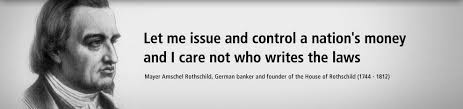
The bankers devised what one of their forefathers, Mayer Amshel Rothschild had preached:


From the bankers' point of view, this was a brilliant idea. They now had total control of the money without having to risk more than a smaller part of their own capital. And the government found this system perfect for buying the people's votes. By issuing more and more debt and allowing banks to leverage their balance sheets, the nation saw their standard of living increase significantly. More cars, televisions, holidays, iPhones etc. Little did the people realise that their improved standards were all at the expense of massive increases in government debt and personal debt.

US DEBT UP 1800X IN 100 YEARS

Total US debt in 1913 was $39 billion. Today it is $70 trillion, up 1,800X. But that only tells part of the story. There were virtually no unfunded liabilities in 1913. Today they are $130 trillion. So adding the $70 trillion debt to the unfunded liabilities gives a total liability of $200 trillion.

In 1913 US debt to GDP was 150%. Today, including unfunded liabilities, the figure becomes almost 1,000%. This is the burden that ordinary Americans are responsible for a burden that will break the US people and the US economy as well as the dollar. 

Whilst ordinary people have been landed with liabilities that they can never repay, the bankers and the 1% elite has profitably (ab)used the leverage that the debt expansion has created and thus amassed massive fortunes.

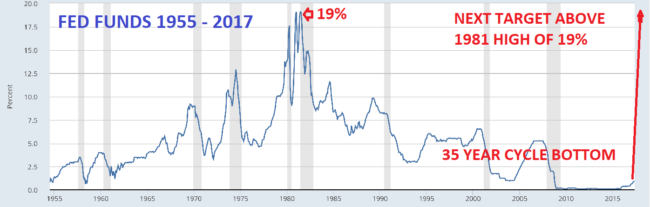
That is why we are seeing this enormous inequality in wealth. Ordinary people have not yet realised that they are liable for this debt. They will of course never repay it, nor will anyone else. Governments will try to solve the problem by printing even more money, thus exacerbating the problem. Eventually this will lead to high inflation turning to hyperinflation with interest rates going to at least 15-20% but probably higher. At that point central banks have lost total control of their interest rate manipulation.

The world will then discover that this time the money printing will have no effect as manufactured money can never create wealth.

BIGGEST WEALTH TRANSFER IN HISTORY

The consequences of the implosion of debt and assets will lead to the biggest transfer of wealth in history. As debt implodes, so will all the bubble assets. Stocks, bonds and property will decline between 80% and 100%. This is difficult for most people to accept but just remember that the Dow declined by 90% between 1929 and 1932. And 2000 to 2002, the Nasdaq declined by 80%.

Neither of these examples involved a global debt situation or asset bubble that we are in now. This time the world must unwind $2 quadrillion of debt, unfunded liabilities and derivatives. That is 29X global GDP of $70 trillion and therefore of a magnitude that will lead to a collapse of the financial system.

HIGHER TAXES WILL NOT SOLVE THE PROBLEM

Governments as well as members of the media are discussing taxing the wealthy to create more equality. Since the wealthy, especially in the US, control the system, higher taxation will be difficult to achieve. In Europe the socialists will most likely increase taxes for the wealthy. But higher taxes are not going to be required to solve the problem. The coming asset implosion will tax the rich much more than any politician could ever achieve. On average the wealthy are likely to lose up to 90% of their wealth. At the same time the debt, either personal or public, that the average person is responsible for will also implode. Thus the wealthy could lose 90% or more of their wealth and the poor will lose their debt.

This will be the biggest wealth transfer in history. But it won't happen without strife. There will be social unrest and possible civil war before all this is over. This was not the case during the 1930s depression except for in Germany with the persecution of the Jews. Today, population in the US or most European countries is not as homogenous as it was in the 1930s. The great number of immigrants in many Western countries will lead to much greater conflict and unrest than in the 1930s.

Except for the average person who is likely to become debt free after the implosion of the financial system, the major beneficiaries will be the investors who have no debt and hold hard assets such as agricultural land, commodity investments, including precious metals of course and also certain food sector investments which will benefit from food shortages and food price inflation.

A PEEK INTO THE NEXT 4-8 YEARS

If we look at levels that various markets could reach in coming years, they might seem totally unrealistic in todays' euphoric and exponential phase.

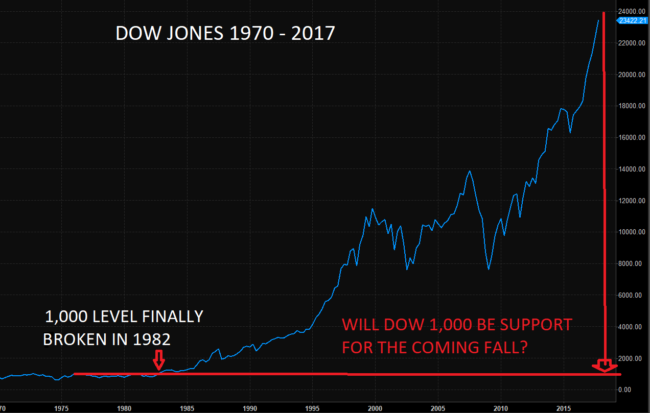
The Dow is today around 23,400. We are now in a melt-up phase that could see markets continue to go up substantially before they top. But the risk is very high, and any surprise will be to the downside.

Once the top is in we are likely to see a long and sustained secular bear market lasting many years. In the early 1980s, the Dow broke out from the 800 to 1,000 level where it had been for over 10 years. This is such a major long term support level that it seems likely to be reached in coming years. That is a 95% fall from here which is just slightly more than the fall in the 1930s.


INTEREST RATES TO REACH 20%

Interest rates were in the high teens in the 1970s and early 1980s, in for example the UK and USA. It is probable that we will see those levels again and much higher if sovereign and private borrowers default which is highly likely. Unlimited money printing, which will certainly take place, is also a form of default since it makes the currency worthless.


CURRENCIES TO REACH ZERO

Currencies will soon start their final move to the bottom. It is not easy to forecast which country's currency will win this race, but it could very well be the dollar since it is the most overvalued of all currencies. But it serves no purpose to measure one fiat (paper) currency against another. They are all likely to reach their intrinsic value of zero.

GOLD $15,000 OR $80,000?

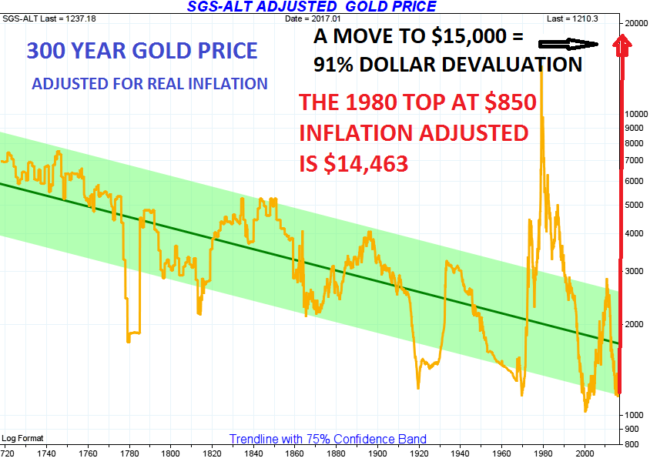
The current era's currency debasement started in 1913 and is now in its final stage. Measured in gold, the dollar has lost 98.3% since 1913. Let's say that the dollar now starts an inverted exponential move of the same magnitude as the move in the last 114 years. As I explained in my article about exponential moves, these are final moves and normally happen very fast. Another 98.3% move down of the dollar would mean $80,000 for one ounce of gold. Part of that price increase is likely to be inflation although I believe that gold should reach at least $10,000 – $15,000 in today's money. $15,000 would be a 91% fall from here of the dollar. With hyperinflation we can add many zeros.


Back in early 2002 when our company invested heavily into physical gold for our investors and ourselves, gold was $300. We have obviously held on to the positions. We certainly have been right on the direction of the move but did expect that the final move up would happen quicker than the almost 16 years so far. Nevertheless, we are convinced that this move is still to come, and it is likely to be exponential as I explained in my recent article.

How long this will take is obviously impossible to forecast. There are a number of factors which indicate that these major moves and changes will have happened by 2025. Cycles also point to gold having a major move into 2021. So the moves could happen within 4 years but it could take as long as 8.

Forecasting exact time and price is a mug's (British for fool's) game, and therefore likely to be wrong. However, what is indisputable is that global risk is currently greater than any time in history. What is also certain is also that gold is the best insurance against these risks, just as it has been for thousands of years.

sabato 18 novembre 2017

Tax Reform Bill in Trouble?

The tax bill is largely expected to be passed along party lines, with no Democrats voting in favor. That would imply that all Senate Republicans need to be on board with the bill, but the first voice of dissent surfaced this week when Senator Ron Johnson (R-WI) said he would not vote for the bill as he believes it unfairly benefits large corporations and while not providing sufficient relief to small and other types of businesses. Senator Susan Collins (R-ME) has also voiced opposition to the tax bill in its current form, as she believes any relief to middle class families will be offset by higher health insurance premiums, given the bill's recent addition of repealing the Individual Mandate of the Affordable Care Act.

Even with these insights, we can't predict where the market is headed. But, we can prepare for it by making sure that your portfolio has the correct asset allocation. Those who make a false step on that front are often left with devastating consequences to their net worth.

Stockman Slams "The Awesome Recovery" Narrative

One of the great philosophers of recent times was surely Sgt. Easterhaus of "Hill Street Blues". As he assigned his men to their daily rounds in the crime infested streets of the Big Apple he always ended the precinct's morning call with his signature admonition:


"Let's be carful out there."

That wisdom has been long lost on both ends of the Acela Corridor. In the face of blatant dangers and even existential threats, their denizens whistle past the graveyard with alacrity. So doing, they turn a blind eye on virtually all that contradicts the awesome recovery narrative, the indispensable nation conceit and the Washington can Make America Great Again (MAGA) delusion, among countless other fantasies.

For example, the GOP should be literally petrified by an horrid fiscal scenario for the coming decade that entails Social Security going bust, another $12 trillion of current policy deficits and a prospective $33 trillion public debt by 2027. And even that presupposes a macro-economic miracle in the interim: Namely, a 207 month stretch from 2009 to 2027 without a recession-----a feat which is twice the longest expansion in recorded history.

Instead, they have passed a FY 2018 budget resolution which implicitly embraces all of the above fiscal mayhem, and then adds upwards of $2 trillion (so far and counting interest) of incremental deficits to fund an ill-designed tax cut that is inherently an economic dud and political time bomb.

As to the former, the GOP is lost in ritual incantation and foggy Reagan-era nostalgia. Unlike the giant Reagan tax cut of 1981, the pending bills do not cut marginal tax rates measurably---or even the individual income tax burden in any meaningful sense.

In fact, if you set aside the so-called pass-thru rate for unincorporated businesses (see below), the entire 10-year tax cut on the individual side amounts to just $480 billion. In the scheme of things, that's a tiny number; it represents only 2.2% of the $22 trillion CBO baseline for individual income tax collections over the next decade; and it also is equal to just 0.2% of the projected nominal GDP over the period.

By way of comparison, the Reagan tax cut amounted to 6.2% of GDP when fully effective; and the net cut for individuals taxpayers alone averaged 2.7% of GDP over a decade. In today's economy, that would amount to a tax cut of $6.5 trillion during 2018-2027 or 14X more than the $450 billion net figure estimated by the Joint Committee on Taxation.

To be sure, the abused citizens of America are more than entitled to even this tiny tax cut and much more. That is, if their elected representatives were willing to cut spending by an equal amount or even raise alternative, more benign sources of revenue (i.e. a VAT on consumers vs. the current levy on producer and worker incomes). But unless a rapidly aging society wishes to bury itself in unsupportable public debt, it simply can't afford deficit-financed tax cuts for either the principle or the politics of the thing.

Moreover, to pretend that the tax concoction fashioned by Congressman Brady---- with a pack of Gucci Gulch jackals nipping at his heels--- will actually generate enough growth and jobs to largely pay for itself is to make a mockery of Sgt. Easterhaus' admonition. Rather than an exercise in fiscal carefulness, it is the height of recklessness to assume that much enhanced domestic growth, employment and Treasury receipts will result from any part of the $2.8 trillion cut for the rich and corporations that is at the heart of the GOP tax bill.

Actually, it's the heart and then some. With recent modifications (including dropping of the $150 billion corporate excise tax intended to prevent companies from hiding domestic profits via over-invoicing of imports from their own affiliates), the net revenue loss of the Brady bill is calculated at about $1.7 trillion.

That means, of course, that fully 165% of the net tax cut goes to: (1) 5,500 dead rich people's heirs per year ($172 billion for estate tax repeal); (2) 4.3 million very wealthy loophole users ($700 billion for the minimum tax repeal); and (3) the top 1% and 10% of households who own 60% and 85% of business equities, respectively, who will get most of the $1.95 trillion of business rate cuts.

In this context, we cannot stress more insistently that Art Laffer's famous napkin does not apply to business tax cuts in today's world of globalized trade and labor rates and artificially cheap central bank enabled debt and capital.

That's because the business income taxes are born by owners, not workers. The wage rates and incomes of the latter are determined in a saturated global labor market where the China Price for Goods and the India Price for internet based services sets wages on the margin.

At the same time, owners are not deterred from making investments by the proverbial "high after-tax cost of capital". That's because it isn't.

Even at the current statutory 35% tax rate (which few pay), the absolute cost of equity and debt capital is cheaper than ever before in modern history.

In fact, the after-tax cost of equity to scorched earth investment juggernauts like Amazon is virtually zero, while the cheap debt-fueled boom in conventional plant, equipment, mining, shipping and distribution assets over the last two decades has stocked the planet with sufficient capacity for decades to come.


In short, if you lower the business tax rates to 20% and 25% for corporations and pass-thrus, respectively, you will get more dividends, more stock buybacks and other returns to shareholders. Those distributions, in turn, will go to the very wealthy and to pension funds/non-profits. The latter will pay no taxes on these distributions while the former will pay 15%-20% at current law rates of o%, 15% and 20% on capital gains and dividends, which the Brady bill does not change.

In short, maybe the $2.8 trillion of tax cuts for business and the wealthy will generate a few hundred billion of reflows over the decade. And even that will not be attributable to the "incentive effect" of the Laffer Curve at all; it's just tax collection mechanics at work as between the personal and business taxing systems.

By the same token, the Sgt. Easterhaus principle is also being ash-canned by the GOP on the politics side of the tax bill, as well. In fact, Republicans have been chanting the "tax cut" incantation for so many decades that they apparently can't see the obvious. Namely, that among the middle quintile of households (about 30 million filers between $55,000 and $93,000 of AGI) the ballyhooed "tax cut" will actually be a crap shoot.

When fully effective, roughly two-thirds of filers (20 million units) would realize a $1,070 per year tax cut, while another 31% (roughly 9.5 million filers) would experience a $1,150 tax increase!

That's a whole lot of rolling dice----depending upon family size, sources of income and previous use of itemized deductions. Yet for the heart of the middle class as a whole----30 million filers in the aforementioned income brackets---the statistical average tax cut would amount to $6.15 per week.

That's right. Two Starbucks cappuccinos and a banana!

So we'd call the GOP's noisy advertising of a big tax cut for the middle class reckless, not careful. Indeed, the Dems will spend hundreds of millions during the 2018 election season on testimonials and tax tables which prove the GOP's claim is a pure con job.

They will also prove the opposite--- that the overwhelming share of this unaffordable tax cut is going to the top of the economic ladder. After all, the income tax has morphed into a Rich Man's Levy over the last three decades. So if you cut income taxes----the benefits inherently and mechanically go to the few who actually pay.

Thus, in the most recent year (2015), 150.5 million Americans filed for income taxes, but just 6.8 million filers (4.5% of the total) accounted for 35% of all AGI ($3.6 trillion) and 59% of taxes paid ($858 billion).

By contrast, the bottom 64 million filers reported only $928 billion of AGI, and paid just 2.2% ($20 billion) in taxes. That is, owing to the standard deduction, personal exemptions and various credits the bottom 44% of taxpayers accounted for only 1.4% of personal income tax collections.

Even when you widen the bracket to the bottom 123 million tax filers (82%), you get $4.3 trillion of AGI and just $284 billion of taxes paid. In other words, the bottom four-fifths of filers pay only 6.6% of their AGI in tribute to Uncle Sam. They may not be getting their money's worth from the Washington puzzle palaces, but you can't get blood from a turnip, either.

In short, Flyover America desperately needs tax relief for the 160 million workers who actually do pay up to 15.5% of their wages in employer/employee payroll tax deductions. Yet by ignoring the $1.1 trillion per year payroll tax entirely and recklessly and risibly claiming that its income and corporate tax cut bill materially aids the middle class, the GOP is only setting itself up for a thundering political backlash.

Nothing makes this clearer than some recent (accurate) calculations by a left-wing outfit called the Institute for Policy Studies that boil down to the proposition that "It Takes A Baseball Team".

That is, the top 25 US persons (like the full MLB roster) on the Forbes 400 list now report about $1 trillion in collective net worth. That happens to match the net worth of the bottom 180 million (56%) Americans.

Needless to say, that egregious disproportion does not represent free market capitalism at work; it's the deformed fruit of Bubble Finance and the vast inflation of financial assets that the Fed and other central banks have enabled over the past three decades.

In terms of the Sgt. Easterhaus metaphor, monetary central planning has planted some exceedingly dangerous political time bombs in the precincts, neighborhoods, towns and cities of Flyover America. Accordingly, if the GOP succeeds in passing some version of its current tax bill, it may be what finally brings the Dems back into power on an out-and-out platform of socialist healthcare (single payor) and tax redistributionism with malice aforethought.

Even as the GOP recklessly plunges forward with gag rules and its sight unseen legislative steamroller (echoes of ObamaCare in 2010), it will never be able to hide what is buried in the bill's tax tables. Namely, an average tax cut for the top 1%---even after accounting for elimination of upwards of $1.3 trillion of itemized deductions----that would amount to $1,000 per week.

Moreover, for the top o.1% (150,000 filers), the Dem campaign ads will show a cut of $5,300 per week; and for a subset of 100,000 of the top 0.1% filers, the GOP's tax cut would amount to $11,300 per week .

That's right. Each and every one of the very ultra rich would get a tax break equivalent to that which would accrue to every 2,000 middle bracket filers under the Brady bill.

As Sgt. Easterhaus might have said: They have been warned!

Meanwhile, at the other end of the Acela Corridor, the good precinct sergeant gets no respect, either. Indeed, gambling in today's hideously over-valued and unstable casino is exactly the opposite of being careful; it's certain to lead to severe---even fatal---financial injuries on the beat.

In this context, we have been saying right along that the essential evil of monetary central planning is that it systematically falsifies asset prices and corrupts all financial information. That includes what passes for analysis by the Cool Aid drinkers in the casino.

But when we ran across this gem from one Steve Chiavarone yesterday we had to double check because we thought perhaps we were inadvertently reading The Onion.

But, no, he's actually a paid in full (and then some) portfolio manager at the $360 billion Federated Investors group who appeared on CNBC, and then got reported by Dow-Jones' MarketWatch just in case you had the sound turned off during his appearance on bubblevision.

So here's how the bull market will remain "alive for another decade." According to Chiavarone, millenials who don't have two nickels to rub together will make it happen. No sweat.

"Millennials are entering the workforce, but their wages are going to be under pressure their whole career," he explained to CNBC's "Trading Nation" on Friday. "They won't make enough money to pay down their debt, fund their life and fund retirement where there is no pension. So, they're going to need equities."

Then again, aspiration and capability are not exactly the same thing. In fact, the frequent yawning difference between the two puts us in mind of the Donald's characterization of his primary opponent as Little Marco Rubio. The latter never stops talking about himself as the very embodiment of the American Dream come true----so for all we know perhaps Marco did aspire to be an NBA star.

But when he famously couldn't reach his water bottle from atop a stool during his nationwide TV rebuttal of an Obama SOTU speech a few years back, it was evident that NBA stardom wasn't ever meant to be.

Nor during the coming decade of stagnant wages and rising interest rates is it any more obvious how millennials will beg, borrow or steal their way to massive purchases of equities. That is, how they will finance what will actually be an avalanche of stock sales by 80 million fading baby boomers who will need the proceeds to pay their nursing home bills.

But never mind. MarketWatch caught the full measure of what shines on the inside of Mr. Chiavarone's financial beer goggles:

The risk is not being in this market," says Chiavarone, who helps run the Federated Global Allocation Fund. The firm's current price target is for 2,750 on the S&P by the end of next year and 3,000 for 2019.

"We are probably frankly low on both of them," he said. "Tax reform could push up the markets." That's not to say there won't be some pain along the way, specifically the potential for a recession in 2020 and 2021, according to Chiavarone.

What's an investor to do in that case? "Buy the recession," he said.

Indeed, it doesn't come any stupider than the market blather that is constantly published on MarketWatch. Today it also informs us that not only have US earnings been galloping forward in recent quarters, but its actually a global trend:

However, this is hardly a U.S.-only story. Corporate earnings have been improving globally, and some of the fastest growth has come from international companies, as seen in the following chart from BlackRock, which looks at U.S. growth against the globe, excluding the U.S.

The chart below is supposed to be the evidence, but we are still scratching our heads looking for the point. It seems that global corporate earnings ex-US based companies have surged.....all the way back to where they were in 2011!

You can't make this stuff up. Did these geniuses notice that China just went full retard in credit expansion to insure that the coronation of Mr. Xi was the greatest since, apparently, the Ming Dynasty invited the civilized world (not Europe) to the coronation of its fourth emperor in 1424?


In fact, the 19th Party Congress is now over, and the Red Suzerains of Beijing are back to the impossible task of reining in the massive malinvestment, housing, debt and construction bubbles which have turned China's economy into a $40 trillion powder keg. So right on cue it reported a sharp cooling of its red hot pre-coronation economy last night.

Thus, value-added industrial output, a rough proxy for GDP, expanded by just 6.2% in October compared to double digit increases a few months back.

Likewise, fixed-asset investment climbed 7.3% in the January-October period from a year earlier. Notably, that's way down from high double digit rates during most of the century, and, in fact, is the slowest pace since December 1999.

Needless to say, the latter data point amounts to a clanging clarion. At the end of the day, the ballyhooed Chinese growth miracle is really a story of construction and debt-fueled asset investment gone wild. And that party is now over.

So whatever Sgt. Easterhaus actually meant during the seven seasons of "Hill Street Blues" which always started with his famous admonition, we are quite sure that today it would not have meant buying the dips in a casino that is rife with unprecedented danger.

Finally, when it comes to real danger we think the most precarious spot along the Acela Corridor is about one mile from Union Station. We are speaking, of course, of the Oval Office and the Donald's questionable tenure therein.

Even as he meandered around Asia double-talking about trade and basking in the royal reception put on by his duplicitous hosts in Tokyo, Seoul and most especially Beijing, the Donald did manage to hit a fantastic bull-eye stateside.

Indeed, his takedown of the three stooges---Brennan, Clapper and Comey-----of the Deep State's spy apparatus will be one for the ages. Not since Jimmy Carter has a president even vaguely admonished the intelligence agencies, but as it his wont, the Donald held nothing back---naming names and drop-kicking backsides good and hard:

"And then you hear it's 17 agencies. Well, it's three. And one is Brennan and one is whatever. I mean, give me a break. They're political hacks. So you look at it — I mean, you have Brennan, you have Clapper, and you have Comey. Comey is proven now to be a liar and he's proven to be a leaker," Trump told the reporters on Air Force One..... 

Yes, the next day he backed away in what appeared to be a pro forma nod to be his own courage-challenged appointees.

We don't think so, however.


The truth is, the Deep State is already in the precinct house. And Sgt. Easterhaus is talking to the wall.