MARKET FLASH:

"It seems the donkey is laughing, but he instead is braying (l'asino sembra ridere ma in realtà raglia)": si veda sotto "1927-1933: Pompous Prognosticators" per avere la conferma che la storia non si ripete ma fà la rima.


mercoledì 9 agosto 2017

The Perfect Crash Indicator Is Flashing Red

What’s the last big toy you buy when things have been good for a really long time and you already have all the other toys? An RV, of course. A dubious thing to own if you already have a house, but when the good times seem likely to roll on forever, why the hell not?
And what’s the first thing you sell when you lose your job and your stocks are tanking? That very same RV. Which makes new RV sales a useful indicator of our place in the business cycle.
What does it say now? Here you go:
Notice the mini-spike in the late 1990s and the major spike in mid-2000s, both of which were followed by corrections. Now note the mega-spike from 2010 and 2016.
And how are things going so far this year? Well, the space is on fire:

‘The RV space is on fire’: Millennials expected to push sales to record highs

(CNBC) – RV shipments are expected to surge to their highest level ever, according to a forecast from the Recreation Vehicle Industry Association.
It would be the industry’s eighth consecutive year of gains.
Thor Industries and Winnebago Industries posted huge growth in their most recent earnings report.
Those shipments are accelerating, and should grow even more next year, the group said. Sales in the first quarter rose 11.7 percent from 2016.
Much of the growth can be attributed to strong sales of trailers, smaller units that can be towed behind an SUV or minivan, which dominate the RV market. The industry also is drawing in new customers.
As the economy has strengthened since the Great Recession, and consumer confidence improved, sales have picked up, said Kevin Broom, director of media relations for RVIA.
Two of the major players in the industry, Thor Industries and Winnebago Industries, both manufacturers of RVs, reported huge growth in their most recent earnings report. Thor saw sales skyrocket 56.9 percent to $2.02 billion fromlast year. Winnebago’s surged 75.1 percent last quarter to $476.4 million.
Gerrick Johnson, an analyst at BMO Capital Markets, attributed much of that growth to acquisitions. Thor bought Jayco, then the No. 3 player in the industry, last June; Winnebago bought Grand Design in October.
Thor stock has experienced strong growth over the past year of almost 40 percent. Winnebago tells an even better story: Its shares are up 56 percent over the past 12 months.
“They’ve done massively well because they’ve made massively creative acquisitions,” said Johnson. “Wall Street didn’t realize how creative those deals were. Each quarter they came through. The RV space is on fire, and the demand metrics are quite positive.”
What we have here is another classic short. During the past couple of recessions, RV stocks plunged as everyone came to their senses and stopped buying $60,000 motel rooms. Based on the above chart that’s a pretty good bet to repeat going forward. Let’s revisit this play in a couple of years.

The Dollar And Equities Will Plunge Together – While Gold Spikes

The dollar has been falling lately, which isn’t what a lot of people expected with the Fed being the only major central bank that’s raising interest rates. Higher yields on dollar balances should, according to basic economics, have attracted foreign capital to Treasury paper, thus putting upward pressure on the dollar. Didn’t happen though. The dollar is down about 10% since the Fed started tightening.
Stocks, meanwhile, might reasonably have been expected to fall, as their dividend yields become less attractive relative to rising risk-free fixed income returns. Also didn’t happen. US equities are now at record levels.
As for what happens next, Ron Rosen of the Rosen Market Timing newsletter has just published some dramatic predictions. Here’s an excerpt:
This REPORT attempts to demonstrate that the day the Dollar Index crosses beneath the 91.88 level will probably be the beginning of a collapse in the stock averages and a massive rise in the precious metals complex.
The completion of the 9 year Zig-Zag correction in the Dollar Index is telling us that D-Day will take place the day that the Dollar Index crosses beneath the 91.88 low. The following is an explanation of a Zig-Zag correction.
Excerpts from the NASDQ description of a Zig–Zag correction: “Zig zags look like a lightning bolt on the chart. There are 2 rules for zig zags: 1. The sub waves of an A-B-C zig zag appear as 5-3-5 2. Wave B of the zig zag cannot retrace 100% of Wave A – most of the time wave B retraces 38-78% of wave A The 3 waves of the zig zag (A-B-C) subdivide as a 5-3-5 meaning the ‘A’ leg has 5 sub waves in it, the ‘B’ leg has 3 sub waves in it, and the ‘C’ leg has 5 sub waves in it. As a result of the ‘A’ and ‘C’ legs both containing 5 sub waves each, the impact of the whole zig zag structure is to be a deep retracement and recover a lot of price from the previous trend. Also, the zig zag was designed to make progress against the trend. Therefore, wave B of a zig zag can be any 3 wave pattern (including another zig zag), but wave B cannot retrace 100% of wave A. A retracement of 99% is acceptable, though unlikely and progress needs to be made.”
It is as obvious as anything can be that the Dollar Index underwent a 9 year zig-zag correction that began in the June quarter of 2008. The zig-zag correction was complete at the high of 103.815.
The S&P 500 and the Dow Jones Industrial Average accompanied the Dollar Index on its huge corrective zig-zag rise. It is highly probable that they will accompany the Dollar Index on its coming collapse.
Gold bullion as representative of the precious metals complex has bottomed and completed its first minor rally. Its explosive move up waits in anticipation of the crossing of the 91.88 level for the Dollar Index.
The XAU as representative of the precious metal shares is in the same bullishly explosive position as gold bullion.
If something like this happens there will be all kinds of fundamental explanations (to go with the technical one outlined above), including political turmoil in the US and abroad, divergent central bank monetary policies and rising geopolitical tensions in Asia and the Middle East.
But the truth will be simpler: This bull market in financial assets has continued for far too long on the back of artificially easy money, something that is by its nature unsustainable. So it eventually had to end and now is that time.

Also nearly certain is that when a currency/stock market crisis finally hits it will be met with a truly breathtaking set of central bank asset buying programs. QE was big, but the equity, corporate bond, and (possibly) real estate buying binge that comes next will put it to shame.

When the "Fix" Increases Systemic Fragility, Things Fall Apart? It's going....


All the "fixes" have fatally weakened the real economy, and created a dangerous illusion of "wealth," "growth" and solvency. The "fix" of the last eight years worked, right? This was the status quo's "fix":

1. Massive expansion of debt: sovereign, household and corporate, all in service of a) bringing consumer demand forward b) fiscal stimulus funded by debt c) corporate stock buybacks to boost stock valuations d) asset bubbles in real estate, bonds, stocks, bat guano futures, etc.
2. Monetary stimulus, i.e. creating and distributing money at the top of the wealth/power pyramid so corporations and the super-wealthy could buy more assets with free money for financiers issued by central banks.
3. Gaming statistics such as unemployment and metrics such as stock indices to generate the illusion of "growth," "stability" and "wealth."
4. Saying all the right things: the "recovery" is creating millions of jobs, inflation is low, virtue-signaling is more important than actual increases in inflation-adjusted wages, etc.

This "fix" has fatally weakened the real economy. The cost of maintaining the illusions of "growth," "stability," "wealth" and solvency is extremely high, and hidden from view: systemic fragility has increased to the point of brittleness. What is fragility? Fragility is the result of an erosion of resilience, redundancy, adaptability, accountability, honesty, feedback and willingness to sacrifice today's consumption for tomorrow's productivity and systemic stability. The status quo "fix" has gutted resilience, redundancy, adaptability, accountability, honesty, feedback and willingness to sacrifice today's consumption for tomorrow's productivity. The status quo is now like a wafer-thin sheet of ice over a deep lake of killing-cold water. To the naive and inexperienced, the ice looks solid; they believe the tall tales of "recovery," growth," "wealth" and solvency. It's all phony public relations. PR doesn't make thin ice thick enough to stand on.


Gravity eventually overpowers financial fakery. When debt-asset bubbles expand at rates far above the expansion of earnings and real-world productive wealth, their collapse is inevitable

The Supernova model of financial collapse is one way to understand this. A Supernova analogy can properly explain why it illuminates the dynamics of financial bubbles imploding. According to Wikipedia, "A supernova is an astronomical event that occurs during the last stellar evolutionary stages of a massive star's life, whose dramatic and catastrophic destruction is marked by one final titanic explosion.". A key feature of a pre-supernova super-massive star is its rapid expansion. As the star consumes its available fuel via nuclear fusion, the star's outer layer expands. Once there is no longer enough fuel/fusion to resist the force of gravity, the star implodes as gravity takes over. This collapse ejects much of the outer layers of the star in an event of unprecedented violence. The financial analogy is easy to see: when rapidly expanding debt consumes a critical threshold of earnings (fuel), the equivalent of gravity (default, inability to service the enormous debt) triggers the collapse of the entire debt/leverage-dependent financial system. If earnings stagnate or decline while debt races higher, eventually earnings are insufficient to service the debt and default is inevitable. The other problem that arises as more and more of earned income goes to debt service is that there is less and less disposable income left to support consumer spending--the lifeblood of economies worldwide. Once debt service absorbs a significant chunk of household earnings, recession is the inevitable result as spending collapses once more debt cannot be loaded on households. In other words, debt is limited by earnings. If earnings decline, or fall far behind the expansion of debt, eventually borrowers can no longer borrow more, or refuse to borrow more. At that point, consumer spending falls and recession generates a self-reinforcing cycle of declining sales, profits, employment and wages. Recession further reduces the ability and appetite for more debt, and this acts as "gravity".

Why The Markets Are Overdue For A Gigantic Bust It's just not possible to print our way to prosperity - part 1


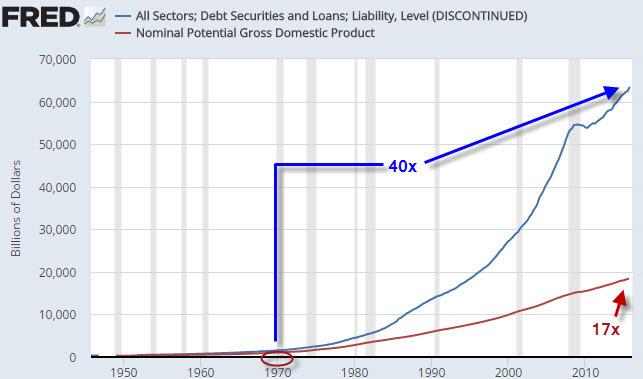
Let's begin with a caveat: confirmation bias is an ever-present risk for analyst as we are. Based on lots of historical inputs, we may anyway conclude that rinting money out of thin air can engineer lots of things, including asset price bubbles and the redistribution of wealth from the masses to the elites. But it cannot print up real prosperity. As much as I try, I simply cannot jump on the bandwagon that says that printing up money out of thin air has any long-term utility for an economy. It's just too clear to me that doing so presents plenty of dangers, due to what we might call 'economic gravity': What goes up, must also come down. Which brings us to the enclosed chart. The 200 bubble blown by Greenspan was bad, the next one by Bernanke was horrible, but this one by Yellen may well prove fatal. At least to entire financial markets, large institutions, and a few sovereigns. It's essential to note that more than two-thirds of the net worth tracked in the above chart is now comprised of ‘financial assets.’ That is, paper claims on real things. As the central banks have printed with abandon over the past decade, they’ve created the most extreme gap between real things (GDP) and the claims on those same things (Net Worth) in all of history. Following the Great Recession, the ‘plan’ of the central banks, such as it was, seems to have been to jam up people’s paper wealth, under the theory that people who feel wealthier are more likely to spend more and hopefully borrow more, too. That plan has worked rather well, at least from the standpoint of creating vastly larger amounts of new borrowing (debt and credit). But "how much GDP growth has resulted?" Not that much.The gap between the two only grows and grows at this point. And the central banks are now stuck at this point. They literally have no idea how to undo this problem they've managed to create. At some point that gap is going to have to close. 

The Market Has Never Done This Before

A fascinating statistic about the current no-vol state of the market, courtesy of Deutsche's Jim Reid, who points out that the last time we had 13 consecutive days in which the S&P moved less than 0.3% in either direction was... never: "... all you really need to know about markets at the moment is that yesterday's move in the S&P 500 (+0.16%) added to the record daily run of less than 0.3% moves in either direction. It’s now 13 days since we had a larger move using daily data back to 1927. The second longest streak of this length was of 10 days which has happened twice in history. The most recent time was in England's solitary football World Cup winning year (06 Jan 1966 - 19 Jan 1966), and the other between 15 Nov 1961 and 29 Nov 1961. So these continue to be remarkable financial times we are living through". Visually (see chart below). Another way of showing the chart reported below is with the S&P's closing prints over the same period: 2474, 2473, 2473, 2470, 2477, 2478, 2475, 2472, 2470, 2476, 2478, 2472, 2477, 2481. And here is some more from Reid: "To put the steady but relentless rally in the S&P in context, it is now 73 trading days since the S&P increased by more than 1% in any one day. Give it another 7 days and we will beat the prior record set back in November 06 and March 07. Although, given the current lull in the activity (VIX now back to below 10), we might even get close to the 100 day record set back in mid-July 1995 to early Dec 1995". Finally, this from BofA: "Earlier this year, the Dow recorded its lowest one-month trading range since 1900, and last summer the S&P traded within a 1.77% range for 42 consecutive days, the tightest such streak in history (the lull was ultimately broken on 9-Sep-16, when the S&P 500 dropped 2.45% on ECB policy, North Korea, and a fear of higher rates in the US).This is just another piece of evidence for Canaccord's thesis that traders are are not complacent, they are simply "paralyzed." Ready for the next plunge?


A chart is worth thousand of words: a key chart not enough seen and stared at.......

A chart is worth thousand of words. That's really true!! If anyone can make a good argument that USA is not in very serious debt trouble, I would love to hear it. And remember, the figures in the included chart don’t even include corporate debt. They only include government debt on the federal, state and local levels, and all forms of personal debt. So are they ready to share the debt accumulated burden?
Nobody that I know could write that kind of a check without sweating. The truth is that as a nation USA seems flat broke. The only way that the game can keep going is for all of them to borrow increasingly larger sums of money, but of course that is not sustainable by any definition.
Eventually they're (and us) going to slam into a wall and the game will be over.
One of my pet peeves is the national debt. USA politicians spend money in some of the most ridiculous ways imaginable, and yet no matter how much we complain about it nothing ever seems to change. For example, the U.S. military actually spends 42 million dollars a year on Viagra. Yes, you read that correctly. 42 million of US taxpayer's dollars are being spent on Viagra every year. And overall spending on “erectile dysfunction medicines” each year comes to a grand total of 84 million dollars… According to data from the Defense Health Agency, DoD actually spent $41.6 million on Viagra — and $84.24 million total on erectile dysfunction prescriptions — last year. And since 2011, the tab for drugs like Viagra, Cialis and Levitra totals $294 million — the equivalent of nearly four U.S. Air Force F-35 Joint Strike Fighters. Is this really where US spending on “national defense” should be going? USA figures are nearly 20 trillion dollars in debt, and yet they continue to spend money like there is no tomorrow.......

lunedì 8 maggio 2017

Bill Blain: "Macron Will Prove A Disappointment As Nothing Is Actually Fixed In Europe"


May 8, 2017 5:57 AM
"To summarise the summary: anyone who is capable of getting themselves made President should on no account be allowed to do the job.."
The best thing about the French Election is I've just won a case of very fine French wine on the result! 
The papers and financial blogosphere are full of positivity – France is fixed, therefore the Euro is safe and its all great news. Put yer buying boots on.. And on the back of Friday's very strong US numbers.. don't worry that bonds continue to rally in the face of a likely Fed Hike..
Please.. the only thing good about the French vote is the least bad candidate won.
I question the grand expressions of upside the market is calling for. France has dodged a bullet, perhaps, but they aint solved the crisis – which boils to down to being the wrong economy using the wrong currency and absolutely no control of monetary or fiscal policy to fix it.
Macron has a head full of supply side policy cliches about sorting the labour market, and some catchy soundbites on Franco-German European hegemony – including the sacrifice of a fraction of the bloated state payroll. For all the hype, he's a compromise of compromise candidates.
Lets not forget that fully 12% of the votes were spoilt – meaning a significant minority of Frenchmen made a conscious choice that neither candidate was any good!
I'll make a grand prediction: Macron will prove a disappointment. His lack of power base from which to actually effect long term change across France means we'll get one or other of the Le Pens in 5 years time. 
Although he will no doubt trade on his youth and popularity – don't be surprised if the lustre quickly fades. A number of blogs say he'll quickly build a coalition of the willing.. I doubt it. He's going to struggle to form any kind of working government in the face of the established parties, and hostility from right and left. 
There is also the likelihood the electorate will come to realise the gifted young game-changer is actually as establishment as they come. Don't forget he is the protégé of Jacques Attali -  those of us of a certain vintage will remember Attali as the archetypal enarch - squandering billions on titivating the Glistening Bank (The EBRD) with marble lifts and ego-building offices rather than actually lending. Macron's paid up membership of the discredited French upper class is something a better organised Front Nationale will play to in coming years.
On the upside, the numbers are moving in Macron's direction. The state isn't in the same perilous debt position pre ECB intervention. A wee bit inflation will massage the numbers nicely. There are no immediate risks on the horizon. Unemployment is trending down (slowly), and is likely to boost his popularity.Merkel looks a shoe in for the German Election (very strong showing at the weekend in Danish Germany).  
But, but and but again..
When Europe looks calm and sorted, its not. Nothing is actually fixed.. For all the happy posts this morning about Euro strength, which stocks to buy on the basis of French recovery, and the rest… I doubt it.
From Bill Blain's latest Morning Porridge edition
"To summarise the summary: anyone who is capable of getting themselves made President should on no account be allowed to do the job.."
The best thing about the French Election is I've just won a case of very fine French wine on the result! 
The papers and financial blogosphere are full of positivity – France is fixed, therefore the Euro is safe and its all great news. Put yer buying boots on.. And on the back of Friday's very strong US numbers.. don't worry that bonds continue to rally in the face of a likely Fed Hike..
Please.. the only thing good about the French vote is the least bad candidate won.
I question the grand expressions of upside the market is calling for. France has dodged a bullet, perhaps, but they aint solved the crisis – which boils to down to being the wrong economy using the wrong currency and absolutely no control of monetary or fiscal policy to fix it.
Macron has a head full of supply side policy cliches about sorting the labour market, and some catchy soundbites on Franco-German European hegemony – including the sacrifice of a fraction of the bloated state payroll. For all the hype, he's a compromise of compromise candidates.
Lets not forget that fully 12% of the votes were spoilt – meaning a significant minority of Frenchmen made a conscious choice that neither candidate was any good!

I'll make a grand prediction: Macron will prove a disappointment. His lack of power base from which to actually effect long term change across France means we'll get one or other of the Le Pens in 5 years time.
Although he will no doubt trade on his youth and popularity – don't be surprised if the lustre quickly fades. A number of blogs say he'll quickly build a coalition of the willing.. I doubt it. He's going to struggle to form any kind of working government in the face of the established parties, and hostility from right and left.
There is also the likelihood the electorate will come to realise the gifted young game-changer is actually as establishment as they come. Don't forget he is the protégé of Jacques Attali -  those of us of a certain vintage will remember Attali as the archetypal enarch - squandering billions on titivating the Glistening Bank (The EBRD) with marble lifts and ego-building offices rather than actually lending. Macron's paid up membership of the discredited French upper class is something a better organised Front Nationale will play to in coming years.
On the upside, the numbers are moving in Macron's direction. The state isn't in the same perilous debt position pre ECB intervention. A wee bit inflation will massage the numbers nicely. There are no immediate risks on the horizon. Unemployment is trending down (slowly), and is likely to boost his popularity. Merkel looks a shoe in for the German Election (very strong showing at the weekend in Danish Germany). 
But, but and but again..
When Europe looks calm and sorted, its not. Nothing is actually fixed.. For all the happy posts this morning about Euro strength, which stocks to buy on the basis of French recovery, and the rest… I doubt it.
Although there is apparently nothing to worry about in Euroland anymore – we've still got the festering pustule that is Italy, episode 47 of the Greek Crisis on our doorsteps, and the who knows what coming from the Brexit negotiations. Europe will continue to amuse, fascinate and frustrate..
I don't normally spend my Sundays watching the TV wallpaper paste that passes as "political comment" but as I supped my coffee, one soundbite caught my ear: "the aim of Europe is to ensure the economic collapse of the UK to make clear leaving the EU is never an option."
Oh dear....
Is there a danger the now pointless UKIP decides to establish some convoluted relevance as the force of anti-Europeanism? Sure enough, someone later suggested we should mount a European boycott. If we stop buying French plonk, German cars, Spanish holidays, etc, then that'll teach 'em.
It so happens an American chum of mine was in Yoorp over the weekend and he popped down for dinner last night. As he is an economist of some renown, and a former Scotsman before he went all Yankee on us, I asked his opinion on Brexit and what America thinks. He was succinct: "We don't give a fig. As long as you all play nice and don't break the global economy meaning we'll have to bail it out, we really don't care about Europe and the UK." Nice.. but to the point..
A trade war with Europe and the nihilistic post UKIP politics of aggression would be a very bad idea... If I can't get good European wine, it will inevitably mean drinking more Argentine Malbec.. Not a bad wine, but it's impossible to function properly afterward!

giovedì 27 aprile 2017

"Lo Stato innovatore" di Mariana Mazzucato - la presentazione del libro

27 aprile 2017


LO STATO INNOVATORE

L’impresa privata è considerata da tutti una forza innovativa, mentre lo Stato è bollato come una forza inerziale, troppo grosso e pesante per fungere da motore dinamico. Lo scopo del libro che avete tra le mani è smontare questo mito.
Chi è l’imprenditore più audace, l’innovatore più prolifico? Chi finanzia la ricerca che produce le tecnologie più rivoluzionarie? Qual è il motore dinamico di settori come la green economy, le telecomunicazioni, le nanotecnologie, la farmaceutica? Lo Stato. È lo Stato, nelle economie più avanzate, a farsi carico del rischio d’investimento iniziale all’origine delle nuove tecnologie. È lo Stato, attraverso fondi decentralizzati, a finanziare ampiamente lo sviluppo di nuovi prodotti fino alla commercializzazione. E ancora: è lo Stato il creatore di tecnologie rivoluzionarie come quelle che rendono l’iPhone così ‘smart’: internet, touch screen e gps. Ed è lo Stato a giocare il ruolo più importante nel finanziare la rivoluzione verde delle energie alternative. Ma se lo Stato è il maggior innovatore, perché allora tutti i profitti provenienti da un rischio collettivo finiscono ai privati?

Presentazione del libro di Laterza:
L’impresa privata è considerata da tutti una forza innovativa, mentre lo Stato è bollato come una forza inerziale, troppo grosso e pesante per fungere da motore dinamico. Lo scopo del libro che avete tra le mani è smontare questo mito.
Chi è l’imprenditore più audace, l’innovatore più prolifico? Chi finanzia la ricerca che produce le tecnologie più rivoluzionarie? Qual è il motore dinamico di settori come la green economy, le telecomunicazioni, le nanotecnologie, la farmaceutica? Lo Stato. È lo Stato, nelle economie più avanzate, a farsi carico del rischio d’investimento iniziale all’origine delle nuove tecnologie. È lo Stato, attraverso fondi decentralizzati, a finanziare ampiamente lo sviluppo di nuovi prodotti fino alla commercializzazione. E ancora: è lo Stato il creatore di tecnologie rivoluzionarie come quelle che rendono l’iPhone così ‘smart’: internet, touch screen e gps. Ed è lo Stato a giocare il ruolo più importante nel finanziare la rivoluzione verde delle energie alternative. Ma se lo Stato è il maggior innovatore, perché allora tutti i profitti provenienti da un rischio collettivo finiscono ai privati?
Per molti, lo Stato imprenditore è una contraddizione in termini. Per Mariana Mazzucato è una realtà e una condizione di prosperità futura.È arrivato il tempo di questo libro. Dani Rodrik, Harvard University
Uno dei libri di economia più incisivi degli ultimi anni. Jeff Madrick, “New York Review of Books”
L’economia tradizionale propone modelli astratti; la dottrina convenzionale continua a sostenere che la chiave è nell’imprenditoria privata. Mariana Mazzucato afferma invece che la prima è inutile e la seconda insufficiente. Un libro brillante. Martin Wolf, “Financial Times”
Lo scopo, come dice Mariana Mazzucato, è che lo Stato e il settore privato assumano insieme i rischi della ricerca e godano insieme dei benefici. Teresa Tritch, “New York Times”
Molti governi si interrogano su come incrementare la produttività e l’innovazione. Questo libro fornisce le linee guida per individuare le politiche industriali più efficaci. Robert Wade, London School of Economics
Lo Stato innovatore dimostra punto per punto quanto pensare per convenzioni sia ottuso. Christopher Dickey, “Newsweek”

A Rising (Central Bank) Tide Turns Everyone into a Genius

April 26, 2017
Until the system implodes--you're a genius.
So you've ridden the markets higher--stocks, housing, commercial real estate, bat guano, quatloos, you name it--everything you touch turns to gold. What can we say, bucko, other than you're a genius!
It's a market truism that rising tides lift all boats. But that's not the really important effect; what really matters is rising tides turn everyone into a genius--at least in their own minds.
Those of us who have been seduced by the Sirens' songs of hubris know from bitter experience how easy it is to confuse a rising tide with speculative genius. When everything you touch keeps going higher, the only possible cause is.... your hot hand, of course!
Stocks--I'm a genius! Housing--I'm a genius! Commercial real estate--yes, well, I suppose the evidence is overwhelming--it does seem I'm a genius.
The only thing better than buy and hold is buy the dips and hold--and use margin or whatever leverage you have to buy more before the price goes even higher.
What can we say other than: this is the strategy of geniuses. The proof is in the charts:
The S&P 500: margin to the hilt and buy every dip: genius!

Housing in Sweden, Toronto, Brooklyn, West L.A., San Francisco, Seattle, Portland, Shanghai and every other blazing-hot market: borrow more from the shadow banking system, mortgage your house to the hilt, do whatever you have to do to get the down payment and buy another flat: pure genius!

Commercial real estate: everyone who jumped in with all four feet in mid-2009 forward: geniuses!

The source of our collective genius isn't an act of Nature--it's that good old pump inflating every asset bubble on the planet, central banks creating credit-money out of thin air and buying assets hand over fist: stocks, ETFs, bonds, mortgages, and so on.
Central banks have collectively purchased $1 trillion in assets year to date:

The Federal Reserve and the other central banks are playing the role of financial gods, intervening in the interactions of mere mortals to create the illusion of stability.
To this end, the Fed has created trillions of dollars and used this money to prop up delusional asset values (high) and destabilizing interest rates (low).
If we look at a decentralized financial system as a self-organizing ecosystem, we find that the strength of the system lies in the adaptability of the myriad organisms in its many micro-climates. The key strength of a decentralized financial ecosystem, i.e. one not organized as a top-down command economy, is the "genetic diversity" of its many participants. There is not just one dominant species in the ecosystem, but many interdependent species.
In a financial ecosystem, there is not one lender and one class of borrowers, but a huge diversity of lenders, borrowers, creditors and savers, and a wealth of interacting, inter-dependent enterprises.
A centrally planned financial ecosystem is a doomed system. The Fed is the equivalent of an ignorant, hubris-infused agency that seeks to "restore" an ecosystem by flooding it with water and unleashing a single predatory species raised in an unnatural, contrived "factory."
The Fed is wiping out diversity and thus the adaptability of the enterprises that survive its crude flooding and replication of a single predatory species.
The Fed is creating a sickly, vulnerable mono-culture of an economy, one dominated by financial predators which are themselves lacking in genetic diversity.
Just as agencies playing god further degrade the natural systems they claim to be "restoring" with ever-grander interventions, so too is the Fed destroying the U.S. economy with equivalent god-like meddling and ever-more grandiose, ever-more delusional interventions in what were once decentralized, self-organizing systems that naturally sought harmony and stability through the low-level churn of bad bets being written off and over-leveraged speculators going bankrupt.
Put another way: the Fed has taken the risks generated by predatory institutions and policies, and distributed it throughout the entire financial system. This distribution of risk in service of maintaining asset bubbles creates the illusion of stability, low risk and "sure thing" speculation.
Rather than let over-leveraged speculators and institutions reap the consequences of their excesses, the Fed (and other central banks) have loaded the entire system with risk.
Until the system implodes--you're a genius.

Central Banks Are Now Printing $200 Billion Per Month… Without a Crisis

April 25, 2017

A tsunami of inflation is rapidly moving through the financial system.
Most investors only pay attention to the Federal Reserve. And they are missing the BIG PICTURE for Central Bank monetary policy.
The Fed is tightening policy by hiking rates. But the rest of the world's Central Banks are printing a combined $200 BILLION in QE every single month.
Yes, $200 billion. At a time when the financial system is out of crisis and the Fed's put its own "print" button on "pause."
This is an all-time record… greater even that the global money printing that occurred at the depth of the 2008 Crisis when Central banks were desperate to prop the system up.
Indeed, at $200 billion per month, we're talking about an annualized pace of over $2 TRILLION in money printing every year.
If you don't believe this will unleash inflation, consider that already in the US, inflation has exceeded the Fed's targets on ALL FOUR of its measures.
Bear in mind, these are the "official" measures of inflation… the ones that don't include things like food, or energy. When you account for the rise in the REAL cost of living in the US, REAL inflation in the US is closer to 6%.
And this is happening at a time when the Fed is hiking rates and NOT printing money.
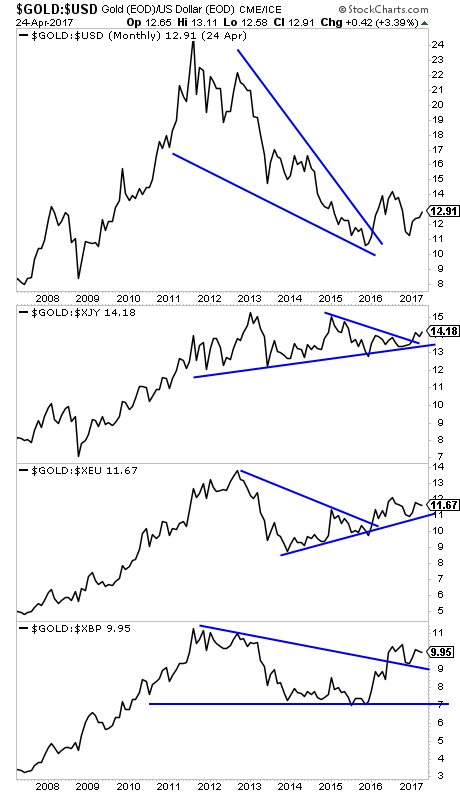
If you don't take my word for it, take a look at Gold priced in the $USD, Japanese Yen, Euro, and British Pound.  The precious metal has begun to break of to the upside in all major world currencies.
Gold "smells" what's coming. It's inflation. And smart investors are preparing for it now.

mercoledì 26 aprile 2017

Stocks Rally, With No Basis In Reality


Tuesday, April 25, 2017

Stocks rallied strongly on Monday given a number of political and geopolitical events converging this week, as President Trump completes his first 100 days in office ahead of this Saturday.
The stock market is hoping this week the GOP Congressional leaders can agree on a bill to repeal Obamacare. Wouldn't it be great if the GOP had been sandbagging a much better bill all along?
The President wants a bill that cuts corporate income tax down to 15% by this Wednesday but can he come up with a bill that doesn't send the deficits up by another $2 trillion? If it's not revenue-neutral will the President get the votes needed to pass it? Most think not.
Also, regarding the budget, the President is adamant about funding a border wall but the Democrats have threatened to shut down the government, so what does the President have to give away to get this in the budget? Does he have to keep Obamacare?
The investment bankers gapped the market open today, setting the highs for the day with the news that it looks like Marine Le Pen might lose the French election, lessening the risk of the EU and the Euro breaking apart.
Over the weekend we saw the victory of pro-European Union centrist Emmanuel Macron, who took an edge in winning the French presidency by winning the first round of voting and qualifying for a May 7th runoff alongside nationalist leader Marine Le Pen.
Macron, 39, who was a former French Minister of the Economy and investment banker, won 24% of the vote representing a more centrist viewpoint. Marine Le Pen won 21.3% of the vote representing a more nationalist perspective and a view of leaving the EU.
The mainstream parties, represented by François Fillon, the French Republican winning 20% of the vote and Jean-Luc Mélenchon, the socialist who took 19.6% of the vote, were both knocked out of the election, but it is thought a large percentage of their voters will support Emmanuel Macron, though the Republicans could swing towards Le Pen.

Stocks Detached from Economic Data
Meanwhile, the odds of the next rate hike have jumped to 69% for June. No one is expecting the Fed to raise rates in May but that may change this week if the President is successful in getting his bills passed in Congress in his first 100 days.
Momentum rules the stock market detached from economic reality.
This last week was the biggest drop in U.S. Macro data in six years, as housing starts, car sales, retail sales, a drop in inflation, deteriorating jobs report, etc., have detached investors from economic reality.
In fact, Charles Schwab, the investment brokerage firm, announced that the number of new brokerage accounts has soared 44% during the first quarter of 2017, the fastest pace the company has seen in 17 years!
In other words, not since the highs of the stock market in the first quarter of 2000, when the public bought at the top of the market, has the public been this enamored with the stock market.
Meanwhile, commodity prices continued to sink today. Gold fell $11.6 to close at $1,275 while crude oil prices fell 39 cents at $49.23 a barrel.
While investors are anticipating much better earnings from the energy sector, they take note that the energy stocks within the S&P 500 allocation have a P/E ratio of 132.66 times earnings ratio, according to the latest data from Zacks. I think the S&P 500 has already factored in any earnings improvements in energy.
While the investment bankers are trying to get us to focus on the French elections and what may or may not happen this week within Donald Trump's first 100 days, investors need to be aware that it was also reported over the weekend that 8,640 retail stores are now in the process of being closed!
Amazon is one thing, but a developing recession is another matter that people just aren't recognizing while the investment banks continue to pump stocks. Beware of chasing stocks purely on the basis of momentum.

martedì 25 aprile 2017

Central Banks Are Now Printing $200 Billion Per Month... Without a Crisis

A tidal wave of inflation is rapidly moving through the financial system.

Most investors only pay attention to the Federal Reserve. And they are missing the BIG PICTURE for Central Bank monetary policy.
The Fed is tightening policy by hiking rates. But the rest of the world's Central Banks are printing a combined $200 BILLION in QE every single month.
Yes, $200 billion. At a time when the financial system is out of crisis and the Fed's put its own "print" button on "pause."
This is an all-time record… greater even that the global money printing that occurred at the depth of the 2008 Crisis when Central banks were desperate to prop the system up.
Indeed, at $200 billion per month, we're talking about an annualized pace of over $2 TRILLION in money printing every year.
If you don't believe this will unleash inflation, consider that already in the US, inflation has exceeded the Fed's targets on ALL FOUR of its measures.
Bear in mind, these are the "official" measures of inflation… the ones that don't include things like food, or energy. When you account for the rise in the REAL cost of living in the US, REAL inflation in the US is closer to 6%.
And this is happening at a time when the Fed is hiking rates and NOT printing money.
If you don't take my word for it, take a look at Gold priced in the $USD, Japanese Yen, Euro, and British Pound.  The precious metal has begun to break of to the upside in all major world currencies.
Gold "smells" what's coming. It's inflation. And smart investors are preparing for it now.